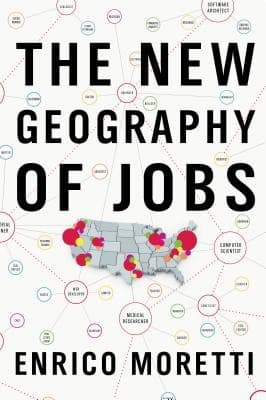
Core Idea
- Moretti’s central claim is that the U.S. is undergoing a Great Divergence: cities with dense human capital and the right innovative industries pull farther ahead, while manufacturing-heavy, less-educated cities fall behind.
- The book argues that the economy is no longer organized mainly around factories, but around brain hubs where innovation, specialized services, and skilled labor cluster and reinforce one another.
- These geographic differences now shape not only wages and jobs, but also health, family stability, politics, civic life, and charitable capacity.
Why Places Diverge
- The Menlo Park vs. Visalia comparison shows how once-similar places can become radically different as education levels, industry mix, wages, and life chances separate over time.
- Moretti rejects the idea that the “death of distance” made location irrelevant; for innovation, proximity still matters because ideas are created through ecosystems, not isolated firms.
- He identifies three forces behind clustering: thick labor markets, specialized suppliers, and knowledge spillovers.
- Thick labor markets help workers and firms find better matches, which is especially valuable for specialized skills and emerging occupations.
- Specialized service ecosystems let startups access legal, advertising, engineering, shipping, and venture support that would be hard to assemble elsewhere.
- Knowledge spillovers are the most distinctive force: nearby inventors learn from one another through face-to-face contact, and patent citations fall sharply with distance.
- Clusters become self-reinforcing: once a city attracts skilled workers and innovative firms, it becomes more attractive to still more of them, creating path dependence and tipping-point dynamics.
- This is why places like Silicon Valley, Boston-Cambridge, San Diego, and New York remain dominant, while cities without an ecosystem face a chicken-and-egg problem.
- Moretti treats the success of clusters as a kind of market failure too: each new worker or firm raises the productivity of others, but those benefits are not fully captured by the market.
Jobs, Productivity, and the Hollowing Out of Work
- The book contrasts the mid-20th-century manufacturing era, when factory work underwrote the middle class, with today’s knowledge economy, where value comes from design, engineering, software, and creative work.
- The iPhone and Shenzhen examples illustrate the new global division of labor: high-value tasks stay in places like Cupertino, while assembly and component production move to Asia.
- Moretti argues that the value in modern products comes primarily from innovation, not assembly, which is why firms like Apple capture large profits.
- Manufacturing employment has collapsed even as manufacturing output remains high, because productivity has soared; this is the same pattern seen historically in agriculture.
- Trade with China and automation have accelerated the shift: imports hit some local labor markets hard, while productivity and competition push surviving firms to upgrade.
- The labor market is hollowing out: high-wage/high-skill and low-wage/low-skill jobs grow, while middle-wage routine jobs shrink under pressure from computers, robots, and offshoring.
- Innovation jobs are broader than tech alone; Moretti includes life sciences, medical devices, entertainment, finance, and digital platforms as innovation sectors.
- High-tech growth creates a local multiplier: each new innovation job supports additional jobs in restaurants, retail, housing, and services, often helping less-skilled workers too.
- But the reverse is also true: when a city loses manufacturing jobs, local service employment also falls, deepening regional decline.
Mobility, Inequality, and Policy
- The Great Divergence is not just economic; it widens gaps in life expectancy, divorce, crime, political participation, and philanthropy across counties and metros.
- More educated places tend to produce better health and civic outcomes, partly through peer and neighborhood effects rather than income alone.
- Cities also increasingly sort by education, which raises wages for college graduates and even for lower-skilled workers who live near them.
- The book emphasizes that education has both a private return and a social return; because society captures spillovers from schooling, public subsidies for education are justified.
- Moretti argues the U.S. underinvests in human capital and R&D, even though both generate spillovers that private actors do not fully capture.
- He estimates that social returns to R&D exceed private returns, so federal and local governments should support basic science and innovation more aggressively.
- He also sees immigration as part of the human-capital strategy: skilled immigrants are disproportionately important in patents, startups, and high-tech regions.
- The policy challenge is not simply to create jobs everywhere, but to sustain the ecosystems where innovation happens while helping workers and places adapt.
- Moretti is skeptical that place-making alone can substitute for jobs; the creative class thesis is not enough, and places like Berlin show that cultural vibrancy without demand does not create a self-sustaining innovation economy.
- He is similarly cautious about top-down cluster-building: successful hubs usually grew from contingent anchors, universities, military research, or fortunate early firms, not from grand design.
- Place-based interventions can work when they solve a coordination problem; the Empowerment Zones are presented as one relatively successful example, with gains in jobs and wages.
- By contrast, big industrial subsidies and firm-picking often overpay for relocations and can fail when governments try to force the future.
What To Take Away
- The book’s deepest lesson is that in the modern economy, where people live matters more than ever because innovation is locally produced and locally concentrated.
- A city’s education level affects everyone in it, so the fortunes of skilled workers and less-skilled workers are tied together more than standard wage stories suggest.
- National prosperity depends on sustaining a few powerful innovation hubs while broadening access to education, mobility, and skilled immigration.
- The future Moretti describes is not a simple story of winners and losers, but of a human capital century in which ideas, talent, and clustering determine growth.
Generated with GPT-5.4 Mini · prompt 2026-05-11-v6