Core Idea
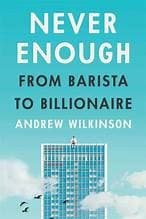
- Never enough is Andrew Wilkinson’s memoir of building wealth while discovering that money does not quiet scarcity, status anxiety, or meaninglessness.
- The book argues that the real problem is not earning more, but learning how to avoid the traps that come with success: mimetic desire, lifestyle inflation, bad businesses, envy, and the endless urge to compare upward.
- Wilkinson’s answer is not anti-wealth simplicity alone; it is to build businesses with strong economics, use lazy leadership and delegation, and eventually redirect wealth toward giving.
From Scarcity to Business Obsession
- Wilkinson traces his money fixation to a childhood of middle-class stress, constant “we can’t afford that” energy, and parents whose financial tension spilled into the household.
- Early hustles—carrying bags for tourists, babysitting, computer sales, teaching older women Macs in New Tricks—taught him that business solves other people’s problems and that small spreads can become big income.
- As a teenager, Macteens and his Apple obsession gave him an early taste of leverage, publicity, and the power of asking; even a request for a Steve Jobs interview led to an Apple Store tour and then the interview itself.
- Dropping out of journalism school and working as a barista pushed him toward web design, where he learned the middleman model: sell client work at a markup, hire labor for less, and keep the spread.
- He started MetaLab by making himself look legitimate online, noting that on the internet “fake-it-until-you-make-it” can actually work.
- Client work, bar nights, and startup networking led to bigger deals, especially with Slack, though he later regretted taking cash instead of equity.
Business as a Machine, Not a Lifestyle
- The 2008 crash nearly wiped him out, teaching him that liquidity matters and that money spent on clothes, gadgets, and booze is not the same as safety.
- From that point he vowed to save, invest, and reinvest rather than treat profits as permission for bigger consumption.
- A major shift came when his friend Mark ran MetaLab smoothly in his absence, proving the company could function without Wilkinson at the center.
- That experience led to Lazy Leadership: the CEO’s job is to design the machine, not do every task, because “there is always somebody else who loves the job you hate.”
- Chris Sparling became the financial counterweight to Wilkinson’s risk-taking, enforcing discipline, pushing for payment, and making books, payroll, and financing work properly.
- Wilkinson’s side ventures often failed—an online DJ school, ChickenSkin.org, a pizza restaurant, and especially H.J. Mews, the cat-furniture business that lost more than $200,000—showing that e-commerce and capital-intensive businesses are far less forgiving than services.
- The contrast reinforced his respect for simple service economics and recurring revenue, especially after reading Basecamp and seeing Shopify themes as a “build once, sell infinitely” model.
- His best businesses came from buying or creating assets with real moats, then improving them without overcomplicating operations.
Wealth, Status, and the Psychology of “Enough”
- After selling Pixel Union, Wilkinson experienced sudden liquidity, but the money brought hedonic treadmill behavior: every upgrade quickly became normal, and each new plane, house, or car became the next baseline.
- He repeatedly shows how wealth changes social life: people treat him differently, want access, pitch deals, or resent him, while he becomes more aware of status markers, conferences, watches, and the “mold.”
- A central insight is mimetic desire: people want what their peer group wants, not necessarily what they themselves truly value.
- The book uses billionaires, chefs, and academic publishing to show how external scorecards distort behavior; even success can become captivity to other people’s rankings.
- Wilkinson’s reading of Buffett and Munger becomes a template for a better approach: buy good businesses with moats, avoid stupidity, respect your circle of competence, and prefer simple, durable economics over “deworsification.”
- He and Chris created Tiny to buy founder-owned companies from people who wanted relief from the burdens of operations, especially businesses with network effects or strong brands.
- Deals like Dribbble and AeroPress showed the strategy in practice: solve the founders’ anti-goals, preserve what made the business special, and then expand overlooked channels.
- The AeroPress deal is especially emblematic: a beloved product with tiny online sales became far more valuable once Tiny pushed growth, turning a niche brand into a serious compounder.
- At the same time, Wilkinson learned that tech businesses can be fragile against capital-rich competitors, as the loss on Flow showed.
The Emotional Cost of Getting Rich
- Money did not eliminate fear; it created new anxieties, including security issues, opportunists, yacht temptation, inflated homes, and the burden of maintaining possessions.
- He concludes that the things you own can become a second job, and that public displays of wealth usually produce envy or backlash rather than admiration.
- He also turns inward on family and ethics: his marriage deteriorates, early employees resent the distribution of upside, and he realizes his own children should not inherit the same money anxiety he did.
- Conversations with Zoe, Derek Sivers, Bill Ackman, and Buffett move him toward a moral reckoning: if wealth is far beyond what one needs, it should be given away.
- That leads to a Giving Pledge-style commitment to give away essentially all of Tiny’s value over decades, plus private settlements to family and early contributors.
- By the end, he reframes himself as an anti-billionaire: not someone who worships the number, but someone trying to shrink the role money plays in his life.
What To Take Away
- More money is not the same as more safety, freedom, or happiness; those can be undermined by status pressure, bad comparison, and lifestyle inflation.
- Simple, recurring, moat-backed businesses are far more attractive than businesses that depend on inventory, hype, or constant heroic effort.
- Delegation and structure matter because a business should not require the founder to do everything, and the best role of a CEO is often to design systems.
- The hardest question is “what is enough?”; Wilkinson’s answer is not to stop caring about wealth, but to stop letting wealth define identity, behavior, or moral worth.
Generated with GPT-5.4 Mini · prompt 2026-05-11-v6