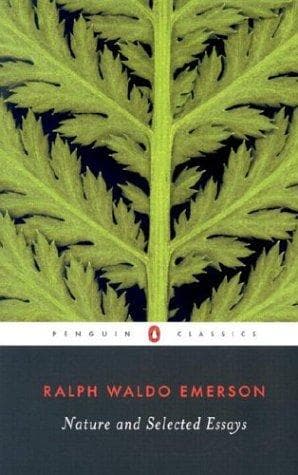
Core Idea
- Emerson’s essays argue that spirit is primary: nature, history, society, and even the self are all symbols or appearances of a deeper unity.
- His central stakes are self-reliance, moral intuition, and idealism against conformity, dead tradition, and the tyranny of material facts.
- Across the book, the individual mind is not a small fragment of the world but the place where the Universal Soul, moral law, and original thought become available.
Emerson’s Vision of Nature, Mind, and Symbol
- In Nature, Emerson organizes the natural world under Commodity, Beauty, Language, Discipline, Spirit, and Prospects, showing how nature serves and educates human beings while also pointing beyond itself.
- Nature provides material use, but its higher function is symbolic: every natural fact is a sign of spiritual fact, and the world is a language of spirit.
- Beauty arises not only from pretty scenes but from virtue, because noble acts make the surrounding world shine with moral radiance.
- Emerson insists that language itself grows from these correspondences: words begin as natural signs, and the human being is an analogist who thinks through resemblance.
- He treats the world as unity in variety: leaf, crystal, season, architecture, and sound all reveal one law in different forms.
- His idealism rejects the common assumption that matter is finally real in itself; what we call the external world may be only appearance in mind, useful but not ultimate.
- The highest interpretation of nature is not scientific cataloguing alone but the relation of things to thought, since poetry, philosophy, and religion all seek the law behind phenomena.
- In Spirit, Emerson says visible nature is a “great shadow” of a prior light, and that the human being, as head and heart of the world, finds itself in all things and all things in itself.
- Prospects turns this into a visionary anthropology: humanity now uses only part of its force, but prayer, eloquence, healing, and miraculous insight hint at a fuller spiritual power.
- The American Scholar makes the same point about intellect: the scholar should be “Man Thinking,” not a dependent reader or bookworm, and must learn from nature, books, and action without becoming subordinate to any of them.
Selfhood, History, and the Moral Sentiment
- Emerson repeatedly claims that history is subjective: there is properly no history, only biography, because great events are intelligible only through the recurring structures of individual experience.
- In History, the student is asked to identify with every age and role—Greek, Roman, priest, king, martyr, executioner—so as to see the same moral possibilities inside himself.
- Great figures and myths survive because they are not remote facts but living forms of human possibility; Prometheus, Antæus, and the Sphinx become symbols of enduring realities.
- Emerson’s Over-Soul is the deepest version of this idea: one common mind unites all people, and sincere thought or conversation is a kind of worship before it.
- The Over-Soul is not a faculty among faculties but the light that animates intellect, will, love, and virtue.
- It abolishes private limits of time and space, making Plato, Shakespeare, Christ, and the present reader contemporaries in one spiritual order.
- Emerson places strong weight on the moral sentiment as intuition of divine law: right and wrong are not merely social conventions but inward recognitions of what executes itself.
- In this framework, evil is privative rather than substantive, and benevolence is the measure of life, because to love is to participate in being itself.
- Religion is valid when it restores self-trust and inward authority; it fails when it becomes miracle-mongering, dead ritual, or dependence on dogma and numbers.
- Emerson praises Jesus as a prophet of human greatness but rejects Christianity’s tendency to over-personalize him into a mythic exception rather than a model of inward divinity.
- In The Transcendentalist, the movement is defined as Idealism: matter, institutions, and public opinion are secondary to consciousness, inspiration, and the soul’s self-sustaining power.
Self-Reliance, Reform, and the Limits of Society
- Self-Reliance is Emerson’s clearest statement of moral independence: one must trust one’s own thought, because genius consists in believing what is true in the private heart.
- “Nothing is at last sacred but the integrity of your own mind” becomes the central anti-conformist maxim of the book.
- Society is described as a conspiracy against manhood, pressing people into consistency, imitation, and borrowed opinion; Emerson answers with nonconformity and present truth.
- He rejects “foolish consistency” and insists that a person should speak what he thinks now, even if it contradicts yesterday.
- The self is not static but developmental: character is a force that radiates through time, and great individuals become “a cause, a country, and an age.”
- In Man the Reformer, Emerson treats reform as necessary but warns that it must begin with the person’s own standards, not merely with institutions.
- He attacks commerce, law, property, and social luxury as systems saturated with compromise, and proposes manual labor and economy as disciplines of independence.
- Love is his deepest social cure: it reforms by attraction rather than force, and is more effective than distrust, punishment, or mechanical schemes.
- Fate adds an important limit to Emerson’s optimism: temperament, ancestry, race, sex, body, climate, and circumstance all constrain what a person can do.
- Yet Fate is not final, because intellect and moral will can convert necessity into instrument, and “Beautiful Necessity” names the reconciliation of law and freedom.
- Emerson’s point is not that we escape conditions, but that we can learn to use them, and thereby raise conduct to the scale of nature instead of cringing before it.
Figures of the Self: Poet, Skeptic, World-Man, Thoreau
- The Poet is the representative man because he names the world, translating nature into thought and giving voice to what others only inhabit.
- Poetry is not mere meter; it is metre-making argument, a living perception that makes form from insight.
- Emerson treats language as fossil poetry: words retain buried images, and the poet restores their original force by seeing the world symbolically.
- The poet must also be simple, chaste, and receptive, not merely clever or intoxicated, because true inspiration comes from purity rather than stimulation.
- Experience shows the instability of life under moods, temperament, and surprise; Emerson distrusts shallow realism because the surface of events rarely matches their later meaning.
- Montaigne; Or, the Skeptic presents skepticism as a middle power: neither abstraction nor crude practicality, but a balanced refusal of overstatement and dogma.
- Montaigne models frankness, moderation, and self-possession, and Emerson uses him to show that doubt is often a stage in growth, not a final creed.
- Napoleon; Or, the Man of the World is the opposite type: brilliant, practical, modern, and ruthless, he expresses the energy of commerce and mass society while lacking generosity and conscience.
- Emerson admires Napoleon’s force and intelligence but condemns him as a liar, manipulator, and moral failure whose career proves that talent without conscience ends in devastation.
- The final essays on Thoreau treat him as a living Emersonian example: radically self-sufficient, exacting, anti-conventional, close to nature, and utterly committed to truth over popularity.
- Thoreau’s life at Walden, his refusal of taxes and social routine, and his fierce observation of Concord’s fields and waters embody Emerson’s claim that real independence is practical, not merely philosophical.
What To Take Away
- Emerson’s book argues that the self and the soul are more real than social convention, inherited opinion, or material fact.
- Nature, history, myth, and language all become legible when read as symbolic expressions of spirit.
- The recurring challenge is to remain inwardly free while still meeting the world’s conditions, whether through reform, labor, art, or thought.
- The book’s lasting claim is that human beings are strongest when they trust the divine source in themselves and refuse to live secondhand.
Generated with GPT-5.4 Mini · prompt 2026-05-11-v6