Core Idea
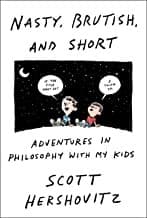
- Hershovitz’s core claim is that children are already philosophers: they ask real questions about rights, truth, justice, authority, mind, and God, and adults should think with them rather than merely about them.
- Philosophy, for him, is the art of thinking: asking what we think, why we think it, what would count against it, and how our concepts shape ordinary life.
- The book’s stakes are both intellectual and parental: if you take kids seriously as inquirers, parenting becomes a practice of cultivating reason, wonder, and moral judgment rather than issuing doctrine.
Morality, Rights, and Social Life
- The opening rights chapter begins from Hank’s bath-time complaint that he has “no rights,” leading to the idea that rights are relations with a holder and an obligor, not just abstract claims.
- Rights matter because they protect possession, exclusion, privacy, and promised treatment; Hershovitz uses Tigey, drinks, and household rules to show how children learn responsibility through rights-talk.
- He contrasts rights-based thinking with consequentialism/utilitarianism, then uses Judith Jarvis Thomson’s trolley cases to probe when harming one person can be justified to save others.
- Chapter 2 argues that revenge is not always pointless cruelty: a second wrong can sometimes restore standing, resist humiliation, or create deterrence; the real issue is status and vindication.
- Drawing on Pamela Hieronymi, Aristotle, and William Ian Miller, Hershovitz treats retaliation and the talion as historically important ways of making wrongdoing costly and intelligible, even while rejecting old honor hierarchies.
- Modern courts inherit some of that corrective function: verdicts and damages can publicly reject injury, as in the Hyatt skywalk case and Taylor Swift’s symbolic $1 battery suit.
- Chapter 3 rethinks punishment as more than deterrence; punishment must be unpleasant, and more importantly must express condemnation through reactive attitudes like resentment, disappointment, and indignation.
- Following Peter Strawson and Joel Feinberg, Hershovitz distinguishes the objective attitude toward little children—manage, train, and protect them—from the reactive attitudes appropriate to people who can grasp reasons and responsibility.
- His parenting ideal is to raise children into people the community can resent when necessary, but without shaming them into seeing themselves as fundamentally bad.
- Chapter 4 distinguishes power from authority: power can make someone comply, but authority is the power to obligate by command.
- He rejects simple competence-based authority and instead ties legitimate authority to roles and responsibilities, especially parenthood, where power is justified by the duty to feed, protect, and prepare children for adulthood.
- The book treats schools and workplaces as partial or problematic authority structures, and cites Elizabeth Anderson’s private government to argue that employers often exercise quasi-political domination.
- His broader political instinct is anti-dictatorial: families are not democracies, but children still deserve explanation, respect, and as much control as their situation allows.
Language, Truth, Mind, and Knowledge
- Swearing chapter: words are not bad by sound alone; offensiveness depends on meaning, use, social convention, and escalating patterns of offense.
- With Rebecca Roache, Hershovitz treats swearing as often useful rather than inherently wrong: it can relieve pain, reduce social pain, signal intimacy, and work as a socially legible emotional release.
- He argues that the main moral issue is insult or disrespect, not the mere fact of using a taboo word; in some contexts swearing is funny, affectionate, or harmless.
- Slurs are different from ordinary swear words because they cue ideologies: they activate racist or sexist ways of seeing the world, which is why mere mention can still be morally loaded.
- He allows limited, role-sensitive reclamation and critique, but insists that outsiders generally should not use slurs because they cannot control the ideology they summon.
- The sexism discussion shows that gender stereotyping harms everyone: boys are pressured to dominate, girls are denied support, and even children’s sports can reproduce unfair expectations.
- On trans athletes, Hershovitz argues that eligibility should track gender, not biological sex, and that a welcoming conception is better for law and social life, even though nonbinary cases remain difficult.
- The truth chapter distinguishes lying from fiction and play: some falsehoods occur in suspended contexts where sincerity is not expected, while lying wrongs because it misrepresents one’s own mind and damages trust.
- He rejects relativism: disagreement does not imply there is no truth, whether about facts or morals; moral inquiry is reason-giving and revisable, not worldview-bound.
- Using epistemic bubbles and echo chambers, he shows how misinformation grows when groups isolate themselves from correction and teach distrust of outside sources.
- The mind chapter returns to Nagel’s question: we can infer others’ mental states, but subjective experience remains partly private, which fuels puzzles about bats, babies, zombies, qualia, and consciousness.
- Hershovitz presents materialism, dualism, Dennett, and Strawson as serious but unsettled responses to the hard problem of consciousness; the main point is that inner life remains philosophically stubborn.
- On infinity, he uses Zeno, Hilbert’s Hotel, and cosmic smallness to show why philosophy and math overlap but do not eliminate ethical seriousness.
- Against utilitarianism in an infinite universe, he insists that persons matter individually even when aggregate arithmetic becomes strange.
God, Fiction, and the Book’s Last Word
- The God chapter treats religion as a live philosophical topic rather than a closed verdict: he does not simply deny God, but wants reasons, questions, and arguments.
- Rex’s thought that “for real, God is pretend, and for pretend, God is real” becomes a version of fictionalism: religion may be treated as make-believe that still structures meaning, ritual, and community.
- He distinguishes faith from mere belief: faith is action-oriented commitment, not just accepting a proposition on evidence.
- Pascal’s Wager and religious practice matter, but he worries that self-interested belief is not the same as genuine faith.
- The Problem of Evil is the strongest obstacle to belief for him; Marilyn McCord Adams’s attempt to reconcile horrific suffering with divine goodness is intellectually serious but, to him, too optimistic.
- Abraham’s bargaining with God models the book’s theological temperament: argument, protest, and negotiation are more authentic than passive submission.
- The closing lesson returns to parenting: keep asking “What do you think?”, “Why?”, “What if you’re wrong?”, and “What do you mean?” so children keep doing philosophy rather than losing it.
What To Take Away
- The book’s deepest claim is that philosophy is not a specialist hobby; it is what happens when adults take children’s questions seriously and follow them wherever they lead.
- Hershovitz repeatedly shows that moral and social life turns on relations, roles, and signals: rights, punishment, authority, slurs, and truth all depend on how speech and action shape standing with others.
- He is skeptical of simple answers—whether utilitarian, relativist, anti-punishment, or doctrinal—because the hard work is usually in noticing distinctions that everyday life hides.
- The closing invitation is practical but philosophical: raise children to reason, doubt, protest, and wonder, because that is how they become fully themselves.
Generated with GPT-5.4 Mini · prompt 2026-05-11-v6