Core Idea
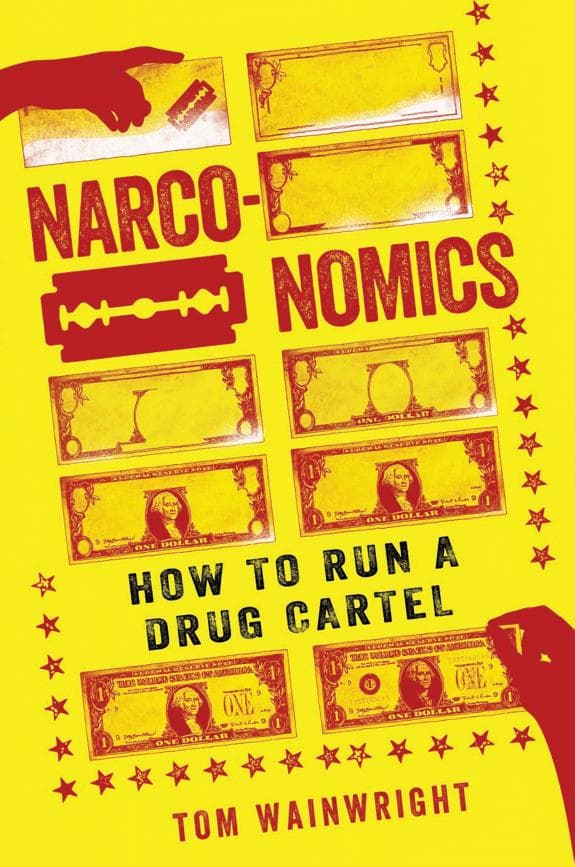
- Wainwright’s core claim is that the drug trade is best understood as a global business: cartels face ordinary problems of pricing, supply chains, labor, regulation, branding, and competition.
- The war on drugs repeatedly fails because governments treat cartels like insurgents to be crushed, while the trade actually behaves like an adaptable market that shifts, innovates, and arbitrages weak states.
- The book’s recurring argument is that policy should focus less on symbolic prohibition and supply shocks, and more on market design, demand reduction, regulation, and institutional reform.
How Cartels Work Like Firms
- Cocaine economics show why source-country eradication is weak: coca leaf is a tiny fraction of retail cocaine value, so even large changes in farm-gate prices barely affect street prices.
- Bolivia’s legal coca system, Colombia’s eradication campaigns, and the “balloon effect” all illustrate that squeezing production in one place usually pushes it elsewhere rather than reducing total supply.
- Cartels often function as monopsonies, so eradication costs get absorbed by poor farmers instead of hitting downstream traffickers.
- The real strategic bottleneck is usually closer to the consumer market, not at the crop itself; attacking coca is like trying to raise art prices by raising the price of paint.
- The book’s violence analysis is similarly economic: violence rises where access is scarce and contested, as in Juárez’s border crossing routes, but falls when gangs collude or divide territory, as in El Salvador’s truce.
- Mexican policing fragmentation created a “regulatory” battlefield in which cartels co-opted different layers of law enforcement against each other, while Salvadoran gangs reduced killing by reaching a mediated territorial settlement.
- Cartels also manage human resources: they recruit under secrecy, replace dead or imprisoned workers constantly, and use prisons as training grounds, networking hubs, and apprenticeships.
- Examples like Carlos Lehder and George Jung show prison as a cartel “college,” while groups like La Nuestra Familia use constitutions, ranks, and impeachment rules to solve internal collective-action problems.
- In richer countries, smaller trafficking outfits often prefer freelancers and specialized contractors, and disputes are frequently settled without violence because preserving relationships is valuable when contacts are hard to replace.
- Ethnicity, family ties, and nationality are used less as cultural preferences than as leverage: traffickers prefer workers whose relatives can be held at risk in the home country.
PR, Offshoring, and Diversification
- Cartels have become skilled at PR: narcomantas, narcocorridos, celebrity-style adulation, and selective philanthropy all help them advertise control, deter rivals, and shape public perception.
- The same image strategy includes intimidation of journalists, newsroom blackouts, and online propaganda; the book emphasizes that cartels want not just advertising but editorial influence.
- “Narcolimosnas” and cartel philanthropy are presented as reputation-laundering, not altruism, especially where communities become dependent on cartel money, loans, or services.
- Cartels also fill institutional voids: they offer local protection, dispute resolution, and even enforcement where the state fails, which can win them a measure of legitimacy.
- The offshoring chapter argues cartels behave like multinationals, moving operations to weak, cheap, poorly governed places where bribery is easy and oversight is thin.
- Central America becomes a “trampoline” for cocaine, while Guatemala and Honduras are shown as especially attractive because of weak police, low tax capacity, privatized security, and porous geography.
- Honduras’s corruption and instability make it a trafficking corridor; Guatemala’s low state capacity and private-security dependence do the same, and both countries become sites where cartel money penetrates politics and land markets.
- Wainwright proposes a Cartel Competitiveness Report—the inverse of business-climate rankings—to show which state weaknesses most attract criminal enterprise.
- He treats legalization as politically plausible partly because producer and transit states increasingly see the drug war as exporting violence while leaving demand untouched.
Legal Highs, Online Markets, and New Products
- Synthetic drugs are driven by a bad incentive structure: manufacturers only need to stay ahead of bans, so each iteration can become more dangerous as products are tweaked for novelty rather than safety.
- New psychoactive substances in Britain, Ireland, and New Zealand show the limits of reactive prohibition; bans often displace sales online or into faster-moving markets rather than eliminating demand.
- New Zealand’s brief premarket-testing regime is the book’s main regulatory experiment: manufacturers had to prove safety before sale, which sharply reduced outlets and products, but the system later stalled because licensing requirements became impracticable.
- The author uses this case to argue for regulated legal markets for the least harmful synthetics rather than endless cat-and-mouse prohibition.
- Online marketplaces like Silk Road changed drug retail by reducing the need for territory and personal networks; TOR, Bitcoin, and reputation systems made anonymous buying more like ordinary ecommerce.
- Online markets can improve customer service, standardize quality, and lower search costs, but they also expand access and may widen demand by making drug buying seem normal and low-risk.
- Enforcement becomes harder online because marketplaces are diffuse and quickly replaced, though the book notes that mid-level brokers and other high-connectivity nodes still matter in offline supply chains.
What To Take Away
- The book’s sharpest insight is that drug policy fails when it ignores incentives: cartels adapt to pressure like firms, not like static enemies.
- Supply-side crackdowns often redistribute violence and profits instead of reducing consumption, because the trade’s value is created far downstream from crops.
- The most plausible gains come from better institutions: safer prisons, stronger police, protected journalism, services that reduce cartel legitimacy, and regulation where prohibition has clearly failed.
- Wainwright’s bottom line is not that drugs are harmless, but that leaving a $300 billion market to mafias is a policy choice—not a necessity.
Generated with GPT-5.4 Mini · prompt 2026-05-11-v6