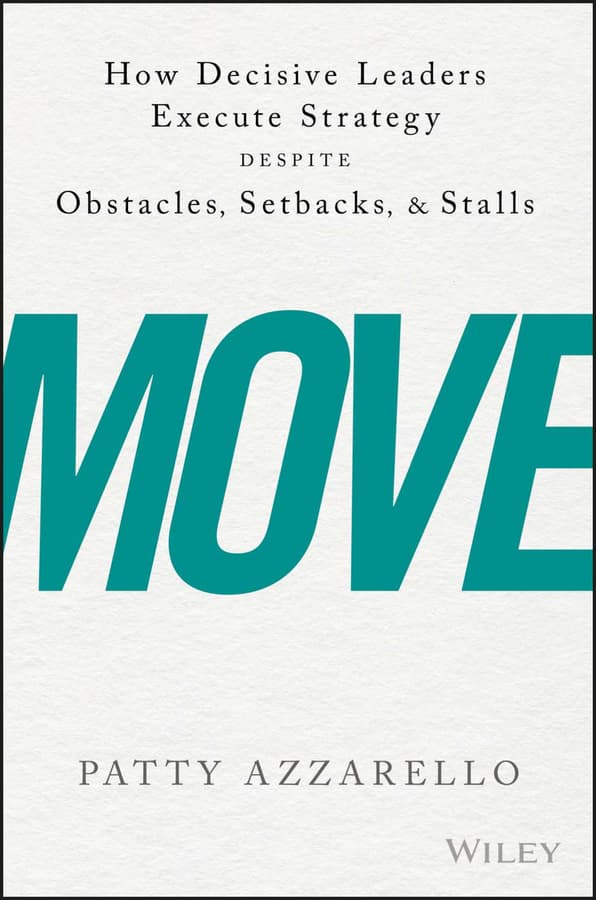
Core Idea
- Patty Azzarello’s core claim is that strategy without execution is just talk, and execution most often fails in the long Middle after launch, when enthusiasm fades and people revert to old work.
- Her answer is MOVE: Middle, Organization, Valor, Everyone—meaning leaders must keep transforming the business through the hard middle by changing the work, the structure, the resources, and the people who actually do it.
- The book’s central warning is that leaders cannot “do” transformation from the top; they must define concrete outcomes, fund them honestly, staff them with the right team, and keep the change visible until it sticks.
Making Strategy Real
- Azzarello contrasts vague aspiration with execution by pushing leaders to turn “situation” talk into outcome talk: instead of admiring the problem, define what success will look like.
- She uses concrete outcomes to uncover the real work, hidden constraints, and cross-functional dependencies; once the outcome is specific, the action plan becomes visible.
- Her examples repeatedly show that specificity creates productive conflict, because choosing measurable outcomes forces people to confront trade-offs instead of hiding behind abstraction.
- She stresses mid-term checkpoints and backward planning from the due date—what must be true at 12, 9, 6, 3, and now months—to keep long initiatives from drifting.
- Good measures are control points, not activity counts; they tell whether the business is actually on track, not merely busy.
- Her favorite contrast is that bad metrics track process or volume, while good control points capture the observable result that matters, like successful pilots, customer satisfaction, or whether users can plainly experience the benefit.
- She argues that the budget is the real strategy: if resources do not move, the strategy is not real, no matter what the speeches say.
- Resource decisions must be explicit about trade-offs, because leaders often promise a 100% plan on a less-than-100% budget and then wonder why nothing works.
- When the economics are impossible, she prefers truth over fantasy; sometimes the right move is Do Less with Less, cut the business down to what is viable, and then rebuild.
- Her anti-fantasy stance includes rejecting “turtles all the way down” planning, where one unrealistic revenue assumption props up the entire staffing and investment model.
People, Teams, and Organizational Change
- The right team is central to everything: if leaders are too busy doing work that should be delegated, they likely have the wrong people.
- Her dogsled test for the right team is whether the ropes are tight: people are facing forward, aligned on course and roles, capable, and motivated.
- She is blunt that there is no real antidote for the wrong team; some people must be moved out, and some strong performers in old roles do not fit the new strategy.
- She distinguishes people who can’t or won’t perform: those who can but won’t support the plan should exit, while those who can learn should be developed.
- Good managers matter because they translate strategy into expectations, measures, feedback, and recognition; bad managers create confusion, politics, and fear.
- Building capacity means performance management should raise the team’s ability over time, not just rate current output.
- Successors should practice your work, your relationships, and your decisions; development requires delegating real responsibility, including the chance to fail.
- She treats failure as part of learning: if leaders keep rescuing people, they prevent growth.
- Recruitment is ongoing, not episodic; leaders should always be looking for stars, people with raw intelligence, unusual advancement, ambition, and fast learning.
- She warns against hiring for pedigree, famous past accomplishments, personality, or longevity instead of capability and potential.
- The wrong people also include bullies, saboteurs, the checked-out, the negative, and the too-invested-in-the-past; bullies should be removed or tightly contained.
- Reorganization should start from the business outcome, not the current org chart or the current people.
- Her ideal org design process is to define outcomes, draw the blank-sheet structure, then fill roles as new roles that match the work needed now.
- She emphasizes that people may be moved sideways, down, or out if they do not fit the new mission, even if they were good in the old one.
How Change Stays Visible
- Azzarello insists that change must be decorated: visible rituals, artifacts, and repeated public signals keep the transformation alive in the Middle.
- Her examples include ceremonies, T-shirts, props, contests, internal blogs, and regular updates that make the strategy tangible rather than abstract.
- She treats top-down communication as necessary but insufficient; leaders must repeat the story, explain what is not changing, and answer the questions people are actually asking.
- Consistency matters more than polish: brief, regular updates from the leader create confidence, while missed updates signal drift or loss of commitment.
- She argues that leaders should listen intentionally and broadly—through one-on-ones, customer visits, and informal conversations—because filtered management reports miss the real obstacles.
- Listening is also a source of better ideas; strong leaders look for useful ideas anywhere in the organization and do not let ego block them.
- Silos are dangerous because they hide information, duplicate work, and create bad decisions; sharing must be intentional and sometimes built into performance expectations.
- She is similarly direct about remote teams: individual productivity may rise at home, but team productivity falls unless expectations, measures, and collaboration time are designed on purpose.
- Her broader point is that transformation is social as much as structural: people need to see peers, sponsors, and leaders visibly supporting the change before they feel safe joining.
What To Take Away
- Transformation stalls when leaders stay at the level of vision; the book’s answer is to make the Middle concrete through outcomes, checkpoints, control points, and resourcing.
- The budget, org chart, and daily behavior reveal the truth of strategy more than slogans do.
- The right team and active sponsorship are not optional; execution depends on building, protecting, and renewing both.
- Trust is the hidden control point: the book argues that every major practice—listening, recognition, clarity, fairness, and visibility—either builds trust or drains it.
Generated with GPT-5.4 Mini · prompt 2026-05-11-v6