Core Idea
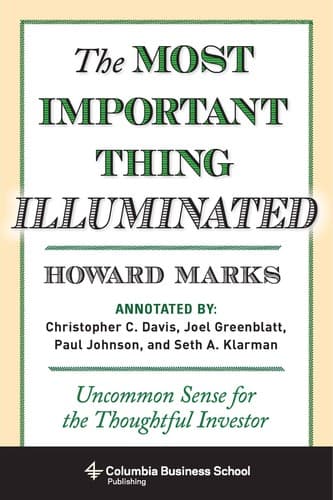
- Howard Marks argues that investing is too complex to reduce to formulas, so success depends on judgment, discipline, and the ability to think differently from the crowd.
- The book is less a manual for prediction than a guide to how to think about price, value, risk, cycles, and psychology in markets.
- Marks’ central claim is that superior returns come from being right when the consensus is wrong, especially by understanding when assets are cheap relative to intrinsic value and when risk is being misperceived.
How Successful Investing Works
- The starting point is intrinsic value: “buy low, sell high” means buying below value and selling above it, not simply buying good companies.
- Marks draws a sharp line between value investing and growth investing; the real question is value today versus value tomorrow.
- Buying things well matters more than buying “good things,” because even excellent companies can be terrible investments if the price is too high.
- The Nifty Fifty is his cautionary example: beloved growth stocks were priced as if nothing could go wrong, then suffered brutal declines when valuations normalized.
- He argues that price and value converge over time, but not on any schedule that helps investors who pay too much.
- The most dependable route to profit is buying at a discount to value, though even that can be painful because markets can stay irrational long enough to make you look wrong.
- Marks identifies four profit routes: rising intrinsic value, leverage, selling to a greater fool, and buying below value; he treats buying cheaply as the most reliable.
- Leverage can magnify outcomes but does not improve the underlying economics and becomes dangerous when liquidity disappears.
Risk, Cycles, and the Pendulum
- Marks defines risk as uncertainty about outcomes, especially the risk of loss, and rejects the academic tendency to equate risk with volatility.
- Risk is also personal and situational: failing to meet goals, benchmark underperformance, career risk, illiquidity, and the danger of being forced to sell all matter.
- His recurring warning is that the greatest risk often comes from high prices, not from low quality or short-term fluctuation.
- When investors believe there is “no risk,” prices usually have already risen to dangerous levels and future returns have been compressed.
- The book treats markets as cyclical: success contains the seeds of failure, and failure contains the seeds of success.
- The credit cycle is especially powerful: easy capital, low risk aversion, and rising prices encourage excess; then losses tighten credit and trigger contraction.
- Marks’ pendulum metaphor describes investor psychology swinging between euphoria and depression, greed and fear, and risk tolerance and risk aversion.
- Bull markets pass through three stages: a few foresee improvement, most recognize improvement, and finally everyone believes improvement will last forever.
- Bear markets mirror this process: a few see trouble, most see deterioration, and finally everyone believes things can only get worse.
- Because extremes eventually reverse, the practical task is to recognize where the pendulum is, even though no one can know exactly when it will turn.
Psychology, Contrarianism, and Finding Opportunity
- Marks thinks psychology dominates analysis in most market mistakes; many investors can understand facts, but far fewer can resist greed, fear, envy, ego, and crowd pressure.
- He repeatedly emphasizes self-deceit and the willingness to suspend disbelief when a narrative is attractive, which helps explain bubbles and crashes.
- Markets are full of herd behavior: people prefer consensus, fear looking wrong, and often capitulate late in the cycle because everyone else seems to be making money.
- Superior investing is often contrarian at the extremes: buy when others are forced sellers, and sell when assets are universally loved and priced for perfection.
- But contrarianism is not a timing trick; “overpriced” does not mean “going down tomorrow.”
- The best bargains are often found in unpopular, misunderstood, controversial, disinvested, or socially disfavored assets, where perception is worse than reality.
- Marks repeatedly stresses patient opportunism: sometimes the best move is to do little, wait for motivated sellers, and let opportunities come to you.
- In crises, the key position is to be insulated from forced selling and ready to buy when others must liquidate.
- His 2008 examples show that distressed debt and other beaten-down assets can produce exceptional returns when panic forces prices far below value.
What To Take Away
- Marks’ framework is built on value, risk, cycles, and psychology; none works well alone, but together they explain why markets repeatedly overshoot.
- The most important discipline is not forecasting every move but estimating value, recognizing cycle position, and respecting how human behavior distorts price.
- The book’s deepest warning is that comfort, consensus, and apparent safety are often the enemies of good returns.
- The practical edge comes from buying with a margin of safety, avoiding leverage-driven ruin, and remaining skeptical when things look easy or inevitable.
Generated with GPT-5.4 Mini · prompt 2026-05-11-v6