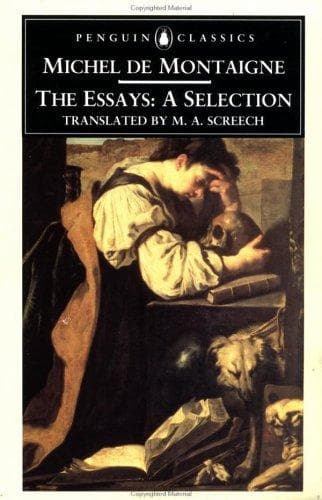
Core Idea
- Montaigne’s Essays are a prolonged experiment in self-scrutiny: he writes to expose how a mind actually works, not to build a system.
- His deepest subjects are human instability, the limits of reason, the pressure of custom, and the art of living and dying with less illusion.
- Across politics, religion, medicine, friendship, education, and war, he keeps returning to one claim: appearance, opinion, and habit govern us far more than we admit.
Self-Knowledge, Skepticism, and the Unreliability of Human Judgment
- Montaigne writes in fragments because he believes the self is inconstant, mixed, and changing; he refuses to pretend to a fixed doctrine or a single character.
- He repeatedly shows that judgment is unstable: the same cause can produce opposite effects, and the same counsel can succeed or fail depending on fortune.
- His skepticism is practical, not merely abstract: we mistake custom for nature, opinion for truth, and habit for reason.
- He distrusts learned certainty in philosophy, law, medicine, prophecy, and religion because each field is crowded with contradiction, overconfidence, and rivalry.
- The senses are not secure foundations either; imagination, fear, desire, sickness, and temperament can all distort what we see and feel.
- In the long skeptical movement of the book, Montaigne treats human beings as poor judges of reality, forced to live by partial evidence and inherited usage.
Living, Dying, Friendship, and Moral Measure
- Montaigne’s most famous moral theme is that to study philosophy is to learn to die: death should be made familiar so it loses tyranny over life.
- He rejects cowardly evasions of mortality, but he also insists that fear of death often does more harm than death itself.
- He is interested in whether a death is truly honorable, and says the intention and inward steadiness matter more than outward success.
- His accounts of suicide are deliberately discriminating: he condemns despair and weakness, but records cases of deliberate death from constancy, shame, public duty, or extreme suffering.
- He treats friendship as the highest human bond, especially in the incomparable friendship with Étienne de la Boétie; true friendship is rare, voluntary, and almost a single soul in two bodies.
- Friendship differs from love, marriage, and kinship because it excludes calculation, profit, and secondary motives; Montaigne’s formula is the famous “because it was he, because it was I.”
- He values moderation in all things, even virtue, because excess can turn goodness into cruelty, zeal into fanaticism, and discipline into inhumanity.
- He repeatedly argues that the best life is not heroic display but steadiness, freedom, and proportion.
Custom, Education, Politics, and the Shape of Civilization
- Custom is one of the Essays’ central ideas: it can make anything seem natural, from clothing and food to law, religion, and political obedience.
- Montaigne uses foreign peoples, ancient examples, and his own travel notes to show that there is almost no human practice that custom cannot normalize.
- He is suspicious of political innovation because reform can unleash worse disorder than the evil it tries to cure.
- In civic life he prefers temperate maintenance to radical correction, and he admires rulers who preserve peace without theatrical severity.
- His chapter on education is unusually detailed: a child should be formed into judgment, manners, and bodily hardiness, not stuffed with memory and words.
- He wants a tutor who can train the pupil to speak, judge, compare, and choose, rather than merely recite; wisdom should be incorporated, not accumulated.
- He prefers history, Plutarch, Seneca, conversation, and travel to scholastic learning, because they show people in action and train discernment.
- He repeatedly attacks pedantry: memory without judgment, learning without digestion, and books used as badges of display rather than tools for living.
Medicine, War, and the Body
- Montaigne is famously skeptical of physic: medicine, he argues, often inflates fear, multiplies remedies, and harms health while claiming to cure it.
- He prefers nature, regimen, and habit over aggressive treatment, and he treats much medical certainty as a moving target of theory and fashion.
- His own bodily experience—especially the stone—becomes a test case for how pain is partly physical and partly shaped by apprehension.
- He believes the force of imagination is enormous: it can create symptoms, intensify pain, alter performance, and sometimes produce what looks like miraculous bodily change.
- In war, he is fascinated by strategy, courage, horsecraft, siege practice, and the moral difference between valor and obstinacy.
- He often praises courage that can evoke mercy, but he also shows how war turns into treachery, cruelty, and theatrical honor codes.
- His travel accounts, especially in Italy and at Rome, mix bodily exactness with historical melancholy: ruins, baths, illness, and religious procedure all become material for reflection.
What To Take Away
- Montaigne’s essays are not a system but a method of honest observation: he keeps testing himself against experience, books, and contradiction.
- The central human problem is not lack of intelligence but self-deception under custom, passion, fear, and vanity.
- His most durable moral ideals are friendship, moderation, liberty of conscience, and freedom from illusion about death.
- The book endures because it makes ordinary life—body, habit, conversation, and doubt—feel like the real site of philosophy.
Generated with GPT-5.4 Mini · prompt 2026-05-11-v6