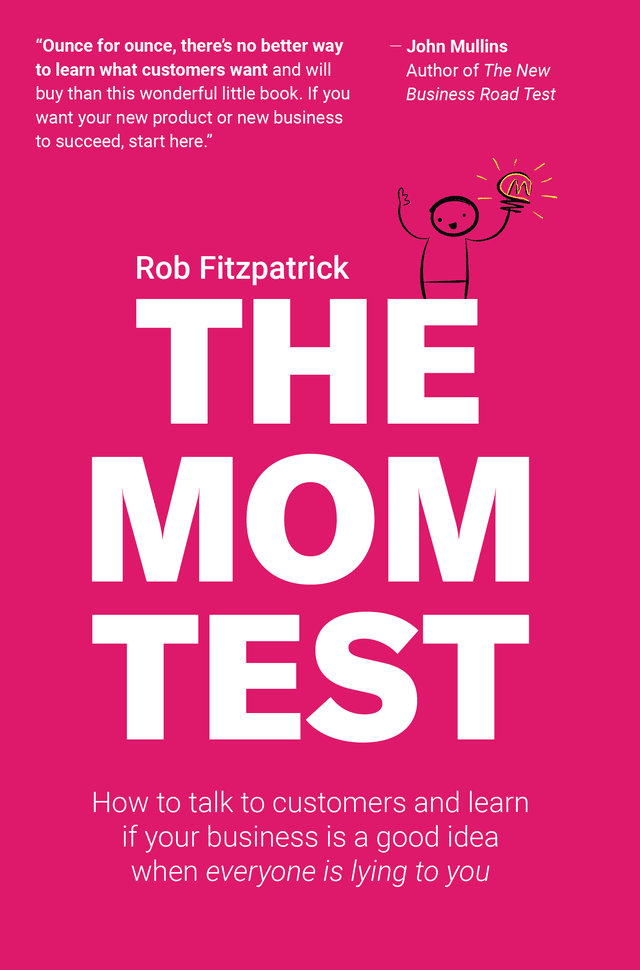
Core Idea
- Customer conversations are useful only if they reveal truth, not praise, and the book’s central warning is that bad questions will reliably produce false positives.
- The Mom Test is to ask about the customer’s life, past behavior, and concrete specifics so the other person cannot simply reassure you, flatter you, or speculate.
- Early customer discovery is about learning quickly and cheaply, not validating your idea or getting someone to say they would buy it.
The Mom Test: What Good and Bad Questions Produce
- The book’s three rules are to talk about their life instead of your idea, ask about specifics in the past instead of generics or the future, and talk less and listen more.
- Bad questions invite opinions and ego-protection, such as “Do you think it’s a good idea?”, “Would you buy it?”, “How much would you pay?”, and “What would your dream product do?”
- Good questions turn vague claims into observable facts: “What’s the last time that happened?”, “What else have you tried?”, “How are you dealing with it now?”, “Who else should I talk to?”, and “Where does the money come from?”
- “Talk me through the last time that happened” is especially powerful because it forces a specific episode instead of a flattering generality.
- Questions like “Why do you bother?” and “What are the implications of that?” help uncover motivation and whether the problem has real economic weight.
- Compliments are fool’s gold: they feel encouraging, but unless they lead to a meaningful commitment they usually reveal very little.
- Fluff includes generics, hypotheticals, and future promises such as “I always…,” “I would…,” and “I might…,” which should be anchored back to an actual past example.
- Ideas and feature requests should be understood, not obeyed; the useful move is to ask why the request matters and what outcome it would enable.
- The MTV example shows why this matters: a requested analytics dashboard seemed important, but the real need was simply weekly emailed reports to reassure clients.
Conversation Hygiene and Common Failure Modes
- Once you enter pitch mode, the conversation starts producing distorted data because people protect your feelings or respond to the product rather than their own reality.
- The book warns about The Pathos Problem, where exposing your hope or ego invites polite agreement instead of honesty.
- If you notice you are pitching, stop, reset, apologize, and return to the other person’s last point rather than trying to rescue the conversation.
- Keep meetings casual when possible, because a quick natural chat often yields better signal than a formal interview.
- The Meeting Anti-Pattern is scheduling everything; a five-minute coffee or hallway conversation can be more valuable than a long calendar block.
- Avoid premature zooming, meaning don’t narrow to a subproblem before you know the larger problem is real and important.
- Start broad when uncertainty is high, then zoom in only after you see strong evidence that the person truly cares and is already trying to cope with the issue.
Who to Talk To, What Counts as Progress, and How to Organize Learning
- A useful customer segment is a who-where pair: you need to know both the people and where you can actually find them.
- Customer slicing is the repeated narrowing of a broad market into a smaller, behaviorally coherent group that produces consistent problems and goals.
- If different conversations keep producing mixed signals, the segment is probably still too broad or too fuzzy.
- Early customers are often “crazy in a useful way”: they have the problem, care deeply, have budget, and have already improvised workarounds.
- The book distinguishes market risk from product risk: if the customer would pay only if you can make the product work or drive enough traffic, then the hard part is likely the product, not the market.
- Customer conversations alone cannot fully validate product-risk businesses; sometimes the right response is to build sooner because the central uncertainty is whether the thing can be made to work.
- A meeting only succeeds if it ends with commitment or advancement, meaning the other person gives up something of value or moves to the next step in your funnel.
- Examples of commitment currencies include time, reputation risk, and money; useful outcomes are next meetings, introductions to decision makers, trials, LOIs, pre-orders, or deposits.
- “That’s cool, keep me posted” is usually a failure signal, and the book treats zombie leads as evidence that no real decision was forced.
- Notes should capture exact quotes, emotions, workarounds, budgets, named people, and follow-up tasks in a simple retrievable system.
- The process is intentionally lightweight: prepare with a few big questions, review notes with the team, and get back to building fast so learning does not bottleneck in one person.
What To Take Away
- Behavior beats opinion: what people actually did last time is far more reliable than what they say they would do.
- Enthusiasm is not evidence: compliments, “I’d definitely buy this,” and “keep me in the loop” do not de-risk a business unless they come with commitment.
- Specific segments matter: broad labels like “students” or “advertisers” blur together too many different problems to learn from cleanly.
- Use customer conversations to reduce uncertainty, not to outsource judgment; the point is better evidence for the next decision, not permission to proceed.
Generated with GPT-5.4 Mini · prompt 2026-05-11-v6