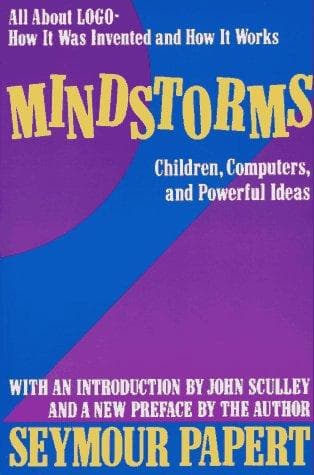
Core Idea
- Papert argues that computers can become “objects-to-think-with” for children, like gears were for him, if they are embedded in a rich cultural and educational context rather than treated as neutral machines.
- His central claim is not that computers automatically improve learning, but that Logo, Turtle geometry, and related microworlds can support new forms of thinking, especially when they make mathematics and science body-syntonic, playful, and personally meaningful.
- The deeper educational target is cultural change: break mathophobia, weaken the humanities/science split, and create environments where children can learn powerful ideas naturally instead of only through school-style instruction.
Learning, Culture, and the Limits of School
- Papert extends Piaget by stressing that children build knowledge through assimilation, but what they can build depends on the cultural materials available to them.
- He contrasts spontaneous Piagetian learning with school’s artificial learning environments, which often force children into passive identities like “I’m not a math person.”
- Mathophobia is not just fear of a subject; it becomes a social identity reinforced by aptitude myths, school culture, and the absence of math-speaking adults.
- He uses the educator as anthropologist idea: educators should study the culture that shapes learning, then intervene by changing that culture rather than merely adjusting curriculum.
- The book repeatedly rejects technocentric questions like “What is the effect of Logo?” because effects depend on implementation, pedagogy, available machines, and surrounding social context.
- Papert’s own childhood story of gears and the differential shows how a system can feel lawful and intelligible without being rigidly deterministic, and how learning is both cognitive and affective.
- He thinks personal computers can spread into everyday life and return educational power to individuals, but only if they are used to alter environments, not just to deliver drill.
Logo, Turtle Geometry, and Learning Mathematics
- Turtle geometry is Papert’s main alternative to school math: a learnable first mathematics that begins from motion, body knowledge, and direct exploration.
- The Turtle is a cybernetic creature with position and heading, so children can identify with it more easily than with Euclid’s abstract point.
- Commands like FORWARD, RIGHT, PENDOWN, and PENUP let children learn mathematical ideas through exploration, then invent procedures like SQUARE and TRIANGLE from smaller ones.
- Papert insists children can also use the Turtle as a sketchpad for animation, editing, recoloring, music, and other expressive work, not just static drawing.
- A major theme is that children learn to speak mathematics through shapes, rates of change, process, and procedure rather than memorized facts.
- He argues that Turtle geometry is appropriable, meaning it connects to what children already know from the body and environment while still being mathematically powerful.
- He treats school mathematics as a historically contingent social construction, shaped by pencil-and-paper constraints and preserved by QWERTY-like inertia.
- New Math is criticized as mathematicians’ mathematics simplified for schools, not mathematics invented from the child’s point of view.
- He presents the economic case that giving every child a computer over 13 years could be feasible relative to total schooling costs, so the vision is not merely utopian in the practical sense.
Microworlds, Debugging, and What Children Can Learn
- Debugging is central: a teacher and child can work together on a Turtle program as genuine collaborators because neither fully knows the answer in advance.
- LOGO’s value is that it creates new situations where both teacher and learner can honestly inquire, rather than enacting fake classroom collaboration.
- Papert distinguishes understanding the microworld from understanding the machine underneath it; children do not need full transparency to gain a usable, complete grasp.
- The triangle/hexagon debugging example shows how a small mistake can reveal a deeper misunderstanding of geometry, not just of programming syntax.
- Mathetics is his term for the study of learning, parallel to heuristics in problem solving: relate new ideas to what you know, then make them your own through creative use.
- He extends Turtle ideas into physics with Dynaturtles, velocity Turtles, and acceleration Turtles, so learners can approach Newtonian motion through staged conceptual steps.
- His sequence is geometry Turtle → velocity Turtle → acceleration Turtle → Newtonian Turtle, each layer preserving prior intuitions while adding new state and laws.
- He argues that students should work in transitional worlds that physicists might not count as “real physics,” because those worlds build intuition before formalism.
- The Monkey Problem shows why learners need a category like “law-of-motion problem”; once monkey and rock are seen as linked objects, the solution becomes obvious.
- Papert values wrong theories as productive, using examples like “trees make wind” to show that children’s theories can be testable, coherent, and educational even when false.
- He wants environments less dominated by true/false judgment so children can construct and revise theories without being shamed for being wrong.
Mind, Aesthetics, and the Social Life of Computing
- Papert links Piaget, Bourbaki, and McCulloch around a shared premise: knowledge and knower are inseparable, and mathematics has genetic roots in bodily action and structure.
- He treats learning as partly bricolage: people build with what they have, patching and recombining local pieces rather than undergoing total cognitive reorganizations.
- In the essay on the mathematical unconscious, Papert reworks Poincaré’s idea that mathematical creativity involves unconscious combinatorics guided by an aesthetic gatekeeper.
- He emphasizes that mathematical thought has an extralogical face—beauty, pleasure, intuition—and that these are not decorative but central to how work gets done.
- The Loud Thinking proof of √2’s irrationality illustrates how a proof can be felt as right when a frame suddenly makes
p^2 = 2q^2aesthetically compelling or absurd. - He uses Pirsig to argue that judgments about the “right fix” or the “right form” intertwine style, identity, and continuity, not just abstract correctness.
- LOGO itself is presented as a cultural experiment: a way to build a new educational culture inside MIT’s computer culture, with ideas spreading through conversation as much as publications.
- Papert explicitly rejects BASIC as an entry language for children because its small vocabulary and design commitments shape what can be thought and expressed.
- His long-term vision is a culture where children and adults use computers to make powerful ideas more natural, more personal, and less alien.
Generated with GPT-5.4 Mini · prompt 2026-05-11-v6