Core Idea
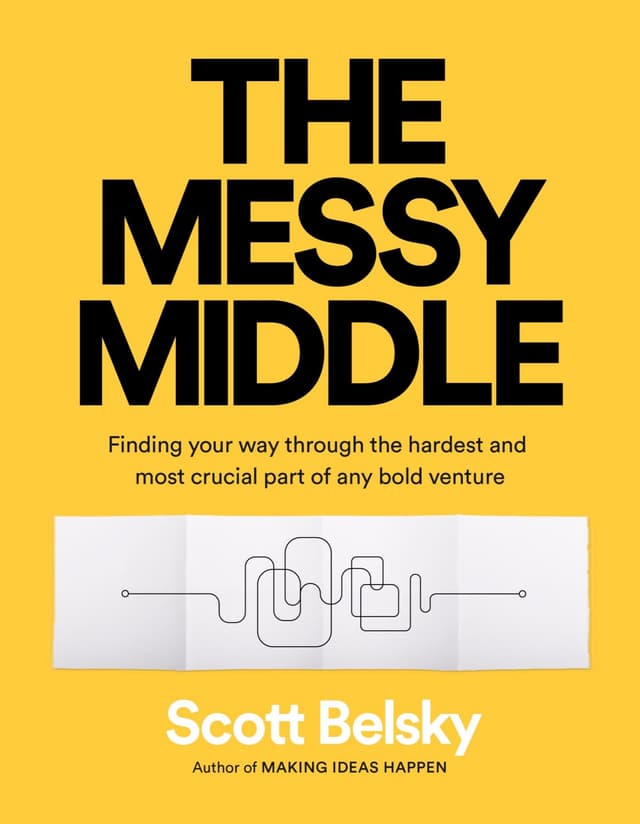
- The central thesis is that bold ventures are not linear; the start and finish get the glory, but the messy middle is where the real work, doubt, and value creation happen.
- Belsky frames progress as “relative joy”: endure the valleys, amplify the peaks, and try to keep the overall slope positive over time rather than expecting constant upward motion.
- The book argues that founders and leaders succeed by learning to endure volatility, optimize what works, and keep teams motivated without fake certainty.
Living Through the Messy Middle
- The middle is defined by self-doubt, anonymity, grind, false starts, pivots, and near-failure, not by the clean narratives startups tell afterward.
- Belsky distinguishes useful optimism from delusion: leaders must short-circuit the reward system with real but small milestones, not pretend wins like paid press, vanity awards, or celebrating fundraising itself.
- He calls repeated, non-actionable checking for reassurance “insecurity work” and argues for rituals, boundaries, delegation, and self-discipline to stop it.
- The founder’s job is to accept uncertainty, keep processing it in parallel, and still make decisions; waiting for perfect clarity is usually a form of delay.
- He rejects a frictionless ideal: friction brings us closer because resistance, disagreement, and setbacks create tolerance, character, and better solutions.
- Leaders should be the team’s steward of perspective—the person who keeps the mission vivid, explains reality clearly, and leaves people with more energy after hard conversations.
- Belsky’s shorthand DYFJ (“Do your fucking job”) captures the need for decisive action in crises, firings, and misconduct, even when the decision is uncomfortable.
- The book repeatedly returns to self-awareness as a competitive advantage, because people at peaks and valleys are least likely to act like their best selves.
How Teams Build, Grow, and Stay Sharp
- Great companies are grown, not gathered: optimization means improving roles, culture, structure, and process around the people you already have.
- Belsky favors resourcefulness over resources: refactor before hiring, use constraints to sharpen creativity, and avoid treating funding as proof of health.
- He values initiative over experience when early-stage work demands hunger, speed, and willingness to do any job.
- Diversity drives differentiation because different backgrounds, languages, and life experiences widen the surface area for original thinking.
- Teams should recruit people who have endured adversity and who can sustain ambiguity, self-reliance, and courage under pressure.
- Strong hires are people whose conversations create a step function—they make the discussion better, not merely more agreeable.
- Belsky warns against keeping chemistry too clean: some polarizing, opinionated people are valuable if they share the mission and prevent groupthink.
- New people must be grafted into the team carefully, with psychological safety, real-time communication, and honest feedback so the “new organ” actually takes.
- He argues for internal apprenticeship: learn in real time from experts, pair juniors with veterans, use stretch assignments, and accept short-term productivity dips for long-term capability.
- Firing is framed as protecting the whole team, not preserving comfort; teams are sports teams, not families, and underperformers can damage stronger performers.
- Comfort is dangerous, so leaders should keep people moving through rotations, stretch roles, and environmental changes that prevent stagnation.
- Culture is not perk-driven; it is created by the stories the team tells, the rituals it repeats, and the meanings it attaches to shared moments.
- Belsky also emphasizes the importance of free radicals: self-directed, resilient people who thrive when organizations give them freedom, tools, and low bureaucracy.
Building, Communicating, and Choosing What Matters
- Good teams optimize the products and systems they use internally, because tools, spaces, and workflows shape the quality of external work.
- Leaders should merchandise progress through milestones, visible cues, slogans, and narrative, because attention and morale need reinforcement.
- A mock-up often beats discussion because visual prototypes collapse abstract debate faster than words.
- Belsky prefers founders who present ideas rather than promote them; candor about uncertainty is more trustworthy than polished hype.
- Communication should be explicit, brief, and medium-aware: sensitive or complex messages often belong on a call or in person, not in a fast email.
- He distinguishes do > show > explain as the right order for first-mile experiences, especially where users are lazy, vain, or self-interested at the start.
- Product strategy depends on stage: target willing, forgiving, viral, valuable, and profitable customers differently as the product and market mature.
- Belsky thinks a strong narrative should precede the product, because it clarifies what human need is being served and what the future is supposed to look like.
- In networked products, the company is a steward, not owner: users own the value, so fairness, transparency, and participant experience matter deeply.
- He treats sales as universal in early companies: everyone is selling the mission to recruits, the vision to investors, and the product to customers.
- The book pushes leaders to focus on boulders, not pebbles: many small tasks feel productive, but only a few hard, differentiating problems actually move the business.
- Conviction beats consensus when decisions need a real judgment call; committees tend to produce the safest, weakest outcome.
- At the same time, once a path is chosen, leaders should not give resistant people false hope; clarity about what changed is more respectful than hedging.
- His long-game examples—Amazon, Netflix, Google/Alphabet, Pinterest—show that the payoff often comes from chapters, patience, and surviving long enough to gain expertise.
What To Take Away
- The book’s deepest lesson is that endurance and optimization matter more than beginnings or endings; the middle is the test of leadership.
- The best leaders combine truth-telling, perspective, and momentum with enough optimism to keep people moving through uncertainty.
- Strong teams depend on fit, diversity, apprenticeship, candor, and disciplined structure, not on comfort or hierarchy alone.
- Progress is usually built through small real wins, clear narratives, and long-term patience, while avoiding the traps of insecurity work, fake progress, and consensus paralysis.
Generated with GPT-5.4 Mini · prompt 2026-05-11-v6