Core Idea
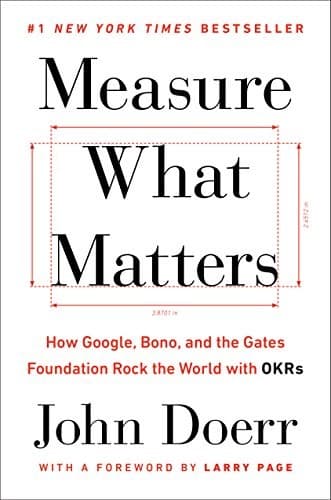
- OKRs are a collaborative goal-setting system for companies, teams, and individuals: Objectives say what you want to achieve, and Key Results say how you will measure success.
- Doerr’s claim is not that goals solve everything, but that when paired with leadership, culture, and judgment, they turn ambition into execution.
- The book’s central case is that well-run OKRs create focus, alignment, tracking, and stretch without becoming a bureaucratic checklist or a substitute for management.
How OKRs Work
- An objective should be significant, concrete, action-oriented, and ideally inspirational; a key result must be specific, time-bound, aggressive yet realistic, and measurable.
- A key result is not a key result unless it has a number, and once the KRs are achieved, the objective is achieved.
- OKRs are meant to be visible, often public, and usually brief; writing them down makes them real and forces tradeoffs.
- Doerr explicitly warns about the dark side of goals: one-dimensional targets can narrow attention, reduce cooperation, invite cheating, and miss critical dimensions like safety or quality.
- His answer is not to abandon goals, but to pair measures with “effect and counter-effect,” so quantity targets do not crush quality, safety, or integrity.
- A healthy OKR system usually uses only three to five objectives per cycle, because too many blur priorities and weaken focus.
- OKRs should evolve during the quarter; teams should be willing to continue, update, start, or stop goals as conditions change.
- They are designed to be separate from compensation, since tying them to bonuses encourages sandbagging, risk aversion, and defensiveness.
What the Book Argues Through Its Cases
- Andy Grove is presented as the intellectual father of OKRs at Intel: goals were public, quarterly or monthly, partly bottom-up, mostly uncoupled from pay, and meant to reward execution rather than hierarchy.
- Intel’s Operation Crush shows the model at work: Intel responded to Motorola’s threat with a rapid company-wide counteroffensive, translating a blunt rallying cry into measurable objectives and key results.
- The key lesson from Crush is that a large organization can change strategy fast when priorities are explicit, visible, and tightly owned.
- Google adopted OKRs because they fit an open, data-driven culture and gave structure to a company that wanted to “think big” while staying nimble.
- At Google, OKRs were public, short, regularly reviewed, and graded; the company normalized “good fails” and treated stretch goals as a feature, not a bug.
- Stretch goals are meant to push beyond comfort, with Google often accepting about 70% attainment for aspirational goals and expecting some to fail.
- Sundar Pichai’s Chrome example shows stretch as “starting over”: the goal was to build a next-generation client platform for web apps, not merely improve an existing browser.
- Chrome’s 20 million seven-day active-user target forced rethinking, distribution deals, offline marketing, and repeated resets upward, even after early misses.
- Chrome’s story also shows that stretch targets can reveal hidden capacity; small changes, not one heroic leap, often produce the final jump.
- YouTube’s shift to watch time shows a key theme of the book: the right metric may be controversial, but once found it can align product, creators, ads, and user satisfaction.
- The one-billion-hour daily watch-time goal was framed as a 10x leap, backed by quarterly and annual OKRs, public tracking, and dozens or hundreds of small improvements.
- The Gates Foundation case shows OKRs can scale to a mission-driven organization: they force hard choices, make tradeoffs explicit, and use metrics like DALYs to compare impact.
- Bono and the ONE Campaign demonstrate that OKRs can also support culture change, not just execution, by making activism, accountability, and organizational “red” visible rather than hidden.
Alignment, Tracking, and Culture
- Alignment comes from transparency: public OKRs let people see dependencies, duplicate work, and where help is needed.
- Doerr argues against rigid cascading, since it can reduce agility and horizontal coordination; he prefers a more market-like model where teams can see top priorities and converge organically.
- Bottom-up OKRs matter because innovation often comes from the trenches, and contributors should own the “how” even when the “what” is aligned.
- Several examples show alignment at scale: Remind narrowed from vague ambitions to quantitative engagement goals, MyFitnessPal learned to surface dependencies across product, marketing, and engineering, and Intuit used OKRs to connect a flat, global IT organization to cloud transformation.
- Tracking means OKRs are living commitments, not spreadsheet artifacts; “zombie OKRs” are a failure mode when goals are never revisited.
- Weekly check-ins, one-on-ones, and visible status updates help teams rescue at-risk KRs and keep work tied to current reality.
- Doerr’s review process includes scoring, self-assessment, and reflection; numbers matter, but context matters too, because a mediocre score can still conceal excellent work or a poorly designed target.
- The book argues that CFRs—Conversations, Feedback, Recognition—provide the human layer that annual reviews often fail to deliver.
- Annual reviews are criticized as costly and low-value, while frequent, specific feedback and recognition are treated as performance tools in their own right.
- Culture is not decorative; Google’s Project Aristotle is used to argue that structure, psychological safety, dependability, meaning, and impact are what make teams work.
- Organizations like Lumeris and Adobe show that OKRs and continuous performance management require trust, executive buy-in, and sometimes cultural reset before they can function honestly.
What To Take Away
- OKRs are a management system for making ambition measurable, not a magic solution and not a substitute for leadership.
- The book’s strongest warning is that goals can do damage when they are one-dimensional, privately owned, or tied too tightly to rewards.
- The recurring pattern across Google, Intel, YouTube, Gates, and others is that disciplined measurement can enable boldness rather than kill it.
- Doerr’s bottom line is to aim high, measure honestly, keep the system visible, and treat failure as data for the next cycle.
Generated with GPT-5.4 Mini · prompt 2026-05-11-v6