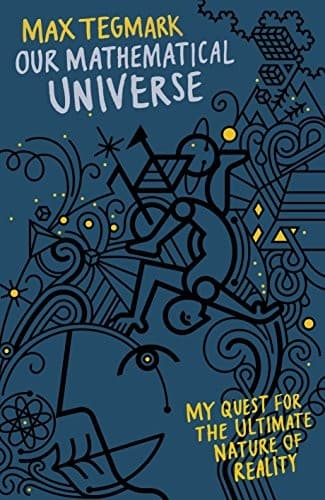
Core Idea
- Reality is fundamentally mathematical—the universe isn't described by math, it is math
- We live in a multiverse where parallel universes with different physics coexist; your observations are one branch among infinite possibilities
- Quantum mechanics describes superposition (multiple states simultaneously), not randomness—accept this as real rather than seeking intuitive explanations
What You're Actually Observing
- Your consciousness experiences discrete observer moments (snapshots of awareness), not continuous flow—your sense of time is your brain's internal model
- You never observe reality directly; you observe your brain's reconstruction of it—question what you assume you "know" firsthand
- Your unified sense of "self" is a useful illusion (a quale), not a fundamental feature of the universe
Cosmological Reality Check
- Observable universe is ~14 billion light-years across but likely infinite; expansion continues accelerating
- Fine-tuned constants (dark energy density, particle masses) are "too perfect" to be accident—strong evidence for Level II multiverse with varying physical laws
- Dark matter (27%) and dark energy (70%) remain unexplained; ordinary matter is only 4% of the universe
Decision-Making Framework
- Use Strong Self-Sampling Assumption: expect yourself to be a typical observer among all conscious beings—apply this to probabilistic reasoning about your future
- Define your reference class precisely before making predictions; avoid comparing yourself to "all atoms" or other meaningless groups
- Your choices don't just affect outcomes—in a multiverse, they determine which branches you experience; act accordingly
Practical Next Steps
- Start with conceptual books (Greene, deGrasse Tyson, Deutsch) before tackling technical papers; use difficulty markers as guides
- Access primary sources: visit http://space.mit.edu/home/tegmark/technical.html for peer-reviewed papers cited in the book
- Organize learning by topic cluster (cosmology -> inflation -> multiverses) rather than linear reading for better retention
- Identify knowledge gaps using the book's index—authors cited frequently (Guth, Linde, Vilenkin, Everett) signal core concepts worth studying
- Question fine-tuning coincidences in your worldview: extreme parameter precision in nature is evidence for multiverses, not luck
Generated with Claude Sonnet 4.6 · prompt legacy-pre-v6 · model inferred from repository history