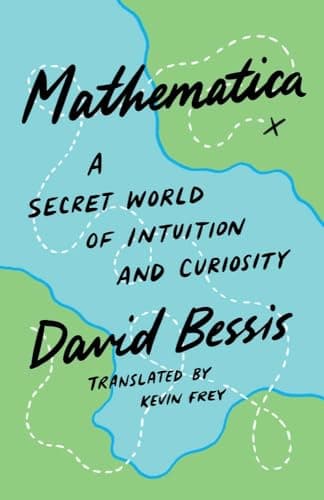
Core Idea
- Mathematics is not mainly a matter of pure logic; it is a human activity of imagination, perception, and bodily training.
- Bessis argues that “secret math”—the intuitive, internal, often visual side of mathematics—is the real source of understanding, while textbook math is only its formal public trace.
- People usually struggle with math not because they lack a special gift, but because they were never taught the hidden mental actions that let intuition develop.
How Mathematical Thinking Works
- Bessis rejects the idea that people are naturally split into “numbers” versus “geometry” types, or that great mathematicians have fundamentally different brains.
- He says logic does not generate thinking; it checks and corrects it, showing where intuition has gone wrong.
- Real mathematical understanding begins with forming mental images of objects like circles, numbers, vectors, knots, or spaces, then manipulating those images until they become clear.
- He treats learning math as analogous to learning a physical skill like walking, riding a bike, using a spoon, or doing the Fosbury flop: you must acquire specific unseen actions, not just descriptions of them.
- Intuition is not fixed; it is a biological capacity that can be trained, strengthened, and reprogrammed through repeated exposure, attention, and correction.
- Bessis adds System 3 to the usual System 1/System 2 distinction: System 1 is immediate image-making, System 2 is explicit rule-following, and System 3 is the slow reflective dialogue that updates intuition over time.
- On this view, learning math means updating System 1 through System 3, not suppressing intuition in favor of cold deduction.
- Errors are central because they reveal the mismatch between current intuition and reality, so dissonance is a productive signal rather than a failure.
Language, Formalism, and the Transmission of Intuition
- Bessis argues that ordinary language and mathematical language are different systems with different limitations.
- Natural language is vague and circular, while mathematics developed logical formalism to speak precisely about invisible objects.
- Formalism is not the essence of mathematics; it is a tool for transmitting, checking, and stabilizing intuition.
- He uses examples like dictionaries and the word “elephant” to show that many things are recognizable without being definable with complete rigor in ordinary language.
- A math book should not be read like a novel; it should be approached desire-first, with attention to the thoughts and intuitions “between the lines.”
- He admires mathematicians like Bill Thurston for treating text as a guide to understanding rather than mistaking the text for the understanding itself.
- Mathematical writing is a lossy transcription of living intuition: symbols preserve what can be checked, but they always compress what is obvious in the mind.
- The hard part of math is often not abstraction itself, but building a usable internal image of the abstract object.
Examples, Witnesses, and Limits
- The ball-and-bat puzzle is used to argue that some answers can be immediately seen once the right internal image is available, so the task is to train intuition rather than distrust it.
- The sum from 1 to 100 becomes a geometric image, such as a triangle of cubes or two mirrored triangles forming a rectangle, showing how arithmetic can be made visible.
- The childhood shape-sorting toy illustrates that mathematical concepts are invented through action and manipulation, not merely explained verbally.
- High-dimensional geometry shows that the problem is often visualization and image-building, not abstraction as such.
- Knot theory illustrates the gap between feeling and proof: one may sense that a trefoil differs from an unknot, but proof provides certainty through invariant reasoning.
- Kepler’s conjecture and sphere packing show that easy-to-state problems can demand huge amounts of formal work and even computation, as in Tom Hales’s proof.
- Cantor’s infinity and Ramanujan’s formulas show mathematics making once-unthinkable ideas concrete and durable.
- Einstein is presented as evidence that great mathematical insight does not require supernatural talent, only curiosity and disciplined means.
- Descartes appears as a witness to introspective clarification and method, not as a cold rationalist stereotype.
- Grothendieck represents the most radical version of the book’s view: mathematical creation involves listening, writing, welcoming error, and preserving childlike innocence.
- Thurston, Deligne, and Serre show that strong mathematical culture depends on clarity, simple questions, and comfort with admitting confusion.
- Ramanujan demonstrates that intuition can produce deep truths before formal proof exists, but Bessis resists treating this as mystical.
- Ted Kaczynski is the warning case: the drive for system and truth can become paranoia if detached from humility, reality, and social correction.
What To Take Away
- Mathematics is best understood as a training of perception, not just a school subject or formal language.
- Intuition and rigor are collaborators: intuition supplies the raw insight, and rigor tests and sharpens it.
- The biggest obstacles to learning are often fear, shame, and the refusal to look wrong, not lack of talent.
- The deepest mathematical skill is the ability to make the abstract feel concrete until it becomes obvious.
Generated with GPT-5.4 Mini · prompt 2026-05-11-v6