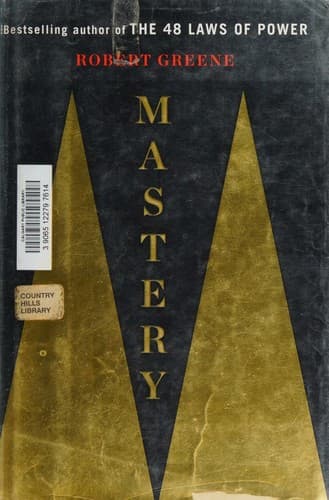
Core Idea
- Mastery is a long-term path of continual learning, not a finish line, and it is available to anyone willing to stay with the process.
- Modern culture is a “prodigious conspiracy against mastery” because it trains people to expect instant results, constant peaks, and quick fixes.
- The central challenge is not achieving one climax, but learning to love the plateau: steady practice, repetition, and patience without attachment to immediate payoff.
The Mastery Curve, Practice, and the Learner’s Mind
- Leonard’s key model is the mastery curve: brief spurts of progress are followed by long plateaus where learning consolidates.
- He distinguishes three anti-mastery types: the Dabbler loves beginnings and quits at the plateau, the Obsessive pushes for fast results and burns out, and the Hacker settles for mediocrity by skipping stages.
- He argues that progress happens by reprogramming habits until effort and attention “click” into automatic skill, then withdraw.
- The real discipline is to stay on the mat, because practice itself becomes the durable source of satisfaction.
- Leonard’s aikido experience is his main laboratory: the mat reveals circumvention, overreaching, and the impossibility of quick fixes.
- Masters often enjoy routine rather than novelty; Leonard points to aikido practice, Steve Largent’s extra drills, Larry Bird’s relentless repetitions, and artists who love the work itself.
- A master’s face, in Leonard’s view, tends to look relaxed and serene, not strained.
Instruction, Surrender, Intentionality, and the Edge
- Leonard says self-teaching is chancy; the best instruction usually comes from a master teacher, though books, tapes, simulators, and friends can help.
- Good teachers are not just credentialed; you judge them by their students, by how they work with beginners, and by whether they use humiliation or only elite performers.
- He contrasts his own wartime flight instruction, where he excelled with talented cadets but alienated slower students, with later aikido teaching, where beginners revealed the art’s structure more clearly.
- Surrender means yielding to teacher and discipline, and sometimes surrendering hard-won competence in order to move to a higher level.
- The image of the cup and quart captures this: a smaller competence may have to be emptied before a larger one can be received.
- Leonard uses the phrase “mind and heart of the beginning” to argue that experts should keep beginnerhood alive at every stage.
- Intentionality—visualization, mental rehearsal, imagery, and attitude—is treated as a real force in performance, not just a motivational add-on.
- He cites Jack Nicklaus, runners, bodybuilders, karate practice, and VMBR (visual-motor behavior rehearsal) to show that images can measurably improve skill and reduce anxiety.
- In aikido, vivid inner images can make a technique like nikkyo more effective than brute force.
- Leonard’s philosophy is that mental structures are real and powerful; the universe looks to him more like a great thought than a great machine.
- Mastery also requires living at the edge: balancing fundamentals and repetition with risk, challenge, and climactic tests.
- He uses Chuck Yeager as an example of someone who honors the plateau while still exploring the envelope, and Julie Moss’s Ironman finish as both heroic and dangerously overreaching.
Obstacles, Energy, and Making Life a Practice
- Homeostasis explains why resolutions fail: individuals, families, organizations, and cultures resist change and tend to snap back to equilibrium.
- Positive change can feel threatening, so Leonard recommends understanding resistance, negotiating with it, building support, and keeping a regular practice.
- He argues that energy is generated by use, not hoarding; people wear out from lack of use more than from effort.
- Children are naturally energetic, but adults and schools often suppress that energy by teaching passivity and over-restraint.
- Leonard’s energy principles include physical fitness, realistic positivity, truth-telling, honoring but not indulging the shadow, setting priorities, making commitments, and staying on the path.
- He warns that denial drains energy, while facing reality and moving on releases it.
- He sees truth-telling in organizations as energizing because it cuts deception and waste.
- He includes thirteen pitfalls that derail mastery, including conflicting lifestyles, goal obsession, poor instruction, overcompetitiveness, laziness, injuries, drugs, prizes and medals, vanity, dead seriousness, inconsistency, and perfectionism.
- He is especially critical of prizes and medals as external rewards that can slow learning, and of perfectionism, because mastery is an ongoing process of trying, failing, and trying again.
- In the final chapters, he broadens mastery beyond formal skill: washing dishes, driving, vacuuming, relationships, and intimacy can all become disciplined practice if done with full awareness.
- Ordinary life is not “in between” higher moments; Zen-like attention can turn commonplace acts into high art.
Foolishness, Beginnerhood, and What the Path Ultimately Means
- Leonard opens the epilogue with a man asking, “How can I be a learner?” and answers, to be a learner you must be willing to be a fool.
- “Fool” is recast positively through the medieval fool, the tarot Fool, and the symbol of zero: emptiness is the fertile condition from which learning begins.
- The cup must be empty for something new to enter, and adults often lose that openness because they fear looking silly.
- He uses toddler speech development to show that learning requires tolerated mistakes, babbling, and successive approximations rather than punitive correction.
- He links this to Maslow’s “second naivete” and Montagu’s neoteny, arguing that genius often includes a childlike or youthful freedom.
- Jigoro Kano’s request to be buried in his white belt becomes Leonard’s emblem for lifelong beginnerhood.
- Even mastery, for Leonard, means repeatedly returning to the stance of the newest student: eager, empty, and willing to risk foolishness.
What To Take Away
- Mastery is a path, not an outcome; the plateau is the normal place where skill deepens.
- Beginnerhood is not a phase to outgrow but a mindset to preserve, because openness matters more than certainty.
- Practice, instruction, surrender, and intentionality are the book’s core mechanisms for sustained growth.
- The deepest promise of mastery is not status or trophies, but a way of living that turns learning itself into fulfillment.
Generated with GPT-5.4 Mini · prompt 2026-05-11-v6