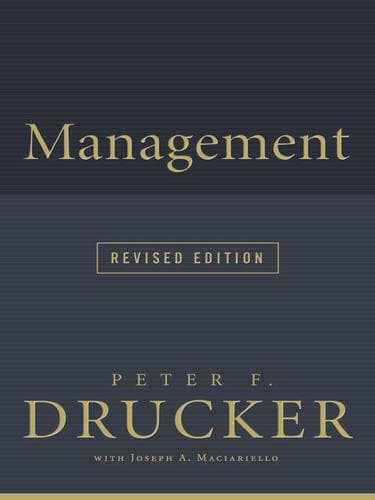
Core Idea
- Management is not a business technique but the organ of any organization that turns human knowledge and effort into results.
- Its central task is to make knowledge workers productive, keep the enterprise outward-facing, and balance economic, human, and social responsibilities.
- Drucker rejects “one right” answers in organization, people management, and structure; management is a practice of fit, judgment, and performance, not a science of universal formulas.
Drucker’s Big Framework
- The book rests on the theory of the business: mission, assumptions, core competencies, customers and noncustomers, and the results the organization is meant to produce.
- That theory must be constantly tested against reality, because when assumptions no longer fit, leaders must abandon obsolete products, processes, and customers and reallocate resources.
- The enterprise should be seen as a system of interrelated elements; optimizing one part while neglecting the whole destroys performance.
- Drucker’s view of management centers on the Spirit of Performance: integrity, results, strengths, responsibility to stakeholders, and contribution to the common good.
- He insists that management exists for outside results; internal efficiency matters only insofar as it serves customers, users, patients, citizens, or other beneficiaries.
- The discipline has three responsibilities: institutional performance, making work productive and workers achieving, and managing social impacts without knowingly doing harm.
What Management Actually Does
- Drucker reduces management’s core tasks to setting objectives, organizing, motivating/communicating, measuring, and developing people.
- Management by Objectives (MBO) begins with the theory of the business and aims at teamwork, self-control, and clear performance expectations rather than command from above.
- Organization should minimize unnecessary layers and relationships, place decisions as low as possible, and combine structures only when the contribution is the same.
- He rejects the idea of a single best structure: a company may need centralized control, local autonomy, functional research, teamwork, alliances, and outsourcing side by side.
- There is no end of hierarchy; every institution needs final authority in a crisis, even when participation is otherwise valuable.
- The real design questions are decision analysis and relation analysis: what decisions are needed, at what level, with whom, and what relationships are crucial.
- Managers are defined by responsibility for enterprise results, not by supervising “the work of others”; upward responsibility is a manager’s first concern.
- Drucker’s recurring warning is that people decisions are the true controls of an organization: placement, promotion, demotion, and firing reveal actual values more than reports do.
Knowledge Work, People, and Control
- The modern corporation is built around knowledge workers, whose knowledge is portable, specialized, and often greater than the boss’s in their area.
- Knowledge workers cannot be managed by bribery alone; they respond to mission, challenge, respect, learning, and decision authority in their domain.
- They should be treated more like associates or volunteers than subordinates, with clear objectives and accountability but substantial autonomy.
- Managing people therefore becomes closer to marketing: starting from what the other person values, can do, and considers a result.
- Drucker’s self-management questions are: Who am I? What are my strengths? How do I perform? What are my values? Where do I belong? What is my contribution?
- Feedback analysis is his main tool for self-knowledge: write expectations down, compare them with results months later, and use the gap to identify strengths, weaknesses, and “no-strength” areas.
- He stresses that performance style is individual and stable: some people are readers, some listeners, some learn by writing, talking, taking notes, or doing.
- Manners matter because they are the “lubricating oil” of organizations; courtesy reduces friction and makes collaboration possible.
- Controls are not neutral measurements; they express values and must be economical, meaningful, appropriate, congruent, timely, simple, and operational.
- The best controls focus on results outside the business, not just internal activity, and they should support self-control rather than domination.
- Budgeting is more than finance: it allocates resources, integrates units, supports zero-based review, and can expose obsolete activities through systematic abandonment.
- For long projects, Drucker emphasizes life-cycle costing, milestone budgeting, and planning tools such as Gantt charts, critical path, and PERT.
Innovation, Nonprofits, and the Changing Corporation
- Systematic innovation is a disciplined search for opportunities, not flashes of genius; Drucker identifies seven sources: unexpected successes/failures, incongruities, process needs, industry/market structure changes, demographics, changes in meaning/perception, and new knowledge.
- Innovation requires piloting, because truly new ideas cannot be validated by conventional market research and rarely work perfectly the first time.
- Nonprofits often demonstrate management better than business, especially in mission clarity, board accountability, and motivating unpaid staff.
- Their power comes from concrete missions that define results outside the organization; good intentions are not enough, and mission prevents splintering limited resources.
- Drucker uses examples such as the Salvation Army, Willow Creek Community Church, the American Heart Association, and the Girl Scouts to show volunteers can be managed as serious, trained, accountable performers.
- He argues the future corporation will be more like a web of partnerships, joint ventures, affiliates, and outsourcing arrangements than a self-contained hierarchy.
- Demographic change, globalization, information technology, and falling communication costs are pushing organizations toward disintegration, multiple organizational forms, and new people policies.
- The corporation’s legitimacy will depend not only on profitability but on being a desirable employer and a responsible social institution.
- Drucker’s final stance is sober: management must become a change leader, because the real future will be shaped less by stable systems than by unexpected shifts, new institutions, and the continual need to rethink what work, organization, and results mean.
What To Take Away
- Management is the practice of making human knowledge productive, not a theory of how to control people.
- There is no universal blueprint: effective organizations require multiple structures, clear authority, and constant re-examination of assumptions.
- The hardest work of management is people judgment—placing, developing, and removing people in ways that serve the enterprise.
- The deepest challenge in the next society is managing knowledge, change, and legitimacy at the same time.
Generated with GPT-5.4 Mini · prompt 2026-05-11-v6