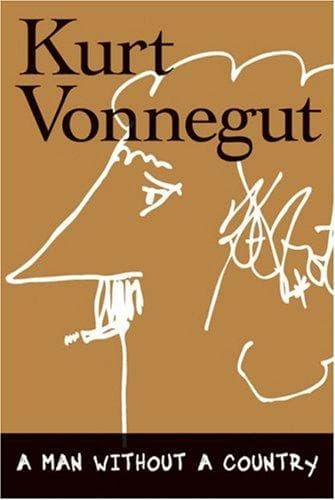
Core Idea
- Vonnegut writes as an aging American humanist who has lost faith in his country’s leaders and institutions but not in decency, music, libraries, or ordinary kindness.
- His central warning is that human beings are making the planet unlivable through war, fossil fuels, greed, and denial while pretending to be rational and civilized.
- He uses memoir, polemic, and humor to insist that truth matters more than patriotic performance, and that laughter is a survival tool until reality becomes too severe.
America, Power, and Moral Failure
- He says the United States has become a nation run by “guessers”: educated people who ignore evidence and act with destructive certainty.
- He distrusts modern power as dominated by psychopathic personalities (PPs)—smart, polished people without consciences who thrive in business and government.
- The Bush administration appears to him as a kind of “Keystone Cops-style coup d’état” enabled by media passivity and contempt for facts.
- He argues that America behaves like an imperial power that dehumanizes others by religion, race, class, and nationality while calling it freedom or security.
- He is sharply skeptical of official religion when it is used to justify cruelty, especially when people invoke the Ten Commandments but ignore the Sermon on the Mount.
- His political and moral heroes are humane dissenters such as Abraham Lincoln, Mark Twain, Eugene Debs, Carl Sandburg, Powers Hapgood, and librarians who preserve banned books and honest records.
Stories, Art, and How to Tell the Truth
- He argues that laughter often comes from fear, frustration, or catastrophe, so comedy can be a way of touching pain without being destroyed by it.
- He says there are subjects that should not be joked about, including Auschwitz, Kennedy’s death, and Martin Luther King’s death, though otherwise almost anything can be approached comically.
- His writing lesson is that stories often move along a G-I axis of good fortune and ill fortune and a B-E axis of beginning and entropy.
- He uses “Man in Hole,” “Boy Meets Girl,” “Cinderella,” and “Kafka” to show the main shapes stories take: trouble and recovery, luck and loss, or a downward slide toward disorder.
- He treats Hamlet as a masterpiece because Shakespeare refuses false certainty about the ghost, the meaning of events, or what happens after death.
- He argues that novels should not omit technology, just as Victorian fiction misrepresented life by omitting sex.
- He resists being boxed into science fiction, saying that label stuck largely because he wrote about Schenectady, General Electric, and industrial life.
- For him, art is a humanizing practice rather than a career: sing, dance, tell stories, write poems, and make something even if it is imperfect.
Humanism, Family, War, and Collapse
- Vonnegut defines himself as a free-thinker who tries to act decently without expecting rewards or punishments after death.
- He prefers the Sermon on the Mount to doctrine because mercy and pity are enough reason to admire Jesus.
- He presents himself as shaped by artists, technologists, and socialists, which helps explain his respect for both imagination and practical intelligence.
- He defends socialism as a humane ideal, not as Stalinist repression, and compares its moral aspiration to Christianity’s call to feed and protect people.
- He identifies as a “freshwater person” from the Great Lakes world, associated with practicality, social reform, and distrust of oceanic glamour.
- He argues that extended families matter because people need many people, not just a spouse and children, to survive emotionally.
- The Ibo in Nigeria and the Kennedys serve as examples of extended family life and its social strength.
- He describes German-American prosperity in the Midwest as rooted in immigrant grit, money, and institutions, not simple assimilation.
- He calls himself a Luddite insofar as he distrusts machinery and systems that replace human becoming, especially computers and nuclear weapons.
- He mourns the loss of tactile, local habits like typing, mailing manuscripts, talking to postal clerks, and ordinary errands, and says electronic communities build nothing.
- Dresden is central to his moral imagination: he calls its bombing a British atrocity that killed about 135,000 people, and says Mary O’Hare helped him see soldiers as “babies,” not heroes.
- He treats war as unspeakable and criticizes the recurring American habit of justifying expansion and violence in places like Mexico, the Philippines, Vietnam, and Iraq.
- He sees fossil fuels as humanity’s deepest addiction: “We are all addicts of fossil fuels in a state of denial.”
- Industrial civilization, in his view, is close to collapse because it has consumed air, water, and energy as if there were no tomorrow.
- He groups autos, planes, electricity, weapons, fossil fuels, and atomic energy into the same dangerous system of modern power and destruction.
What To Take Away
- Vonnegut’s deepest claim is that kindness, truth, and community matter more than status, ideology, or economic growth.
- His recurring enemies are war, greed, technocratic confidence, and leaders who ignore evidence while pretending to know what they are doing.
- He treats humor as a form of resistance, but his final note is grave: age and grief make jokes less sufficient, yet moments of simple joy still deserve notice.
- The book’s lasting message is captured in his wish to recognize ordinary goodness and say, “If this isn’t nice, I don’t know what is.”
Generated with GPT-5.4 Mini · prompt 2026-05-11-v6