Core Idea
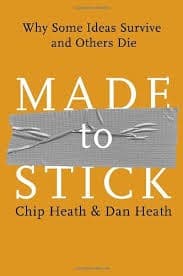
- Sticky ideas are those that are understood, remembered, and capable of changing beliefs or behavior.
- The book argues that stickiness is not mainly a gift of charisma or luck; it can be designed by using the SUCCESs principles: Simple, Unexpected, Concrete, Credible, Emotional, Stories.
- The central enemy is the Curse of Knowledge: once we know something, we forget what it was like not to know it and make our messages too abstract, dense, or obvious to ourselves.
How Sticky Ideas Work
- Simple means finding the core of an idea and stripping away everything else, not dumbing it down.
- Effective simplicity is often a compact principle or Commander’s Intent that guides action when details fail, as with “We are THE low-fare airline” at Southwest.
- A simple idea often works like a proverb or a strong analogy: it hooks into an existing schema in the listener’s mind, as in “Die Hard on a bus” or “Jaws on a spaceship.”
- Unexpectedness grabs attention by violating expectations, but it must be post-dictable—the surprise should make sense afterward rather than feel like a gimmick.
- Good surprise identifies a gap in what people expect and then resolves it, as in the Enclave crash ad, Nordstrom’s service anecdotes, or the “There will be no school next Thursday” lead.
- Concrete language beats abstraction because people remember and act on sensory, specific details better than on generalities.
- Concrete thinking helps novices learn, helps large groups coordinate, and gives abstract ideas a form people can picture, as with Mount Hamilton Wilderness, Saddleback Sam, or the maroon leather portfolio in a venture-capital pitch.
- The authors repeatedly show that concrete examples create more retrieval hooks in memory and are easier to operationalize than abstract goals like “maximize shareholder value.”
- Credibility can come from authority, but also from the message’s own internal logic, from lived experience, or from a claim the audience can verify for itself.
- The book favors testable credentials and vivid proof, such as Wendy’s “Where’s the beef?”, Reagan’s “Are you better off now…?”, or the Sinatra Test—one strong example that establishes the claim.
- Statistics are most persuasive when they show a relationship or scale in human terms, not when they stand alone; concrete comparisons make large numbers feel real without losing accuracy.
- Emotional stickiness often comes from making people care through identity, empathy, self-interest, or values, not just through facts.
- Emotional framing can be built from association, as in “Don’t Mess with Texas,” the Truth anti-smoking campaign, or Honoring the Game replacing the fuzzier “sportsmanship.”
- Stories matter because they do two jobs at once: they simulate action and they inspire action.
Evidence, Templates, and Story
- The book’s evidence ranges from urban legends to ads, classrooms, organizations, and public campaigns, all used to show the same pattern: clarity plus psychological force beats raw information.
- A recurring claim is that many good ideas are spotted in the world and then adapted, rather than invented from scratch.
- For inspiring stories, the authors identify three core plots: Challenge, Connection, and Creativity.
- Challenge stories show a protagonist overcoming a daunting obstacle, as in Jared/Subway, Rosa Parks, or Seabiscuit.
- Connection stories bridge a social divide, like the Good Samaritan.
- Creativity stories show inventive problem-solving, like the Ingersoll-Rand Drag Test or the World Bank’s knowledge-management springboard story.
- Stories are powerful because they let listeners mentally rehearse action; the neonatal ICU story and the Xerox repair story both create new schemas for future decisions.
- Mental practice research in the book supports this: simulating a process improves performance, and even a brief story can function like a flight simulator for the brain.
- Springboard stories are especially useful in organizations because they do not just explain a point; they trigger people to solve the problem for themselves.
- The book’s closing applications to strategy and teaching insist that ideas must change behavior, not merely sound sophisticated.
- Strategic language works when it gives employees a shared picture they can act on, whether that is CHIFF at Cranium, a vivid customer persona at Trader Joe’s, or a concrete promise like FedEx’s Purple Promise.
- In teaching, all six SUCCESs principles can be used deliberately: simple core, curiosity gaps, concrete examples, credible demonstrations, emotional engagement, and stories.
What To Take Away
- Make the core visible first; if people cannot say what your idea is in one sentence, they cannot reliably repeat or use it.
- Replace abstraction with specific people, actions, objects, and comparisons whenever the audience needs to remember, judge, or act.
- Use surprise to open attention, but always repair the surprise with a meaningful insight rather than a clever trick.
- When fighting false but sticky ideas, do not merely deny them; answer with a stickier competing idea that is equally concrete, credible, emotional, and memorable.
Generated with GPT-5.4 Mini · prompt 2026-05-11-v6