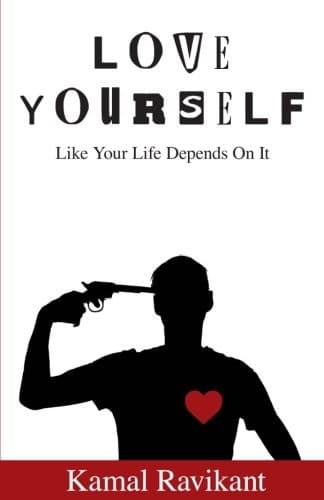
Core Idea
- Self-love is the central practice, and Ravikant treats it as something you do daily, not a mood, slogan, or one-time realization.
- The book’s claim is that when you genuinely love yourself, your mind, body, relationships, and choices change in ways that feel almost “magical.”
- The practice is framed as urgent: if life is fragile and short, then learning to love yourself becomes the way to live fully.
The Vow and the Main Method
- The whole system begins with The Vow: “I vow to myself to love myself. I LOVE MYSELF.”
- Ravikant says the vow worked because it was absolute, with no middle ground; he had to go all in rather than treat it as a nice idea.
- The first tool is the mental loop: repeat “I love myself” constantly until it becomes the mind’s default groove and anchor.
- He insists repetition matters because thoughts are often just inherited loops; a new loop, practiced with feeling, can outgrow the old one.
- He prefers love over like or accept because love reaches the subconscious more deeply and carries a built-in sense of healing and nurture.
- He describes a window metaphor: negative thoughts are not fought directly; instead, you “clean the window” so light can enter.
- The practice is meant to be simple but demanding: it only works if it is repeated long enough to become embodied rather than intellectual.
The Four Tools and How They Work
- Ravikant organizes the practice around four tools: mental loop, meditation, mirror, and one question.
- In meditation, he recommends seven minutes with soothing music, back against a wall, inhaling “I love myself,” and letting whatever arises pass without judgment.
- The point of meditation is not mental force but allowing the subconscious to do the healing work while attention stays gentle and anchored.
- The mirror practice means standing close, looking into your eyes, and saying “I love myself” even when it feels false at first.
- He says the mirror matters because it makes self-love physical and visceral instead of abstract or image-based.
- The one question is some version of: “If I loved myself truly and deeply, would I let myself experience this?” or “What would I do?”
- That question is meant to interrupt automatic reaction and restore choice, especially in conflict, fear, or decision-making.
- A recurring instruction is to choose a line in the sand—for him, at minimum, daily meditation—so the practice survives bad days and moments of slackening.
Forgiveness, Fear, and Returning to the Present
- Before the vow can be clean, Ravikant says you must forgive yourself by writing down what you blame yourself for, reading it, and destroying the page.
- He uses the same logic with painful memories: do not wrestle them; meet them with self-love until their charge changes.
- He repeatedly reframes fear as something false or unhelpful, drawing on examples like “hallucinated snake,” “not useful,” and “real or not real” to expose fear’s unreality.
- A major lesson from relapse is that the old grooves are deep: if you coast, the mind slides back into its earlier channels.
- In emotional pain, he says the mind often jumps into the future, and the remedy is to return to the present by touching the heart and saying, “I return to this” or “I return to me.”
- He treats abandonment pain as especially childlike: the younger self experiences it as death, so self-soothing is not indulgence but repair.
- Another repeated shift is from “what if” to “what is,” because imagined futures feed suffering while present reality is the only place action can happen.
What Changes When the Practice Is Kept
- Ravikant claims self-love made him calmer, more open, more attractive to others, and less reactive in relationships.
- It also changed how he handled his own history: he recasts himself from victim to hero, not by denying abuse, but by choosing a different identity in the present.
- He extends the practice beyond the current self to the future self, the child self, and even to imagining a Bigger Than Me—Life, God, or the Universe—loving him back.
- He believes rituals hardwire the change: ten breaths on waking and before sleep, self-love pauses during the day, meditation, mirror work, and tracking with a calendar.
- He warns against coasting after progress, because improvement is vulnerable to laziness and ego once life starts working better.
- His later relapse becomes a proof point: after slipping badly, he returned to the practice and felt changed again in under a month, reinforcing his claim that the method still works.
- He ties the inner practice to outer life through the idea that thought, emotion, body, and circumstances are connected; loving thoughts create a different life from fear-based loops.
- He ends by stressing that the work is ongoing: you fall, restart, forgive, and return to self-love again and again.
What To Take Away
- The book’s core proposition is that self-love is a discipline, and Ravikant treats it as the most practical response to fear, shame, grief, and self-sabotage.
- Its main mechanism is not insight alone but repetition plus ritual: vow, loop, meditate, mirror, question, repeat.
- The book’s most distinctive claim is that when you keep returning to self-love, old emotional patterns lose power and life can feel more alive, spacious, and responsive.
- Ravikant’s final message is simple: if you fall off, come back; if life scares you, keep going; if you want to shine, love yourself more.
Generated with GPT-5.4 Mini · prompt 2026-05-11-v6