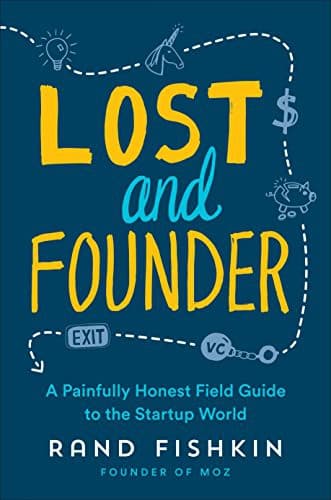
Core Idea
- Fishkin’s central claim is that startup culture is full of myths, survivorship bias, and “model home” storytelling, so founders need cheat codes from people who have actually lived the hard parts.
- He treats startups as a brutal learning game where the real advantage comes from honest self-inquiry, transparency, and behavioral discipline, not fantasy narratives about genius or hustle.
- The book is partly a memoir of Moz and partly a warning: many founder decisions that look bold in retrospect were actually costly mistakes made under pressure, optimism, and outside incentives.
What Startups Really Are
- Fishkin argues that founders are often older, less privileged, and less stereotypically “visionary” than startup mythology suggests; he presents himself as a non-programmer, non-Ivy, non-VC-backed outsider.
- Transparency is a core value for him, and he defines it as deliberately revealing uncomfortable truths, not merely avoiding lies.
- He contrasts real transparency with secrecy around debt, layoffs, and internal problems, arguing that omission causes more harm than early disclosure and empathy.
- Moz’s early consulting business nearly collapsed under bad office decisions, hires, ads, and debt that was personally guaranteed, teaching him that business trouble was also family trouble.
- He argues that services businesses are often underrated: they can start cheaply, survive longer, and sometimes leave founders wealthier than product founders after dilution.
- Moz itself began as consulting, then accidentally became software through content, free tools, and SEO education that attracted demand for a subscription product.
- His lesson for moving from services to product is to let consulting fund product development, build marketing that serves both, and avoid becoming so comfortable with services revenue that product focus dies.
How Startups Grow, Drift, and Break
- Fishkin’s view of founders and CEOs is unsentimental: once a company grows, the founder spends far less time on the craft they love and much more on management, hiring, fundraising, and coordination.
- He describes a recurring CEO problem-solving pattern: identify pain, try fixes, fail repeatedly, find partial relief, absorb side effects, then either compromise or restructure the company to eliminate the burden.
- He warns against romanticizing the pivot; real pivots are usually desperation moves when the original business is already failing.
- He repeatedly shows that initial choices about market, model, and customer matter more than later execution tweaks, because switching costs are high.
- Fishkin’s framework for founders is that startups inherit the founder’s strengths, weaknesses, values, and blind spots as company DNA.
- He uses examples like Amazon, Craigslist, Slack, and inDinero to show how founder traits shape culture, operations, and product direction.
- Founders should map their own expertise honestly across four levels: theoretical knowledge, managerial knowledge, practical experience, and deep teachable expertise.
- He argues that weaknesses can be handled by learning the work, finding cofounders who have the strength, or building enough knowledge to hire and manage well.
- Sarah Bird is his model for technical leadership: ask better questions, learn the domain deeply, empower engineers who can explain tradeoffs, and hire leaders who like to teach.
- Moz’s later management problems showed the danger of making management a reward instead of a skill; high-performing ICs are not automatically good people managers.
- The fix at Moz was a dual-track career path so individual contributors could gain title, pay, and influence without being forced into management.
Growth, Funding, Values, and the Limits of Exit
- Fishkin is skeptical of venture capital unless the company truly fits the power-law model, where a tiny number of outlier wins pay for many failures.
- He says investors are not ordinary partners: their incentives are tied to fund-level returns, not just the company’s welfare or a founder’s preferred outcome.
- Fundraising is portrayed as slow, status-heavy, and power-laden; boards can replace founders, term sheets matter, and founders should understand every clause and trust their investors deeply.
- He stresses that private-company equity is often illiquid and misleading: even a “successful” startup may not make founders or employees rich because of dilution, preferences, and inability to sell.
- Startup labor is therefore often a bad wealth strategy but can still be worthwhile for autonomy, mission, learning, and the chance of a rare major win.
- Fishkin’s TAGFEE values—Transparency, Authenticity, Generosity, Fun, Empathy, and The Exception—are presented as real only if they cost money or convenience.
- He rejects the idea that values can be installed after hiring; instead, companies should hire people already predisposed to them.
- He argues that diversity strengthens, rather than weakens, a values-based culture, and cites Moz’s improvements in inclusion, retention, and product thinking as the company broadened who it hired.
- He distinguishes hacks from real systems: growth hacks can help, but durable growth comes from a marketing flywheel of content, amplification, search, links, social sharing, and repeat visits.
- The best hacks, in his view, reduce friction in the flywheel rather than replace it; Moz’s survey content worked because contributors wanted to share it and it earned links naturally.
- He criticizes the overuse of the MVP mindset for public launches, arguing that weak products can damage a prominent brand.
- His preferred standard is the EVP—an exceptional viable product—for launches that will be judged by a real audience.
- He applies that lesson to Keyword Explorer, which succeeded because he delayed launch until it felt worthy and matched the customer workflow.
Collapse, Recovery, and the Honest Aftermath
- Moz’s worst period came after the company spread into too many products, too many audiences, and too much complexity while growth slowed and spending rose.
- Fishkin says the company made a major error by assuming capital meant it had to spend aggressively to “find growth,” when the real issue was focus and retention.
- The 2016 layoffs were the most painful event in the book, and he says the deepest regret was failing to be transparent earlier about how bad things had become.
- The layoff package became a values test: Fishkin and Sarah Bird pushed for generous severance, even though it cost the company badly.
- He concludes that some of Moz’s decline came from overemphasis on acquisition, dilution of the brand through too many products, organizational sprawl, stronger focused competitors, and underestimating the law of large numbers.
- The deepest throughline of the book is that feelings are not facts and outcomes are not fully controllable; founders should judge themselves by behavior, not by fantasy about results.
- Fishkin’s final “cheat codes” are practical and specific: choose a brand name with room to grow, validate demand with real user interviews and landing pages, document beliefs and biases early, protect psychological safety, and write a transparent roadmap even though it will change.
- The book’s hard-earned bottom line is that startups are rarely heroic epics; they are messy systems where honesty, focus, and self-knowledge matter more than the mythology of disruption.
What To Take Away
- Treat startup advice skeptically when it comes from winners who omit luck, privilege, dilution, and failure.
- Build around your actual strengths, but don’t confuse them with universal truths about what companies need.
- Prefer transparency, empathy, and focus over secrecy, complexity, and performative growth.
- Measure startup success by whether the behavior, values, and business model are durable—not by whether the story sounds inspiring.
Generated with GPT-5.4 Mini · prompt 2026-05-11-v6