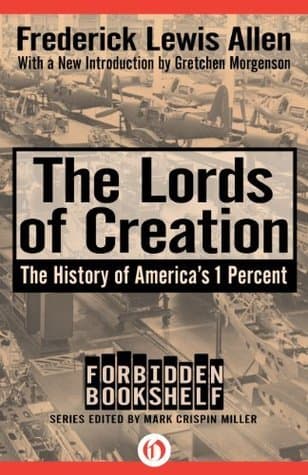
Core Idea
- Allen’s central claim is that modern American capitalism was forged in the era from the 1890s through the 1930s, when corporate consolidation, Wall Street finance, and speculative manias created a new class of economic rulers.
- He treats “the 1 percent” not as a static social category but as a shifting elite whose power came from holding companies, investment banking, pyramiding, interlocking directorates, and control over credit.
- The book is both a business history and a social history: it asks how these men made money, how they justified themselves, how they lived, and how their system produced both remarkable growth and repeated instability.
How the 1 Percent Built Power
- The first great mechanism was the move from competition to combination: trusts, holding companies, and mergers replaced brutal price wars in oil, railroads, steel, and utilities.
- Standard Oil’s rebates, the trust device, and New Jersey’s permissive incorporation laws helped normalize corporate concentration and stock “watering.”
- Promoters and bankers became central figures, assembling combinations, issuing securities, and taking large organizing profits; Wall Street gradually displaced the factory as the command center.
- The iconic breakthrough was U.S. Steel, born from Morgan’s purchase of Carnegie and then assembled into a New Jersey holding company controlling half the nation’s steel output.
- Allen stresses the ambiguity of “watered” capitalization: defenders said monopoly increased earning power and made the higher paper valuation real, while critics argued the gains should have gone to workers or consumers.
- The new corporate order widened the distance between financial controllers and the industrial workers they governed, especially in steel where labor could combine less than capital.
- E. H. Harriman showed a parallel form of power in railroads: operational genius, financial engineering, and aggressive market raids such as the Northern Pacific corner.
- The 1901 Northern Pacific panic and the formation of Northern Securities showed how a speculative struggle among magnates could spill into the entire market and force political resistance.
- Roosevelt’s suit against Northern Securities signaled that organized public opposition to the new combinations had begun.
Speculation, Crisis, and the Banking Elite
- Allen argues that Wall Street’s recurrent crises came from overissuance of securities and from the habit of financing new combinations without adding enough real assets.
- The panic of 1907 was not just a “United Copper” accident but the result of stretched credit, speculative pools, vulnerable trust companies, and a shrinking supply of new buyers.
- In 1907 Morgan became the crisis center of the financial system, personally organizing rescues, directing bankers, and deciding which firms would live or die.
- The episode showed both the strength and the danger of private financial sovereignty: the system could be stabilized, but only by the judgment of a few men operating behind closed doors.
- The panic also pushed the country toward institutional reform, eventually leading to the Federal Reserve, whose purpose was to mobilize reserves and prevent similar breakdowns.
- Allen repeatedly notes that concentration created a class of insiders who could profit from rearranging securities, manipulating affiliates, and controlling access to credit while ordinary investors bore the risk.
- He is careful, however, not to reduce the story to pure villainy: many financiers were sincerely religious, socially respectable, and convinced they were acting within the accepted rules of the game.
Reform, Regulation, and the Long Shift to State Power
- Reform did not begin in 1907; it grew out of Populism, labor unrest, socialist ideas, muckraking, and anti-monopoly agitation already active before the panic.
- Roosevelt, Wilson, and later the New Deal each extended federal authority over finance and industry, but in different ways and with different assumptions.
- Under Wilson, the FTC, Clayton Act, income tax, tariff revision, and the Federal Reserve Act gave the federal government stronger tools against concentration and unfair practices.
- Allen emphasizes that these reforms were real but incomplete: many recommendations from the Pujo era were ignored, and no one fully broke the power of holding-company finance.
- The New Deal marked a larger turn: Roosevelt treated the federal government as responsible for the functioning of the economy itself, not merely for policing abuses.
- Glass-Steagall, the Securities Act, and the 1934 Act tried to end the old securities practices—especially affiliate banking, insider manipulation, and misleading disclosure—but Allen says the reforms remained partial.
- The underlying problem, in his view, was structural: modern business needed perpetual expansion, but debt, speculation, and technological displacement made that expansion increasingly fragile.
What the Financial Elite Looked Like
- Allen’s 1920s elite is more polished and socially integrated than the rougher Morgan-era figures, but also more self-perpetuating and college-educated.
- Their world was organized around clubs, Fifth Avenue, Long Island, yachts, racing, collecting, and philanthropy, with New York society increasingly intertwined with Wall Street wealth.
- They were not all vulgar money men: figures like Otto Kahn supported opera and theater, and many financiers gave real money to colleges, museums, and hospitals.
- Yet Allen sees a persistent moral tension: these men could be cultured, religious, and generous while still profiting from practices that distorted markets, labor, and politics.
- The 1920s bull market was not just popular frenzy; it was an inside-driven boom powered by broker loans, holding companies, investment trusts, corporate treasury speculation, and aggressive securities sales.
- Its collapse exposed how much of modern capitalism depended on leveraged confidence rather than durable value, and how quickly that confidence could evaporate.
What To Take Away
- The book’s lasting argument is that American economic power became increasingly financialized, centralized, and opaque between 1890 and 1933.
- Allen sees no simple villain: the same system produced efficiency, scale, lower prices, and national growth, but also instability, inequality of power, and repeated crashes.
- The key historical change is not just the rise of rich men, but the rise of institutions that let a small group control vast assets with little personal stake.
- The Depression and New Deal closed the era of banker-dominated capitalism, but Allen ends by warning that the next order of American finance is still uncertain.
Generated with GPT-5.4 Mini · prompt 2026-05-11-v6