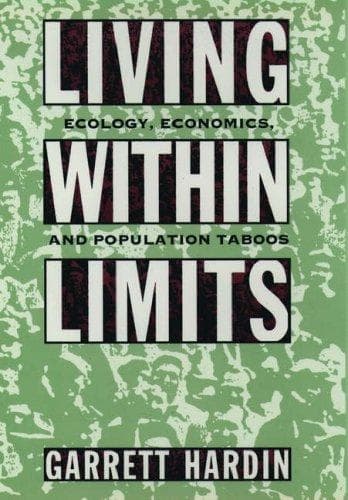
Core Idea
- Hardin’s central claim is that modern civilization keeps evading a simple ecological fact: human demands grow exponentially while Earth’s supplies, sinks, and space are finite.
- He argues that population growth, energy use, pollution, and debt all expose the same mistake—treating limits as if they were temporary inconveniences rather than structural realities.
- The book’s moral and political challenge is not whether society should use coercion, but whether it will design legitimate, mutual coercion early enough to avoid collapse.
The Population Problem and the Taboo Around It
- Hardin says population was increasingly ignored in public environmental debate because of a population taboo, often entangled in the U.S. with abortion politics and wishful thinking.
- He treats population as the master variable behind many environmental failures: if demand rises without bound, no technical fix can permanently restore balance.
- He rejects the idea that overpopulation can be solved by space colonization, calling it numerically absurd, energetically impossible, and politically self-defeating.
- His recurring warning is that any “solution” that depends on the values of the people selected for it will select for its own failure.
- He frames the issue with Malthus and Darwin: any positive reproductive rate, however small, eventually overwhelms a finite world.
- He uses ghost acreage to show that urban life depends on huge unseen land bases; cities never stand alone, even when they appear crowded or empty from the air.
- Population debates are distorted by “information-mutable sciences,” since publishing demographic ideas can change the behavior being studied.
- Hardin says the right unit of analysis is not just population size but growth rate over time, because small percentages become large absolute increases.
- He insists that “nobody ever dies of overpopulation” is a taboo-driven evasion; scarcity, disaster, and deprivation often reflect too many people relative to carrying capacity.
- His policy bottom line is that population control must be tied to sovereignty, because no world state exists to enforce global restraint.
Economics, Ecology, Debt, and the Logic of Limits
- Hardin contrasts economics with ecology: economics tends to count production and exchange, while ecology includes source, production, and sink together.
- He criticizes GNP because it can rise when society spends more on cleanup, illness, and repair, even if the underlying natural capital is being destroyed.
- A key ecological principle is that wealth can only grow by capturing more solar input or using nature more efficiently, not by magical creation.
- He uses the earth’s energy budget to argue that the planet is a zero-sum thermal system over the long run: sunlight enters, heat radiates away, and nothing escapes conservation.
- Debt is the one thing that can grow exponentially without limit in paper terms, which is why usury resembles a kind of financial perpetual motion machine.
- Hardin cites Frederick Soddy, Aristotle, and Oresme to argue that money cannot literally breed money, even if banking makes it look that way.
- He treats banking crises, inflation, taxes, repudiation, and bankruptcy as the real-world mechanisms that eventually curb runaway debt.
- The same logic applies to population: reproduction behaves like compound interest, so unchecked fertility in a finite world creates eventual crisis.
- He distinguishes fecundity from fertility: the issue is not potential reproduction in the abstract, but actual generational increase.
- He repeatedly returns to scale effects and the law of diminishing returns: what works at one size can become destructive at a larger scale.
Altruism, Commons, and the Politics of Shared Costs
- Drawing on Darwin, Hardin argues that pure altruism is unstable because selection favors mutants that avoid its costs; real altruism is always impure or selective.
- He breaks altruism into scopes such as kin altruism, cronyism, tribalism, patriotism, and universalism, each with different costs and loyalties.
- He treats reciprocal altruism as the basis of exchange and money, since money makes obligations transferable and divisible.
- A major political theme is CC-PP: Commonized Costs, Privatized Profits.
- He uses public grazing, farm subsidies, dams, disaster relief, and medicine to show how costs are often pushed onto the public while benefits stay private.
- The “medical commons” is especially important: heroic care can be socially expensive, and low infant mortality is not automatically a sign of social success if it is purchased through open-ended collective costs.
- He sees welfare-state rhetoric and rights-talk as dangerous when they obscure responsibilities, especially in reproduction.
- His preferred principle is “mutual coercion, mutually agreed upon”: democracy already uses coercion, so the issue is how to make it fair and ecologically rational.
- Population policy, in his view, must combine incentives and penalties rather than rely on moral exhortation or crude policing.
- He argues that women’s literacy and liberation are among the most promising fertility-reducing forces, though he stresses this as an ecological rather than sentimental point.
Nuclear Power, Technological Optimism, and the Limits of “Progress”
- Hardin treats nuclear power as the clearest case of modern technocratic overconfidence: the problem is not just generation but waste, decommissioning, liability, and long-term vigilance.
- He argues that there is no away to throw to; dangerous wastes and damaged systems do not disappear, they only move into new, risky forms.
- His critique of fusion is that even if the core reaction is “clean,” the surrounding system still depends on dirty inputs, radioactive materials, and eventual decommissioning.
- He is skeptical of official safety analyses like the Rasmussen report, which he sees as politically packaged, overly optimistic, and unable to handle rare but catastrophic failures.
- Hardin emphasizes the human factor: safe nuclear systems would require a permanent priesthood of vigilant experts, yet human beings are unreliable, bored, and vulnerable to error.
- He uses Three Mile Island and Chernobyl as reminders that unanticipated human failure matters more than elegant models.
- More broadly, he rejects technological fantasies that promise endless expansion while ignoring ecological feedbacks; “progress” often means clearing forests, eroding soils, and moving the damage elsewhere.
- Rachel Carson and Aldo Leopold mark a cultural shift in his telling: from technological optimism to ecological scrutiny, where the world is seen as a place of wounds and unintended consequences.
What To Take Away
- Hardin’s book is a sustained argument that limits are not optional, and that denial of limits drives both ecological damage and social hypocrisy.
- The recurring intellectual tools are scale, conservation, exponential growth, externalities, and carrying capacity.
- His most important political claim is that societies must choose explicit, mutually agreed coercion over invisible coercion through crisis, collapse, and shared ruin.
- His deepest warning is that modern systems often reward short-term optimism and punish ecological realism, even though the latter is what finite worlds ultimately require.
Generated with GPT-5.4 Mini · prompt 2026-05-11-v6