Core Idea
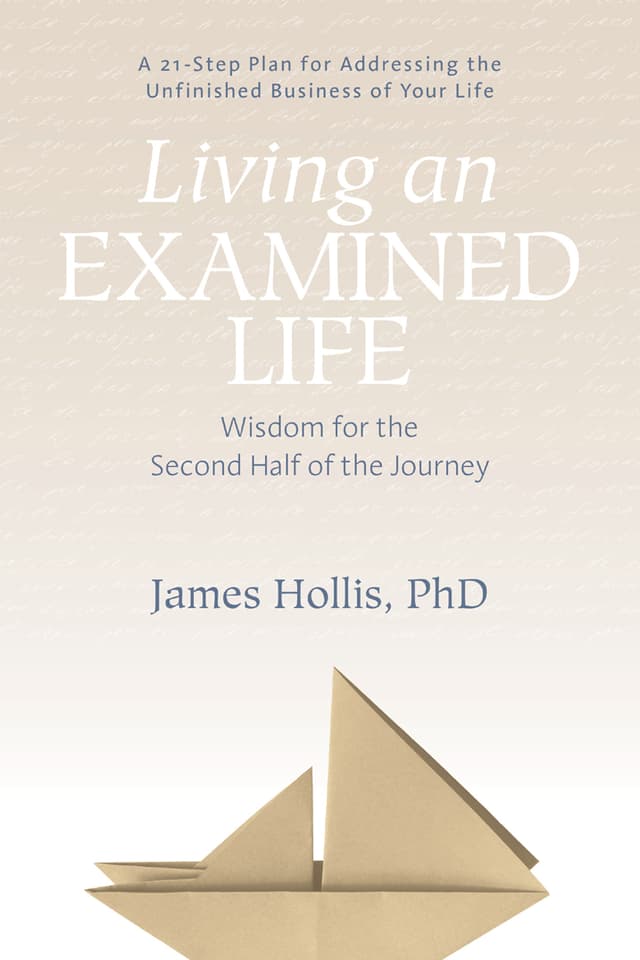
- Hollis argues that an examined life is one in which a person gradually recovers agency, meaning, and self-knowledge from family scripts, cultural conditioning, unconscious complexes, and fear.
- The book is not a self-help manual but a set of 21 desiderata: disciplines for enlarging life, outgrowing rather than “solving” its recurring problems.
- Its central wager is existential and psychological: even with limited freedom, we are responsible for how we live, what we repeat, and whether we answer the soul’s summons.
What Keeps Us Unconscious
- Hollis says we are shaped by family, culture, religion, genetics, history, and the unconscious, so “choice” is always constrained, but never abolished.
- Social norms often masquerade as absolute truth, yet much of what people inherit as “right” is historically constructed and must be discerned rather than obeyed automatically.
- Two recurring forces block adulthood: Fear, which says the world is too big, and Lethargy, which seduces us into comfort, distraction, and numbness.
- We repeat old patterns through projection, transference, and repetition compulsion, carrying earlier wounds into love, work, politics, and authority relationships.
- What looks like a present crisis is often an old template reactivated; Hollis’s repeated question is, “What am I asking of the other that I am not addressing myself?”
- He treats many symptoms and breakdowns as the soul’s protest, asking not only what hurts but what is being resisted, ignored, or unlived.
Becoming Adult, Authoritative, and Responsive to the Soul
- Growing up is not a matter of age or role performance but of psychospiritual independence: showing up despite fear, resentment, and inertia.
- Because modern culture lacks traditional rites of passage, many people remain psychologically adolescent, organized by external approval and internalized authority figures.
- Hollis distinguishes personal authority from compliance: maturity means learning to hear one’s own voice amid the din of parents, institutions, and complexes.
- He repeatedly frames development through Jung’s triad of insight, courage, and endurance.
- A key turning point is recognizing that the ego is not sovereign; dreams, symptoms, and inner images often reveal what consciousness does not want to know.
- He contrasts first adulthood, governed by inherited models, with second adulthood, which begins when crisis, emptiness, or depression forces a deeper accounting.
- Second adulthood involves a kind of death: of the old self-image, the fantasy of being exempt from suffering, and the hope that a perfect choice will eliminate ambiguity.
- Hollis’s preferred test for major choices is simple: Does this enlarge me or diminish me?
- He uses examples like Marcus Aurelius and James Hampton’s private, visionary art to show that fidelity to an inner summons is more important than prestige or public recognition.
- The book’s version of vocation is not grandiosity but showing up as oneself, contributing one’s particular piece to history’s mosaic.
Meaning, Permission, Shadow, and Spiritual Maturity
- Hollis insists that the deepest human need is not happiness but meaning; happiness is transient, while meaning can sustain suffering.
- The soul often speaks through dreams, symptoms, feelings, burnout, and dissatisfaction, especially when a life is too small, too safe, or too inherited.
- Many people remain trapped because they never claim permission to be themselves; permission is usually not given by parents, religion, or culture, but seized inwardly.
- Wounds to self-esteem can either cripple or become the site of resolve and genius; even selfie culture is read as compensation for not feeling seen.
- He argues that a healthy life requires integrating the shadow—the disowned, embarrassing, selfish, cowardly, or contradictory parts of oneself.
- Grace, in Tillich’s sense, means accepting that we are accepted despite being unacceptable; self-forgiveness is part of becoming whole.
- Parenting matters because children inherit not only instruction but the parent’s unlived life; the best parents do not recruit children to repair their own failures.
- Good parenting, for Hollis, means telling children they are here to become themselves, not to live the parent’s life.
- His spirituality is intentionally anti-infantile: he rejects both guilt-based religion, which mirrors parental punishment, and prosperity religion, which flatters wish fulfillment.
- Mature spirituality begins with resonance—whether something truly fits one’s inner reality—and with willingness to live in mystery rather than certainty.
- He treats mystery as the radically other that cannot be owned, privatized, or reduced to dogma; religion becomes pathological when it claims possession of that Mystery.
- Spiritual maturity also requires bearing uncertainty, taking responsibility for one’s life, and letting beliefs be judged by whether they deepen humanity rather than provide easy answers.
What To Take Away
- Much of what feels like fate is actually a collision of history, fear, and unconscious repetition; the task is to become more conscious than one’s conditioning.
- The examined life is measured less by certainty than by whether one is willing to answer the soul’s recurring question and live with its cost.
- Hollis’s recurring standard is enlargement: the right choice is the one that increases aliveness, responsibility, and fidelity to what is deepest.
- The book’s closing note is sober but hopeful: we travel alone in one sense, yet are also accompanied by invisible companions on the road.
Generated with GPT-5.4 Mini · prompt 2026-05-11-v6