Core Idea
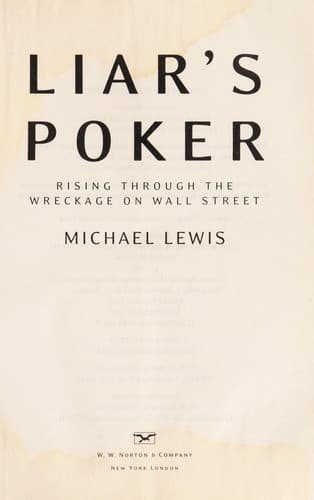
- Liar’s Poker is Michael Lewis’s inside account of Salomon Brothers in the 1980s, where bond trading, salesmanship, and institutional bravado produced extraordinary wealth for young people who often barely understood the business.
- The book’s central contrast is between the glamourless mechanics of bonds and the macho culture that grew around them: who could bluff, dominate, read others, and survive the floor mattered as much as technical skill.
- Lewis shows that Wall Street’s “gold rush” was not just about intelligence or theory; it was about status games, incentives, and a growing disconnect between money, merit, and institutional loyalty.
Salomon’s World: Money, Hierarchy, and the Code of the Floor
- Salomon’s culture is built around the idea that traders and salesmen are the real power center, while everyone else exists to support them.
- The title game, Liar’s Poker, becomes Lewis’s shorthand for bond trading: both depend on statistical judgment, bluffing, and reading the other side’s weakness while hiding your own fear.
- Chairman John Gutfreund rules by presence and intimidation; his Liar’s Poker challenge to John Meriwether symbolizes the firm’s worship of nerve and status.
- The firm’s training program is a brutal sorting machine, with front-row climbers and back-row skeptics, and with trainees constantly ranking one another for future access.
- Lewis presents the analyst/trainee path as humiliating labor: photocopying, proofreading, sleeplessness, and the sense that many are there mainly to survive long enough to cash out.
- The mantra around recruiting is “never, ever mention money”; the approved story is that people join for challenge, people, and deals, not pay.
- Yet the whole system is obviously money-driven, and Lewis repeatedly shows how relative compensation and perceived favor matter more than absolute sums.
Bonds, Mortgages, and the Big Money Machine
- Salomon’s rise comes from recognizing that bonds, once unfashionable, became wildly profitable after Volcker’s interest-rate shock and the 1980s explosion in borrowing.
- The firm acts as a toll taker: finding value, moving it quickly, and clipping small spreads repeatedly rather than creating grand products.
- Bond culture is split from equities culture; bonds are rougher, more dominant, and less supplicating, while equities must flatter customers and dress themselves in culture and refinement.
- The mortgage business, led by Lewie Ranieri, is the most important case of Salomon’s innovation and aggression.
- Mortgages were transformed from sleepy thrift assets into a huge market by securitization, then by CMOs, which sliced cash flows into tranches and made them legible to new investors.
- The core technical problem is prepayment risk: homeowners refinance or pay off early when rates fall, which makes mortgage cash flows hard to price.
- Ranieri’s genius is less theory than instinct and market-reading; he builds a department out of back-office people and misfits, then turns them into a tribe.
- Mortgage culture is portrayed as loud, masculine, and loyal, with its own covenant and mythology of meritocracy, even as it becomes increasingly unstable.
- The department’s success also exposes Salomon’s weaknesses: internal jealousy, opaque compensation, and a management structure that cannot preserve loyalty once the money gets large.
- Competitors eventually poach Salomon traders and customers, spreads shrink, and the mortgage desk’s monopoly-like advantage disappears.
Europe, Selling, and the Collapse of Loyalty
- Lewis’s London work shows how sales really function: cold calls, pressure, improvisation, and the constant need to convert complexity into confidence.
- European markets are more relationship-based and less deferential than New York’s, but they are also less willing to accept Wall Street’s oligopolistic pricing.
- On the sales floor, a “priority” is a position Salomon wants unloaded; the salesman’s job is often to dump risk on customers while pretending to create opportunity.
- Lewis learns by imitation from characters like Dash Riprock and Alexander, who embody two versions of trading skill: technical opportunism and broad contrarian instinct.
- The book repeatedly shows that success can hinge on tiny advantages, but also on who gets credit, since internal opportunists can steal deals, memos, and recognition.
- European expansion looks grand but often loses money; the office becomes a place where bonuses, layoffs, and status anxiety matter more than any stable mission.
- Lewis treats bonus season as a revealing ritual: enormous payouts still feel insulting because Salomon creates a relative-grievance system where someone else always gets more.
- By the late 1980s, the firm’s loyalty bargain is broken; employees are trained to think like mercenaries, and many leave as soon as better guarantees appear elsewhere.
Junk Bonds, Takeovers, and the Crash
- Salomon misses the rise of junk bonds and the takeover boom, even though these are the era’s defining financial innovations.
- Michael Milken and Drexel turn junk into a vast market by treating risky corporate debt as a financing tool for growth, buyouts, and raiding.
- Lewis emphasizes that junk is not just “bad debt” but a market built on exploiting the gap between real risk and perceived risk.
- Salomon’s management dismisses or misunderstands the new business, then abruptly pivots to it after the Perelman takeover scare, which exposes how vulnerable the firm itself has become.
- The Southland junk episode shows the ethical unease of selling securities one does not believe in, especially when the whole deal is pushed by internal pressure rather than conviction.
- The 1987 crash acts as a stress test that reveals how badly Salomon had misread its own organization: layoffs are chaotic, departments are cut blindly, and people become expendable overnight.
- The crash also shows how trading outcomes depend on macro structure: bond traders benefit as stocks collapse, while junk and equity-linked structures freeze or unravel.
- Lewis’s final judgment is that Salomon’s leaders preserved control but damaged the firm’s covenant, while Milken’s world more fully captured the era’s real financial logic.
What To Take Away
- Money is not a reliable measure of merit; Lewis’s own experience at Salomon destroys that belief for him.
- Wall Street in this era rewards aggression, timing, and institutional gamesmanship as much as talent or intelligence.
- Financial innovation can create enormous markets, but it also amplifies opacity, internal conflict, and moral detachment.
- The book’s lasting lesson is not how to win on Wall Street, but how a culture of bluff, status, and incentive can make absurd behavior feel normal.
Generated with GPT-5.4 Mini · prompt 2026-05-11-v6