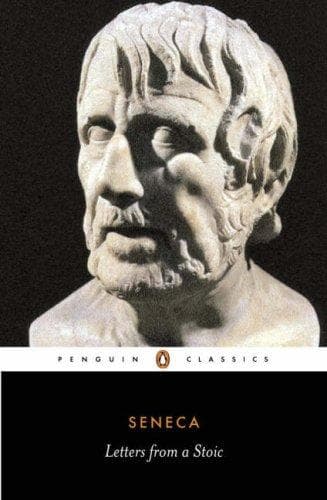
Core Idea
- Seneca’s Letters are not casual correspondence but sustained Stoic essays to Lucilius, using short, pointed arguments, examples, and quotations to train character.
- Their central aim is inner freedom: to make the soul independent of Fortune, public opinion, luxury, fear, pain, and even death.
- The book repeatedly insists that the only true good is virtue / the honourable, while externals—wealth, office, health, reputation, and length of life—are at best preferred, never decisive for happiness.
The Stoic Program: Train the Soul, Not the Externals
- Time is our most urgent possession because it is continually stolen, wasted, or neglected; Seneca’s first warning is to hold every hour.
- Progress requires digesting a few good authors or doctrines deeply rather than skimming many superficially; philosophy must become blood, not notes.
- Friendship, sociability, and even retirement are all judged by whether they support virtue: trust a real friend, avoid the crowd’s moral contagion, and withdraw only to improve the soul.
- Seneca repeatedly opposes theatrical philosophy: no shabby self-display, no deliberate oddity, no performative austerity; the philosopher should differ inwardly, while remaining decent outwardly.
- He recommends recurring disciplines such as rehearsing poverty, living plainly, and reflecting daily on death so that fear does not surprise the mind.
- The mind must learn to say what it can say openly, desire only what it can admit publicly, and keep an inward guardian over conduct.
Virtue, Fortune, and the True Scale of Value
- Seneca’s main doctrine is that virtue is the only good: if something can be lost without loss to the soul, it is not truly good.
- Wealth, rank, beauty, pedigree, and applause are all exposed as unstable and morally secondary; the wise man may use them but never depend on them.
- He often sharpens this with paradox: the poor may be freer than the rich, retirement may help philosophy more than office, and the wise man may be happiest when needing happiness least.
- Happiness is defined as peace, steadiness, and right judgment—a soul that is one, self-possessed, and equal to events.
- Seneca rejects pleasure as the good because it belongs to the body and can coexist with vice; the happy life is not softer feeling but firmer reason.
- He treats the soul as something godlike within us: God is near, reason is divine, and the good person becomes a kind of guest-body for the divine.
- Fate, God, and Chance are handled with the same practical rule: obey Providence cheerfully or withstand Fortune bravely, but never treat externals as masters.
How Stoic Training Works in Practice
- Seneca’s method is concrete and repeated rather than systematic in a modern sense: each letter attacks one error—fear of death, lust, greed, crowds, travel, grief, drunkenness, or sophistry.
- He often uses vivid comparisons: the body is a leaking ship, a decrepit house, or a temporary lodging; the soul should not cling to the lodging as if it were home.
- The wise man must not confuse pain with evil, because pain can be endured or outlasted, and fear of pain is often worse than pain itself.
- He distinguishes bodily complaints from moral ones: illness, aging, and weakness are real, but the larger problem is the soul’s response to them.
- Death is treated as natural, universal, and in one sense indifferent; the important question is whether one meets it nobly.
- This leads to Seneca’s recurring defense of suicide under certain conditions: if life becomes slavery, degradation, or unbearable ruin, a rational exit may preserve freedom.
- Yet he is equally firm that people should not seek death out of rage, panic, or theatrical despair; the issue is judgment, not mere escape.
Human Community, Morality, and Social Critique
- Seneca is unusually severe on crowds, gladiatorial games, drunkenness, luxury resorts, and public ambition because they spread vice by imitation and habit.
- He rejects cruelty in public and private life alike: slaves are men, fellow-servants under Fortune, and even household relations should be governed by respect rather than fear.
- Grief, gratitude, and friendship must be morally disciplined: do not perform sorrow, do not count benefits like debts, and do not love only by utility.
- Travel, offices, and status changes cannot cure the soul because one always brings oneself along; only a change of character can do that.
- Seneca’s social vision is cosmopolitan and moral rather than political: “this whole world is my country,” and the wise person belongs to the universe more than to a city.
- He repeatedly uses examples from Roman history—Cato, Socrates, Regulus, Stilbo, Bassus, Scipio, and others—to show that courage and freedom are possible under tyranny, poverty, exile, and pain.
What To Take Away
- Seneca’s letters are a manual for inner sovereignty: the self must become stronger than circumstance.
- The book’s core test is simple but severe: do your judgments still hold when wealth, health, reputation, pleasure, and life itself are stripped away?
- Stoic progress is not rhetoric or paradox, but the hardening of character into consistent reason, gratitude, courage, and self-command.
- Seneca’s lasting claim is that a human being becomes free not by owning more, but by needing less and valuing the right things.
Generated with GPT-5.4 Mini · prompt 2026-05-11-v6