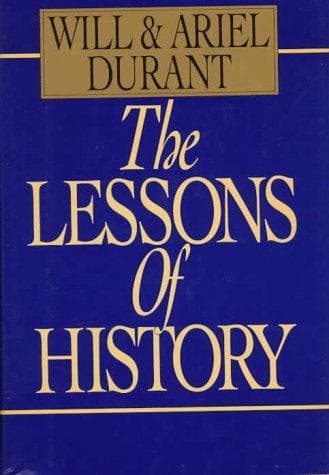
Core Idea
- The Durants treat history as art, industry, and philosophy, not a predictive science; it can organize facts and suggest cautious perspective, but it cannot deliver firm laws of the future.
- Their governing claim is that human nature changes slowly while civilization changes quickly, so the same deep pressures—competition, inequality, fertility, war, belief, and power—keep reappearing in new forms.
- History’s real value is provisional wisdom about the recurring conditions that shape civilization, rise, decay, and partial survival.
Human Nature, Society, and the Recurrent Pressures of History
- Geography matters through climate, rivers, seas, and terrain, but technology increasingly weakens its control, and air power may matter more than sea power.
- Life is competition: groups struggle for food, mates, and power, and war is “a nation’s way of eating,” with cooperation often serving a larger competitive unit.
- Life is selection and inequality, not equality; civilization tends to magnify differences by rewarding talent, luck, and power, and the authors treat freedom and equality as in tension.
- Population is a central historical force: high birth rates often accompany “low” civilizations, while lower birth rates accompany “high” ones, until famine, pestilence, and war check growth.
- The book treats birth control as socially important and argues that parenthood should be tied to health and readiness, not mere sexual impulse.
- The Durants reject race as a creative explanation of civilization and dismiss writers such as Gobineau, Chamberlain, and Madison Grant for overreading blood purity.
- Their alternative is that civilization makes the people: mixed populations can become new peoples over time, and history is “color-blind” in its ability to foster civilization under many skins.
- Character is more stable than institutions, because enduring instincts—acquisitive, pugnacious, sexual, parental, imitative, and others—persist across eras even as social forms change.
- Social change comes mainly through custom, education, imitation, and innovation, not through a transformation of basic human drives.
Institutions: Great Men, Morals, Religion, Economics, and Government
- The great man matters, but as both product and agent of his time; figures like Churchill, Napoleon, Mohammed, Pasteur, Edison, Marx, Lenin, and Mao are effective because they answer historical need.
- Conservatives and radicals are both necessary, since new ideas need resistance to test them and old institutions preserve hard-won wisdom; social vitality depends on their tension.
- Morals shift with economic life: hunting, agriculture, and industry each generate different codes, so many “vices” may once have been functional virtues under earlier conditions.
- The industrial city weakens the old agricultural code of continence, early marriage, fatherly authority, and multiple maternity, leaving society between moral systems.
- Religion is indispensable as social support because it consoles suffering, disciplines youth, stabilizes covenants, and often keeps order where secular morality is weak.
- Religion likely began in fear of hidden forces and became tied to law and state legitimacy; historically, church and state often reinforced one another.
- Religion also repeatedly corrupts itself through power, fraud, orthodoxy, and war; the Church’s moral claims were damaged by the Inquisition, forged documents, and political entanglement.
- The Durants doubt that history proves a benevolent God; the evidence looks more like impartial nature or dualism, since good and evil alike survive or perish without obvious favor.
- Economics is one of history’s deepest motors, because trade routes, capital, labor organization, taxation, and wealth concentration shape states, revolutions, and culture.
- State socialism has many historical precedents, from Sumer and Egypt to Rome under Diocletian, China under Wu Ti, Wang Mang, and Wang An-shih, the Incas, Jesuit reductions, and revolutionary Europe.
- These experiments usually work briefly under crisis, then fail through bureaucratic corruption, heavy taxation, war, weak incentives, or elite resistance; the likely long-term outcome is a synthesis of capitalism and socialism.
- Wealth concentrates naturally, partly because ability concentrates, and societies often answer explosive inequality with revolution or redistribution, as in Solon’s Athens, the Gracchi, the French Revolution, and modern welfare policies.
- Government exists to create order, and monarchy, aristocracy, and democracy all have historical merits and defects rather than any permanent right to rule.
- Democracy is hard because it requires widespread intelligence, but it has done more good than harm by widening freedom, lowering privilege, and enabling education, science, and enterprise.
- Democracy can still decay into dictatorship when war, class hatred, economic failure, or mass manipulation makes people trade liberty for security.
War, Decay, and Survival
- War is the constant of history and the final competition of states, but modern war is worse because it mobilizes whole peoples and can destroy centuries of civilization in one campaign.
- The authors contrast the general’s logic—security through preemptive strength even at terrible cost—with the philosopher’s plea for magnanimity, negotiation, and resistance to war’s historic momentum.
- Civilizations grow by meeting challenges and decay when elites fail to respond to drought, invasion, trade shifts, taxes, urban concentration, moral breakdown, or cultural leveling.
- Civilizations do not fully die so much as migrate and survive selectively in memory, books, language, art, institutions, and education.
What To Take Away
- The book’s deepest pattern is challenge, adaptation, concentration, decay, and partial survival.
- Its most memorable thesis is that social forms change faster than human drives, so history keeps circling the same tensions in new costumes.
- The Durants are most confident in the long continuities of competition, inequality, religion, war, and power, and least confident in grand deterministic theories.
- Their final optimism rests on education as civilization’s main transmission system, because progress means making the human inheritance of knowledge, art, and moral experience richer and more widely shared.
Generated with GPT-5.4 Mini · prompt 2026-05-11-v6