Core Idea
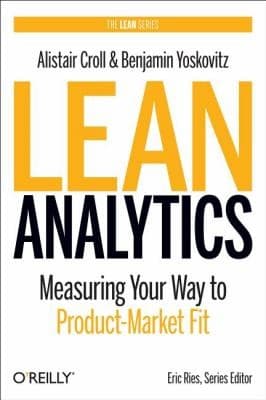
- Lean Analytics argues that startups need data not as a reporting layer, but as a way to replace self-delusion with evidence fast enough to change decisions.
- The book’s central promise is to help founders find the One Metric That Matters (OMTM) for the current stage, define a line in the sand, and know when to iterate, pivot, double down, or stop.
- It builds on Lean Startup and customer development: startups are searching for a scalable, repeatable business model, and analytics belongs to the “measure” part of build → measure → learn.
The Book’s Main Frameworks
- A good metric is comparative, understandable, and actionable; the best metrics are usually ratios or rates because they expose tension and suggest what to do next.
- The book draws sharp distinctions between vanity vs. actionable, qualitative vs. quantitative, exploratory vs. reporting, leading vs. lagging, and correlated vs. causal metrics.
- The warning against vanity metrics is constant: hits, page views, followers, downloads, and similar numbers can look impressive while changing nothing.
- The authors insist that instincts are experiments; data is proof, but they also warn that data alone can mislead if it is dirty, unnormalized, over-optimized, or detached from context.
- Their operating principle is “Humans do inspiration; machines do validation”: founders need judgment to choose what matters, then use data to verify it.
- The book’s main startup-stage model is Empathy → Stickiness → Virality → Revenue → Scale, and the metric focus should change as the company moves through those stages.
- The Lean Canvas is presented as a living one-page plan that surfaces risk across problem, customer, UVP, solution, channels, revenue, cost, metrics, and unfair advantage.
- The book repeatedly emphasizes that a startup needs both a business that works and a business the founders actually want to run; desire, ability, and market demand all matter.
How Analytics Changes by Business Model
- The right metrics depend on the business model, because the biggest risk is usually where the money comes from.
- In e-commerce, the key question is whether the business is in acquisition, hybrid, or loyalty mode; repurchase rates determine strategy more than traffic alone.
- E-commerce success is often better measured by revenue per customer than conversion rate, because cart size, repeat buying, and abandonment all matter.
- Search terms, recommendation acceptance, email, shipping, and fulfillment are all part of the funnel, not side issues.
- In SaaS, metrics move from attention to trial to stickiness to conversion to recurring revenue, then to CAC, CLV, churn, uptime, upsell, and MRR.
- Freemium is treated as a sales tactic, not a business model; it only works when marginal cost is low and the free offer naturally leads to value, virality, or paid conversion.
- The book stresses that churn must be measured carefully, often by cohort, because simple startup-growth formulas can distort reality.
- In mobile apps, app-store ranking and featuring are major constraints and advantages, because Apple and Google control distribution and limit experimentation.
- Mobile monetization often relies on in-app purchases, upgrades, ads, or feature unlocks, and the key metrics are downloads, active use, percent who pay, ARPU, time to first purchase, churn, and lifetime value.
- The mobile lesson is that monetization can damage engagement if it feels like a “money grab,” so the product must balance fun, retention, and revenue.
- In media, the business is a numbers game in which inventory, ad rates, engaged time, and audience quality matter as much as raw traffic.
- The book notes that referral traffic from social platforms can be much less engaged than other sources, so not all traffic is equal.
- In user-generated content, the business is the engagement funnel itself: lurkers → voters → commenters → posters → creators.
- UGC platforms depend on participation asymmetries, spam control, notifications, and sometimes donation-style monetization rather than ads.
- In two-sided marketplaces, demand usually matters more than supply; the buyer side is often the scarce side, and marketplace health depends on trust, liquidity, listings, and leakage prevention.
- Marketplaces and UGC both face chicken-and-egg problems, so seeding, curation, and cohort tracking are essential.
How to Learn, Validate, and Grow
- The Empathy stage is about discovering a painful enough problem, understanding how people solve it now, and testing whether they will care enough to pay.
- The authors recommend qualitative interviews first, with strong attention to bias, concrete asks, and actual behavior rather than hypothetical enthusiasm.
- A common rule is to speak with at least 15 prospects before concluding the problem is real; if you cannot find enough people to interview, selling may be harder than expected.
- The MVP is not a tiny version of the final product but the smallest test that preserves the “aha” and de-risks the riskiest assumption.
- Static Pixels’ removal of InstaOrder is used to show that analytics can reveal when a flashy feature is harming the core job to be done.
- Stickiness means proving users come back and derive enough value to make the product part of their routine.
- The book warns against buying growth too early: if you cannot keep 100 users, acquiring 1 million is pointless.
- Virality is defined as spread from infected users to new users, and the authors distinguish inherent, artificial, and word-of-mouth virality.
- Viral growth depends on both the viral coefficient and cycle time; a small improvement in speed can matter as much as a better invite rate.
- Revenue comes after the product has enough traction to justify monetization, and the goal is to maximize revenue per customer while keeping acquisition economics sound.
- The classic rule is CLV must exceed CAC, with the book treating payback period and cohort economics as more useful than simplistic averages.
- Scale is about proving the model can expand beyond the founder-led phase through channels, ecosystem effects, operational efficiency, and repeatable acquisition.
- For intrapreneurs inside large firms, the same logic applies, but with extra constraints: executive sponsorship, internal politics, existing brands, and compliance shape what can be tested.
What To Take Away
- Lean Analytics is less about dashboards than about deciding what to measure when uncertainty is highest.
- Its core discipline is to use the right metric for the current stage, tie it to a business-model risk, and make it strong enough to force a decision.
- The book’s enduring lesson is that good startups do not worship data or intuition; they use each where it is strongest, then test relentlessly.
- The deepest claim is that learning faster than your own illusions is a startup’s real advantage.
Generated with GPT-5.4 Mini · prompt 2026-05-11-v6