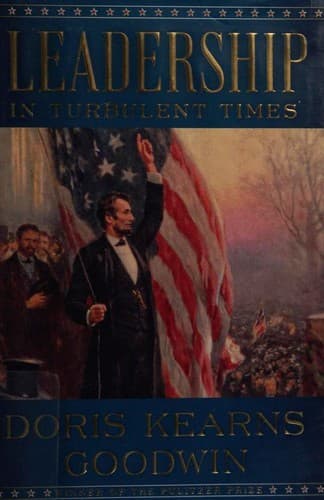
Core Idea
- Goodwin argues that leadership is made, not simply born: ambition, talent, and temperament matter, but sustained effort, self-education, and repeated response to adversity shape the leader.
- The book’s central question is not who holds power, but who can match historical necessity with purpose, character, and judgment when crises expose the difference between title and real leadership.
- Lincoln, Theodore Roosevelt, Franklin Roosevelt, and Lyndon Johnson are treated as a kind of family tree of leadership, each fitting a different national emergency and each learning leadership through contact with ordinary people.
How Leaders Are Made
- Goodwin emphasizes early formation: all four men came from very different circumstances, but each developed fierce ambition and a drive to succeed through family pressure, hardship, or privilege turned into discipline.
- Lincoln emerges from poverty, self-education, melancholy, and a hunger to be “esteemed” through deeds that would also benefit others.
- Theodore Roosevelt turns sickly childhood confinement into a program of reading, bodily training, and self-transformation through the “gospel of will.”
- Franklin Roosevelt grows up in security and confidence, but his later leadership depends on emotional intelligence, listening, and a temperament Holmes called “a second-class intellect. But a first-class temperament.”
- Lyndon Johnson inherits political instincts and ambition from his father, but his desire to be someone and prove himself is sharpened by insecurity, class feeling, and the need for approval.
- Goodwin repeatedly insists that leadership is developed through work on the self: Lincoln writes down words and rereads them, Theodore makes his body, Franklin learns to manage fear and organize others, and Johnson learns to dominate process and read people.
Crisis as the Crucible of Leadership
- Each man is marked by a major reversal that threatens identity and forces growth: Lincoln’s humiliation and depression, Theodore’s loss of mother and wife, Franklin’s polio, and Johnson’s setbacks and heart trouble.
- Goodwin treats resilience as the core test of leadership: what matters is not suffering itself, but how ambition survives frustration and is redirected.
- Lincoln’s depression after the collapse of internal improvements and his broken engagement becomes a turning point toward law, politics, and a more disciplined public voice.
- Theodore Roosevelt’s double bereavement in 1884 drives him out of Albany and into the Badlands, where hard labor, danger, and solitude rebuild him physically and psychologically.
- Franklin Roosevelt’s paralysis forces him to build confidence, conceal pain, and rely on planning, empathy, and public reassurance rather than physical command.
- Johnson’s rise is shaped by repeated apprenticeship under stronger men, where every setback becomes another chance to seize responsibility and prove effectiveness.
The Leadership Style Each Era Required
- Goodwin argues there is no master key to leadership; traits fit the times like a key fits a lock.
- Lincoln is presented as uniquely suited to the Civil War because he combined patience, humility, humor, legal precision, moral seriousness, and a capacity to hold contradictory truths together.
- Theodore Roosevelt fits the age of monopoly and industrial conflict because he is combative, theatrical, energetic, and willing to confront corruption directly.
- Franklin Roosevelt fits the Great Depression and World War II because he restores confidence through optimism, staged communication, and flexible experimentation.
- Johnson fits the civil-rights era because his southern roots, legislative mastery, and use of pressure, persuasion, and deadlines allow him to move hard legislation.
- Goodwin stresses that leaders are both shapers and shaped: they influence the public, but they also read and adapt to public sentiment.
What Good Leadership Does in Practice
- Lincoln’s leadership is defined by timing, empathy, and moral restraint: he waits when necessary, listens carefully, and refuses to let resentment govern action.
- His Emancipation Proclamation is treated as a military and moral act, but one he frames legally and delays until conditions, especially Antietam, make it possible.
- He manages the cabinet as an “official family,” builds trust by private attention and public praise, and controls anger by rewriting or discarding hot letters.
- Franklin Roosevelt leads through frankness, vigor, and organization: the bank holiday, fireside chats, task forces, and continuous legislative pressure restore trust and then remake institutions.
- His New Deal method is experimental rather than doctrinaire; he uses multiple agencies, overlapping assignments, and public communication to create momentum and adjust course.
- Johnson’s strongest domestic leadership comes from mastering procedure and narrative: he turns policy into human stories, uses deadlines and bargaining, and keeps Congress and the White House working in sequence.
- His best achievements—civil rights, voting rights, Medicare, education, public works, and the Great Society—depend on combining principle with relentless legislative management.
- Goodwin also shows the limits of this style: in Vietnam, Johnson hides reality, fails to build a shared rationale, and breaks faith with the public by escalating war without candor.
What To Take Away
- Goodwin’s deepest claim is that leadership rests on a moral bond with the people, not just command, charisma, or ambition.
- The leaders she admires learn to connect private character with public purpose, and to turn personal suffering into enlarged responsibility.
- Their achievements endure because they matched individual temperament to a national need and made history legible to the public.
- The book’s final standard is remembrance: leaders matter when their actions outlast them and help later generations understand freedom, government, and civic duty.
Generated with GPT-5.4 Mini · prompt 2026-05-11-v6