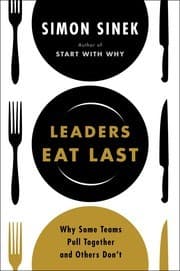
Core Idea
- Sinek argues that great leadership is about protecting people, not maximizing numbers, so teams can focus on external challenges instead of internal fear.
- The central test of leadership is whether people feel safe inside the organization’s Circle of Safety; when they do, trust, cooperation, innovation, and loyalty rise.
- When leaders protect only themselves, or when systems reward short-term performance over human care, organizations become driven by cortisol, self-preservation, politics, and distrust.
How Leadership Works in the Book
- The book’s title comes from the Marine tradition that leaders serve the youngest first and themselves last, because leadership is a privilege that costs self-interest.
- Sinek uses Bob Chapman at Barry-Wehmiller/HayssenSandiacre as a model of truly human leadership: removing bells and time clocks, opening access, listening first, and treating employees like family.
- That approach is presented as more than kindness; it reduced theft, improved care, increased loyalty, and helped revenue rise from $55 million to $95 million.
- The Circle of Safety is the book’s key organizational idea: leaders must reduce internal danger so people can cooperate against outside threats.
- The circle is mutual: leaders must protect their people, but members also have a responsibility to notice and care for leaders under strain.
- The author contrasts safe cultures with fear-based ones, arguing that when people have to spend energy managing internal danger, the organization is weaker outside.
- High-performing teams are described as places where people look out for each other, share credit, and act with a sense of belonging rather than isolated ambition.
- Sinek repeatedly argues that trust is extended, not demanded; leaders earn it by first treating people as people.
Human Biology, Stress, and the Organizational Environment
- The book grounds leadership in human biology: people evolved for small, cooperative tribes, not modern systems that isolate them and constantly trigger stress.
- Sinek distinguishes four “happy chemicals”: endorphins and dopamine as the more selfish, achievement-driven chemicals, and serotonin and oxytocin as the social chemicals that build belonging and trust.
- Dopamine drives goal pursuit and short-term reward, but in modern life it can be hijacked by phones, email, likes, gambling, substances, and performance metrics.
- Serotonin is the feeling of pride and status granted by others; in the book it is the “leadership chemical” because it bonds parent and child, coach and player, boss and employee.
- Oxytocin is the chemistry of love, generosity, and trust; physical presence, generosity, handshakes, hugs, and time together build it.
- Cortisol is the threat chemical, and the book argues that rumors, layoffs, politics, mistrust, and constant pressure keep it flowing in unhealthy workplaces.
- Sinek cites studies linking poor work experiences to depression, anxiety, heart disease, and reduced sense of control, arguing that many jobs are literally damaging health.
- The point is not that comfort is the goal, but that safety inside the organization frees people to handle real danger, complexity, and change.
Culture, Incentives, and the Danger of Abstraction
- Sinek argues that modern organizations often overvalue abstractions like share price, quarterly targets, rankings, and metrics, while forgetting the people behind them.
- He contrasts leaders who protect people with leaders who “protect the money,” arguing that when the latter wins, culture decays and trust collapses.
- A recurring warning is that abstraction kills: the farther decision-makers are from real people, the easier it becomes to harm them.
- He uses Milgram’s obedience experiment, the Peanut Corporation salmonella scandal, the Titanic lifeboat failure, and financial scandals as examples of what happens when rules, hierarchy, or legality replace moral judgment.
- The book criticizes a narrow reading of “within the law” and insists that trust depends on a higher moral code, not mere compliance.
- Sinek also attacks shareholder primacy as a doctrine that distorts incentives, shortens time horizons, and encourages layoffs, fraud, and short-term stock manipulation.
- Examples such as GE under Jack Welch, Merrill Lynch under Stanley O’Neal, BP before Deepwater Horizon, and Goldman Sachs are used to show what happens when leaders chase status, growth, or share price at the expense of culture.
- By contrast, Costco, 3M, Southwest, Barry-Wehmiller, Next Jump, and the Taj Mahal Palace Hotel are presented as examples of organizations where protecting people supports long-term performance.
What To Take Away
- The book’s core claim is that leadership is a responsibility to create safety for others, not a license to extract value from them.
- Strong organizations do not eliminate pressure; they keep it pointed outward by building trust, shared purpose, and mutual protection inside.
- The most durable cultures reward people-first judgment, honesty, and sacrifice, because those are what make cooperation possible when conditions get hard.
- Sinek’s final message is that leadership is everyone’s job: “Let us all be the leaders we wish we had.”
Generated with GPT-5.4 Mini · prompt 2026-05-11-v6