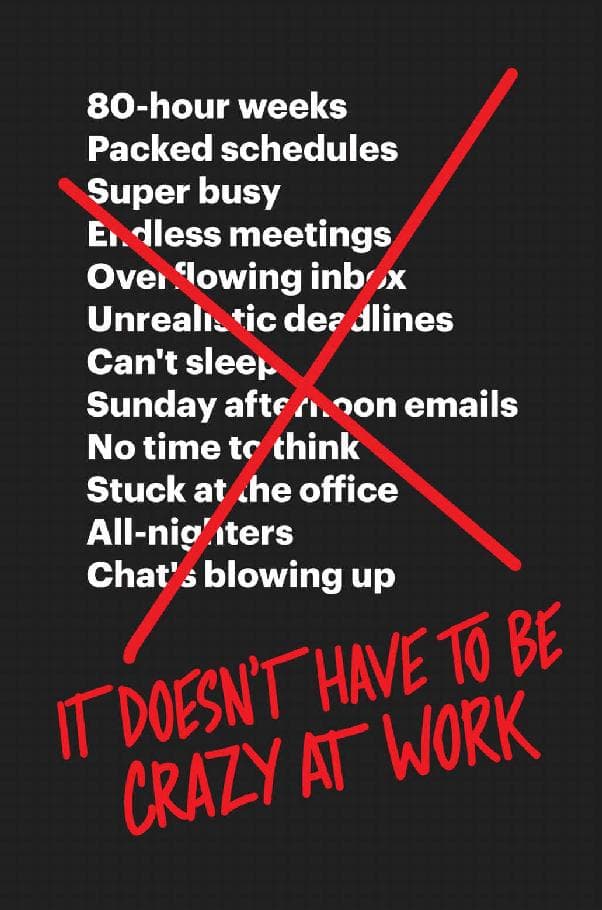
Core Idea
- The book’s central claim is that “crazy at work” is a choice, not a law of nature: companies can be calm, profitable, and competitive without constant urgency, exhaustion, or growth-at-all-costs thinking.
- The authors treat the company itself as a product that can be deliberately redesigned, iterated, and improved like software.
- Their version of calm is practical: protect time and attention, keep hours reasonable, favor asynchronous communication, and build for sustainability over spectacle.
Protecting Time and Attention
- The book argues that the real scarce resource is not effort but uninterrupted, high-quality time.
- Meetings, chat, status updates, visible calendars, instant-response expectations, and open-office interruptions fracture the day into unusable fragments.
- Their preferred rule is asynchronous first, real-time second: write updates, use office hours, and reserve chat for when speed truly matters.
- Office Hours lets experts choose scheduled windows for questions instead of being interrupted all day.
- They criticize shared calendars because they create calendar Tetris, where one person’s time gets cheaply broken up while everyone else loses the ability to do meaningful work.
- The Presence Prison is the pressure to constantly signal availability and busyness; the authors argue work should be judged by output, not visible motion.
- They turn workplace FOMO into JOMO—the joy of missing out—by freeing people from the expectation to follow every conversation in real time.
- They say work doesn’t happen at work when the office is designed as an interruption factory, so they advocate Library Rules: quiet, focus, and privacy.
- Vacations should be real vacations, with no fakecations, no checking in, and no hidden leash back to the office.
What Good Work Requires
- The authors reject hustle culture: long hours, exhaustion, and sleep deprivation are not virtues but warning signs.
- Effective > Productive is a key distinction: productivity is machine language, while effectiveness means doing less, cutting obligations, and leaving room for life.
- 8’s Enough, 40’s Plenty captures their view that a 40-hour week is enough for great work, and they even work 32 hours in summer.
- If everything cannot fit into 40 hours, the answer is to choose better, not work longer.
- They reject the myth that you can simply outwork everyone else; real work ethic means being reliable, respectful, and not becoming a bottleneck.
- Comfy’s Cool pushes back on the idea that discomfort is inherently good; most of the time, discomfort is a signal that something is wrong.
- Sleep is non-negotiable, and all-nighters are red flags rather than heroic acts.
- The goal is not more hours but more 1 × 60 hours rather than 4 × 15 fragments.
How Basecamp Stays Calm
- The company runs on short cycles and fixed deadlines with flexible scope: the deadline stays, but scope can be cut to fit reality.
- Projects are intentionally narrow; they narrow as they go, prototype early, and then focus on finishing rather than endlessly exploring.
- They prefer commitment, not consensus: everyone can weigh in, but one person decides and explains the choice clearly.
- They are wary of best practices, because what works for one company or stage may be wrong for another.
- They avoid dependencies that force teams to wait on each other, and they use three-person teams as a practical default to stay coordinated without becoming unwieldy.
- “Whatever it takes” usually means unrealistic expectations and hidden spillover into nights and weekends; they prefer asking what will it take?, which opens room for tradeoffs, simplification, and refusal.
- They reject “we’re family” language and say coworkers are coworkers; leaders should support people’s real families rather than demand sacrifice for the company.
- Leaders must model the behavior they want because they’ll do as you do; overworked managers teach overwork.
- The trust battery matters because repeated interactions either build or drain trust, and low trust makes ordinary work feel volatile.
- Hiring is for the work, not the résumé; they care about current ability, fit, and what someone can do on a real project.
- New hires should not be expected to hit the ground running; they need time to unlearn prior habits and adapt to a new environment.
- Compensation is designed to reduce friction: they do not negotiate salaries, pay the same level the same salary, and aim for the top 10% of the market for each role.
- Benefits are meant to help people leave work, not trap them there: vacations, sabbaticals, education stipends, CSA shares, massages off-site, and fitness support.
- They avoid priced-to-win customer dynamics by pricing Basecamp flat, so no giant customer can dominate the roadmap.
- They reject growth at any cost and profitless expansion; calm’s in the black, because profitability buys freedom, stability, and time to think.
- They believe in taking risk without putting yourself at risk: make bold changes only when the business can absorb them and recover.
What To Take Away
- Crazy at work is not inevitable; it is a bundle of habits, incentives, and norms that can be changed.
- The strongest recurring principle is to protect time and attention, because that one choice drives many of the others.
- The authors consistently prefer less, smaller, slower, and clearer over more, bigger, faster, and louder.
- A good company should be good to work in, good to buy from, and sustainable to keep running.
Generated with GPT-5.4 Mini · prompt 2026-05-11-v6