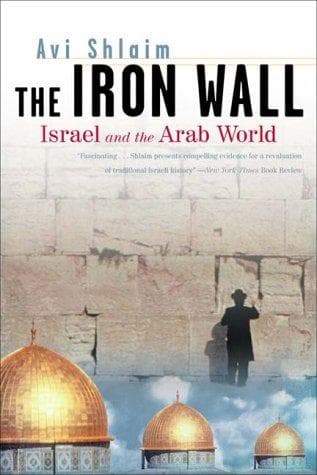
Core Idea
- The Iron Wall argues that Israeli policy toward the Arabs has been shaped less by repeated Arab rejection than by a long Zionist/ישראלי strategy of seeking power first and accommodation later.
- Shlaim’s central image is Jabotinsky’s “iron wall”: Arabs would only negotiate seriously after realizing they could not stop Jewish state-building by force; in practice, Israeli leaders often turned that logic into a durable excuse for coercion, delay, and territorial retention.
- The book is a revisionist history of Israel’s diplomacy and wars from 1948 to 2006, built from archival evidence and used to challenge official narratives about peace, security, refugees, and borders.
How Shlaim Reconstructs the Conflict
- Shlaim openly writes from a personal and political standpoint: he accepts Israel’s legitimacy within the 1967 borders, but rejects the Zionist colonial project beyond the Green Line.
- He grounds the book in primary sources, especially declassified Israeli archives, while using oral testimony as a supplement and warning about memory’s limits and self-justification.
- The prehistory of the conflict begins, for him, with early Zionist blindness to the Arab presence in Palestine, epitomized by Yitzhak Epstein’s 1907 warning that Zionism had hidden “the question of our relations with the Arabs.”
- Zionism’s recurring strategic move was to bypass the local Palestinians and seek backing from an external great power, first Britain, later the United States.
- Weizmann’s British strategy helped produce the Balfour Declaration, but Shlaim emphasizes its demographic hollowness and its contradiction with Britain’s promises to Arabs.
- Jabotinsky’s iron wall is presented as the clearest articulation of the hard-line Zionist view: force would establish an unbreakable Jewish presence, after which the Arabs might be willing to bargain.
- Ben-Gurion differed in temperament from Jabotinsky but not, in Shlaim’s reading, in fundamentals: he also believed time, force, and state power would compel Arab acceptance.
- The 1948 war is recast as a war of power and diplomacy, not miracle: Israel prevailed because it became militarily stronger, not because it was a tiny David defeating Goliath.
- Shlaim disputes the myth of total Arab unity in 1948 and stresses the hidden Abdullah–Meir understanding, the refugee exodus, and Israel’s readiness to use military victory to expand beyond the partition map.
Israeli Strategy After 1948: Status Quo, Reprisals, and Delay
- After the armistices, Israel became a status quo power: it sought to freeze the post-1949 order territorially and demographically, especially by preventing Palestinian return.
- Ben-Gurion saw peace as desirable but not urgent; he believed Israel could manage without it and that borders, Jerusalem, and refugees would improve over time for Israel.
- The Lausanne talks exposed the deadlock: Arabs wanted refugees and territory addressed under international principles, while Israel treated the armistice lines as de facto borders and rejected meaningful return.
- In Jerusalem, Ben-Gurion used symbolic acts to harden claims, declaring Jewish Jerusalem inseparable and moving the government there, even at the cost of UN conflict.
- The book’s most recurring operational theme is the struggle between activists and moderates: the activists trusted reprisals and deterrence; the moderates, led by Sharett, worried about diplomacy, law, and cumulative political damage.
- Shlaim rehabilitates Moshe Sharett as a serious alternative to Ben-Gurion, one who understood Arabs better and preferred restraint, but was repeatedly outmaneuvered by the military and activist camp.
- Reprisals, especially under Dayan, are presented not as clean deterrence but as escalation that often produced civilian harm, diplomatic isolation, and more violence.
- The Qibya massacre is a turning point in the book’s moral and strategic argument: it shows how reprisal doctrine could become collective punishment while the state lied to cover it up.
- Israel’s border policy in the 1950s combined punitive force, settlement, and tactical diplomacy, while the elite increasingly used peace talk as a cover for waiting or for unilateral advantage.
From Suez to Oslo: Separate Peace, Territory, and the Limits of Negotiation
- The 1956 Sinai/Suez War is treated as a collusive, expansionist campaign that achieved military success but not a durable political settlement.
- After Suez, Shlaim argues, Israel shifted toward a strategy of deterrence plus external guarantees, cultivating the U.S., France, West Germany, and a “periphery alliance” with non-Arab states like Iran, Turkey, and Ethiopia.
- Ben-Gurion’s nuclear project at Dimona fit this logic: nuclear capability was the ultimate deterrent against Arab numerical superiority and existential fear.
- The 1967 war is presented as a result of Israeli escalation, especially on the Syrian front, and not as a simple defensive miracle.
- Post-1967 diplomacy repeatedly split between a Jordanian option and a Palestinian option, but Israel usually preferred to keep control while avoiding a real Palestinian sovereignty issue.
- Golda Meir embodies immobilism: she denied Palestinian nationhood, relied on force and American support, and treated peace as something to be postponed until Arabs accepted Israel on its terms.
- The War of Attrition and the Yom Kippur War show the cost of stalemate: Egypt used limited war to break the deadlock, while Israel’s overconfidence in static control and military superiority proved dangerous.
- Likud’s 1977 victory marks the ideological hardening of the “Greater Israel” project, with Begin recasting the iron wall as permanent territorial entitlement rather than a path to eventual compromise.
- Begin’s peace with Egypt is real and important in the book, but Shlaim stresses that it came through separate bilateral diplomacy, while the Palestinian question was left unresolved and autonomy was emptied of substance.
- The Oslo process is the book’s central late-century test case: it created mutual recognition and limited self-rule, but the hardest issues—refugees, Jerusalem, settlements, borders—were deferred, which allowed Israel to keep expanding on the ground.
What To Take Away
- Shlaim’s deepest claim is that Israeli leaders repeatedly used peace rhetoric to manage time, not to make final compromise, while facts on the ground accumulated in Israel’s favor.
- The book insists that understanding the conflict requires taking Palestinian dispossession, Arab pragmatism, and Israeli coercion seriously at the same time.
- Its moral argument is that national myths of innocence and inevitability prolong conflict; a fairer, more complex history is a precondition for reconciliation.
- Across the book, the decisive pattern is not one peace process failing once, but a recurring struggle between leaders willing to trade land for peace and leaders who preferred deterrence, delay, and territorial control.
Generated with GPT-5.4 Mini · prompt 2026-05-11-v6