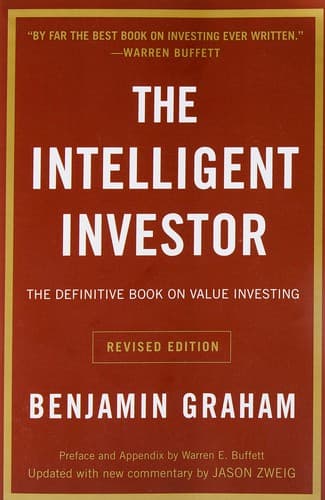
Core Idea
- Graham’s central claim is that intelligent investing is not about IQ, predictions, or excitement, but about patience, discipline, emotional control, independent thought, and a strict margin of safety.
- The book is aimed at investors, not speculators; its main job is to help readers avoid the big errors that destroy capital and behavior.
- Zweig updates Graham’s ideas by arguing that the hardest part of investing is usually managing yourself, especially in booms, busts, and periods of seductive market enthusiasm.
Investment vs. Speculation
- Graham defines an investment as an operation, after thorough analysis, that promises safety of principal and an adequate return; anything else is speculation.
- He insists the terms are widely confused: people call themselves investors even when they are really betting on price moves, leverage, or hot stories.
- A nonprofessional who buys on margin is, by definition, speculating; so are “hot” issues and trading systems that rely on price momentum.
- Speculation is not immoral, but it becomes dangerous when people mistake it for investing, overcommit to it, or risk money they cannot afford to lose.
- Zweig repeatedly warns that the stock market encourages a “financial videogame” mentality, where ticker symbols and price blips replace business reality.
- The right stance toward speculation is to keep it separate, tiny, and explicitly money you can lose; for most people, that means a very small “mad money” account.
Graham’s Framework: Safety, Value, and Behavior
- Graham’s key test is whether the price paid is sensible relative to what is being bought; stock losses often begin when buyers stop asking “How much?”
- His philosophy is to minimize irreversible losses, maximize sustainable gains, and avoid self-defeating behavior.
- He divides investors into defensive and enterprising types: the defensive investor wants safety and simplicity, while the enterprising investor has time, skill, and temperament for more work.
- For the defensive investor in the early 1970s, Graham thought high-grade bonds looked better than stocks on both safety and yield, though inflation and future business improvement could change that judgment.
- His practical compromise was to hold a meaningful portion in both asset classes, usually around a 50–50 split, or at least a wide range between 25% and 75% in stocks depending on circumstances.
- Graham rejects age-based formulas like “100 minus age”; allocation should reflect cash needs, temperament, and real life shocks, not a mechanical rule.
- A minimum bond/cash cushion matters because it helps the investor stay invested in stocks during declines rather than sell in panic.
- Rebalancing is central: keep target stock/bond proportions and adjust periodically so rising markets do not quietly turn a conservative portfolio into a risky one.
- His stock-selection standard for ordinary investors is conservative: large, financially strong companies, long dividend records, and prices restrained relative to earnings and assets.
- Graham repeatedly prefers present value and hard figures over stories about future growth, because forecasts are uncertain and enthusiasm is usually already embedded in the price.
Markets, Inflation, Bonds, and Growth
- Graham argues that stock and bond attractiveness changes with market conditions, especially interest rates, inflation, and valuation levels.
- The book and commentary stress that inflation can be missed because of money illusion: investors focus on nominal gains instead of what their money buys after inflation.
- Inflation is not dead, but the text also warns that deflation can hurt stocks and other assets too.
- Stocks are only a half hedge against inflation: over long stretches they often outpace inflation, but not always, and not reliably in every period.
- The commentary introduces REITs and TIPS as additional inflation defenses, with TIPS especially useful inside tax-deferred accounts because inflation adjustments are taxable.
- Graham’s historical analysis shows that the market can rise for long periods while valuation becomes stretched; he treats the 1949–1969 boom as partly a bootstrap operation driven by changing attitudes.
- He warns against extrapolating past returns into the future; once optimism becomes widespread, expected returns usually fall.
- The commentary uses Shiller’s CAPE and long-run return estimates to reinforce Graham’s point: high valuations usually imply lower future returns.
- Growth stocks are not automatically superior: the danger is paying in advance for prosperity that may already be fully priced in.
- Even celebrated names like IBM, Texas Instruments, Emerson, EMC, and Exodus are used to show that strong businesses can become terrible investments when priced too richly.
Enterprising Investing, Bargains, and Special Situations
- Graham accepts that better-than-average results are possible, but only by using methods that are both sound and unpopular.
- He thinks many active strategies fail because they depend on short-term forecasts, trading, or ideas that disappear once they become widely known.
- A major active approach is buying undervalued or neglected stocks; these often exist because prices diverge from value, not because the market has discovered something the analyst has missed.
- Graham distinguishes appraisal value and private-owner value, and likes bargains where price is far below either estimate.
- His favorite bargains include stocks selling below net working capital or far below conservative asset value, because they leave little or nothing paid for fixed assets or goodwill.
- He also discusses secondary companies, which the market often undervalues because they lack glamour, even though many are durable, profitable businesses.
- “Special situations” like arbitrage, liquidations, reorganizations, and merger deals can be attractive, but Graham says competition and complexity have made them less rewarding than before.
- The commentary emphasizes that many seemingly clever formula systems, hot funds, and market tricks self-destruct once publicized or copied.
What To Take Away
- The book’s deepest lesson is that investment is about protection first, prediction second.
- The most important edge is not information brilliance but self-control, humility, and a disciplined definition of value.
- Diversification, reasonable prices, and a margin of safety matter more than glamour, market timing, or confidence in forecasts.
- Graham and Zweig both argue that if you stay in the safe, narrow path of businesslike investing, you can do well without needing to be exceptional.
Generated with GPT-5.4 Mini · prompt 2026-05-11-v6