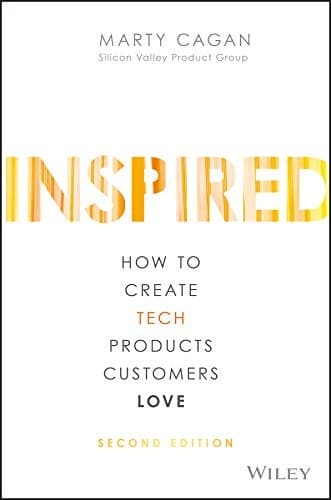
Core Idea
- Great products are discovered, not just built: engineering excellence cannot rescue a product that nobody wants, so teams must find something that is valuable, usable, and feasible before execution.
- The book’s central claim is that product success comes from disciplined people, process, and product choices, especially tight collaboration among product management, UX design, and engineering.
- Cagan argues that most failures come from weak product management, late or superficial design, and confusing product definition with implementation.
How Great Products Are Found
- Product work has two distinct phases: discovery asks what to build, and delivery asks how to build it right.
- Discovery is collaborative and creative, not a construction schedule; teams should prototype early, test often, and keep a parallel path for the next release while engineering executes the current one.
- The best “spec” is often a high-fidelity prototype, because it captures the full user experience and can be tested for feasibility, usability, and value before engineering starts.
- Cagan strongly prefers minimal products: define the smallest product that can satisfy the objective, then validate it and avoid late churn that turns into schedule slips.
- Product validation depends on real users, not opinions; he treats prototype testing as one of the most important things a PM does.
- His practical testing rule is to keep iterating until roughly six consecutive users understand the product, can use it, and see its value.
- For opportunity assessment, PMs should define the problem first and answer questions about target market, market size, metrics, competition, differentiation, market window, go-to-market, critical requirements, and go/no-go.
- He warns against turning opportunity assessment into a solution debate, because that causes teams to abandon good opportunities when one solution path fails.
- Improving an existing product can be more valuable than building a new one; he gives examples like doubling conversion or reducing customer-service load by fixing usability.
Roles, Organization, and Decision-Making
- Cagan draws hard lines between product management, product marketing, project management, design, and engineering because each requires different skills and ownership.
- The product manager owns what product will be built, not how it will be implemented; product marketing owns positioning, pricing, launches, sales tools, and messaging.
- He criticizes “marketing-driven” products and “two people, one role” or “one person, two roles” setups because they dilute accountability and break product ownership.
- In Internet software, product management and project management should usually be separate, especially when a release-train model requires active coordination at the release level.
- He likes a distinct Product organization on par with engineering and marketing, often led by a VP of Product or CPO, so product has an executive seat.
- A product council can speed decisions if it is small, cross-functional, and focused on deciding strategic direction, resource allocation, and milestone go/no-go decisions.
- The council is not there to design or build; it reviews product strategy, opportunity assessments, prototypes, launch readiness, and post-launch results.
- Great PM managers hire strong people, avoid micromanagement, align product strategy to business strategy, and remove PMs who cannot do the job.
- Managing up matters because product managers face many stakeholders; Cagan recommends using data, concise communication, recommendations instead of raw problems, and explicit handling of churn.
- He repeatedly emphasizes that teams should focus on the problem, target persona, and goals, and make tradeoffs visible rather than relying on vague labels like “critical” and “important.”
Discovery Inputs, Design, and Product Types
- Direct customer contact is essential; PMs who are barred from talking to users should try to change the policy or leave.
- Market research tools—surveys, analytics, personas, usability tests, competitive analysis—help understand users, but they do not by themselves tell you what product to build.
- He is skeptical of focus groups as a source of product breakthroughs, though he allows them as exposure to target users if the PM attends and interprets them personally.
- Personas are useful for focusing tradeoffs, but they must be grounded in real users and usually should identify a primary persona per release.
- He distinguishes interaction design from visual design: one makes the product usable and task-focused, the other shapes the emotional and aesthetic experience.
- Visual design is not superficial; the same functionality can feel very different depending on typography, color, layout, and polish.
- For enterprise software, he stresses usability, working reliably, avoiding specials, charter user programs, sales-channel fit, installation, configuration, and supporting both buyers and end users.
- For consumer Internet products, he emphasizes scalability, availability, privacy, viral growth, globalization, gentle deployment, and community management.
- He distinguishes solutions products from platforms: solutions solve a business-level problem with integrated components, while platforms provide a foundation and API for others to build on.
- Across product types, he returns to the same warning: avoid custom work that turns the team into a services shop or creates bad revenue that harms customer experience.
What To Take Away
- The hard part of product development is not coding, but choosing and validating the right thing to code.
- Product management must be a real, accountable discipline with clear ownership, strong design partnership, and enough authority to say no.
- Testing with real users early and often is the book’s core mechanism for reducing risk and improving product quality.
- The best teams optimize for customer value, not internal convenience: they use principles, councils, prototypes, and metrics to keep decisions anchored in what users actually need.
Generated with GPT-5.4 Mini · prompt 2026-05-11-v6