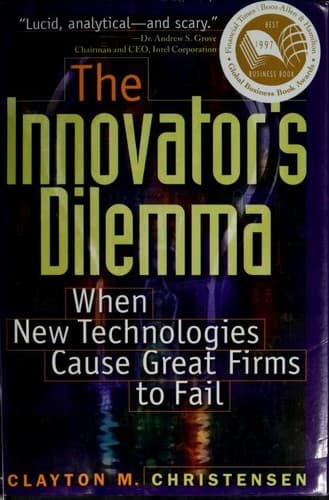
Core Idea
- Christensen’s core puzzle is that well-managed, customer-focused, financially disciplined firms often fail when confronted by certain technological changes.
- The failure is not usually bad execution; it is that good management makes firms choose the innovations their current customers and profit formulas demand, which can leave them vulnerable to disruptive innovation from below.
- Sustaining technologies improve performance on dimensions mainstream customers already value, while disruptive technologies initially underperform on those dimensions but offer different attributes that matter in new or fringe markets.
How Disruption Works
- Christensen’s main evidence comes from the disk-drive industry, where incumbents repeatedly led sustaining innovations but usually lost to entrants in disruptive architectural shifts such as 14-inch to 8-inch, 5.25-inch, 3.5-inch, 2.5-inch, and 1.8-inch drives.
- The pattern repeats across excavators, steel, computers, printers, retailing, and other industries: incumbents succeed when the innovation fits their current value network, but fail when it belongs to a different one.
- A value network is the context that shapes who the customer is, what attributes matter, what prices can be charged, and what cost structure is viable.
- The same product feature can have different value in different networks: for example, mainframes prize capacity and speed, while portable computers prize ruggedness, size, and low power.
- Technology often improves faster than customers can use it, creating performance oversupply; once one attribute is oversupplied, competition shifts to another basis such as convenience, reliability, size, or price.
- Disruptive technologies often start by serving small, unattractive, or lower-end markets where their simpler, cheaper, or more convenient form is actually an advantage.
- Incumbents are often “held captive” by their best customers, who do not want the disruptive product, so customer-driven planning directs resources away from the future.
Why Great Firms Miss the Turn
- Christensen argues that the failure mechanism is rooted in resource dependence: customers, investors, and internal budgeting routines steer firms toward projects with known demand, known margins, and clear growth.
- Small markets are especially hard for large firms because they need large absolute growth; a tiny emerging market that is strategically crucial to disruption looks financially insignificant.
- The book’s resources-processes-values (RPV) framework explains why firms cannot simply “decide” to do both old and new businesses well.
- Resources help, but processes and values are the real constraints: processes that work brilliantly for one business can block another, and values shift toward higher margins as firms move upmarket.
- Mature firms therefore tend to reject disruptive ideas even when prototypes exist internally, because the proposals look unattractive to marketing, finance, and senior management.
- In disk drives, Seagate and others often had disruptive prototypes before approval, but mainstream customers found them unattractive, so the ideas were shelved in favor of sustaining work.
- Northeastern pull captures the tendency of successful firms to migrate upmarket toward larger, more profitable opportunities, leaving the low end open to attackers.
- The same logic appears in steel: integrated mills moved toward the profitable northeast corner of higher-quality sheet steel, while minimills entered low-end rebar and then climbed upward.
- Thin-slab casting showed the pattern sharply: it promised lower cost and smaller capital requirements, but integrated mills chose conventional thick-slab investments because thin-slab output initially served lower-end markets.
What Successful Disruptors Do
- Disruptive innovations are usually found through trial and error, not through detailed forecasts, because the right application often cannot be known in advance.
- Christensen calls this discovery-driven planning and agnostic marketing: treat the initial market as unknowable, test assumptions early and cheaply, and learn from actual use.
- The most effective organizations for disruption are often small, autonomous spinoffs with a cost structure suited to the emerging market, rather than large units inside the mainstream business.
- Examples include Quantum’s Plus Development, Control Data’s separate 5.25-inch effort, IBM’s autonomous PC organization, and HP’s isolated ink-jet operation.
- This separation matters because a single organization usually cannot sustain two different cost structures and two different profit models at once.
- Christensen distinguishes three ways firms can create new capabilities: acquire them, change the existing organization, or spin out a new one; when values conflict, spin-outs are often the most workable.
- The book also distinguishes lightweight teams, heavyweight teams, and autonomous organizations: the more the new business conflicts with existing processes and values, the more separation it needs.
- In the EV discussion, Christensen stresses that a disruptive product should be designed for the market it can actually win first, not forced into the mainstream auto market too early.
What To Take Away
- Listen to customers is excellent advice for sustaining innovation, but it can be fatal when the next opportunity lies in a different value network.
- The central managerial challenge is not to fight disruption with better execution inside the old business, but to organize around a different set of customers, economics, and processes.
- Disruptive technologies usually win first where the incumbent’s best customers do not care, and only later improve enough to invade the mainstream.
- The book’s enduring warning is that rational decisions inside the current business model can still produce failure when technology and markets shift in disruptive ways.
Generated with GPT-5.4 Mini · prompt 2026-05-11-v6