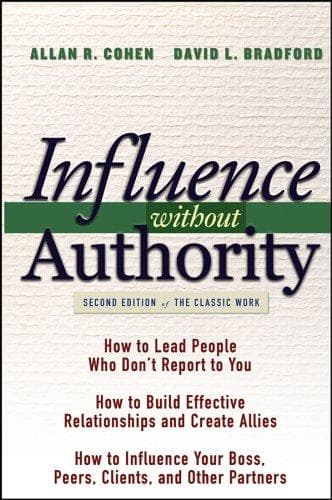
Core Idea
- Influence without authority is the ability to get work done when you cannot rely on formal power, especially across functions, upward, or in temporary teams.
- The book’s central argument is that modern organizations are interdependent and fragmented enough that reciprocal exchange, not command-and-control, is the real mechanism of action.
- Influence succeeds when you can create win-win trades: give the other person something they value in return for what you need.
The Cohen-Bradford Model: How Influence Works
- The authors present a six-step model: assume ally potential, clarify your goals, diagnose the other person’s world, identify currencies, deal with relationships, and make exchanges.
- The model is especially useful when the other person is resistant, unfamiliar, expensive to influence, or unlikely to give you another chance.
- A major premise is that many influence failures come from self-created barriers, not just external power differences.
- Internal barriers include lack of influence knowledge, fear of reactions, fear of failure, and blind or stereotyped attitudes toward the other side.
- External barriers include big power asymmetries, incompatible goals, hostile histories, and mismatched performance measures.
- The book warns against looking Machiavellian; short-term manipulation may work, but it damages trust and invites retaliation.
- Reciprocity is treated as the lubricant of organizational life: people expect to be paid back, whether with help, information, support, or visibility.
- The authors distinguish positive exchange from negative exchange; they prefer positive trades but acknowledge that pressure or withholding can sometimes be necessary.
- A recurring trap is the negative attribution cycle, where resistance leads you to assume bad motives, which then makes future influence even harder.
Currencies, Diagnosis, and Self-Knowledge
- Currencies are the goods and services people value enough to exchange for cooperation, and they vary by person, context, and culture.
- The book groups currencies into inspiration-related, task-related, position-related, relationship-related, and personal-related forms.
- Examples include vision, excellence, mentoring, resources, challenge, information, recognition, visibility, inclusion, understanding, gratitude, ownership, and comfort.
- The same action can count as different currencies to different people, so influence depends on fitting the recipient’s meaning system, not just on the sender’s intention.
- False advertising is a major warning: overpromising or exaggerating destroys the reputation that makes future exchanges possible.
- The authors repeatedly urge readers to diagnose the other person’s world: task demands, reward system, culture, career stage, worries, history, and assumptions.
- Measurement systems are especially powerful because people tend to do what they are rewarded for, not what leaders merely say they want.
- Direct, non-accusatory questions are recommended because sincere inquiry often uncovers what the other person values and builds trust at the same time.
- The book also insists on self-diagnosis: know your own must-haves, nice-to-haves, resources, and legitimate personal needs before negotiating.
- People often constrain themselves too tightly by job descriptions or assumptions about authority; the book argues that influence often requires initiative beyond formal role boundaries.
- You can even influence your boss by learning the boss’s critical needs and supplying currencies like extra performance, reliable information, early warnings, loyalty, or political awareness.
- A key self-trap is silent over-giving: if you never remind others of your contributions or ask for what you are owed, reciprocity may never happen.
Relationships, Teams, and Change Work
- Relationships are often hardest with strangers inside the organization, meaning people from different functions, backgrounds, or work styles.
- Good relationships matter because they increase credibility, lower the burden of proof, allow broader repayment over time, and make personal currencies more usable.
- Poor relationships distort perception, raise suspicion, and make even neutral actions look manipulative.
- The authors distinguish the current state of a relationship from how the other person wants to be related to; influence often means building a workable alliance, not friendship.
- Work style differences are a major source of friction: analysis vs action, detail vs big picture, structure vs ambiguity, caution vs risk, and convergence vs divergence.
- Style conflict should be treated as an interaction problem, not a character defect; name the difference and work on how to use both tendencies productively.
- When relations are already bad, the goal is a satisfactory enough working relationship, and the right sequence may be task first or relationship first depending on the situation.
- In cross-functional teams, loyalty, pay, promotion, and supervision usually still point back to the member’s home base, so commitment is split.
- The book recommends building roughly 70% commitment to the new group in task forces and cross-functional teams, while committees usually remain weakly committed to the new task.
- Team leaders should carefully diagnose members’ currencies, recruit respected “sell” people, and use the project as a license to learn, build reputation, and create contacts.
- Leaders need enough openness to surface conflict about data and judgments, but not so much control that members feel no real voice.
- Large change efforts work best through an accordion method: small core-group work alternates with wider stakeholder meetings.
- The Sheila Conrad example shows how someone with “no money and no authority” can mobilize change through a credible plan, a compelling vision, and carefully sequenced stakeholder support.
Hardball and Limits
- When positive exchange is not enough, the book allows hardball: tougher tactics that raise the other side’s costs while still trying to preserve a future relationship.
- Hardball should escalate gradually, with warnings and as little pressure as needed; the authors prefer keeping the possibility of win-win alive.
- A person being blocked by a powerful boss may still have leverage through competence, information, reputation, and the boss’s dependence on their success.
- The book draws a bright line between influence and manipulation: tailoring arguments is fine, but lying, faking concern, or creating impossible obligations is not.
- The authors also warn that truly malicious actors may require self-protection, but even then toughness should not become permanent warfare.
What To Take Away
- Influence is treated as a disciplined practice of exchange, not charisma or formal authority.
- The most effective influencers understand both what they want and what the other side values, then trade accordingly.
- The hardest part is often not the other person but your own fear, stereotyping, rigidity, or reluctance to ask.
- The book’s enduring lesson is that durable influence usually improves both task results and relationships if you keep reciprocity, credibility, and context in view.
Generated with GPT-5.4 Mini · prompt 2026-05-11-v6