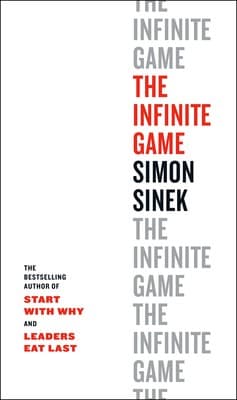
Core Idea
- The Infinite Game argues that business, life, relationships, and politics are not contests with a finish line but ongoing games in which the real aim is to keep playing.
- Sinek contrasts finite thinking—win/lose, short-term, rank-obsessed, and score-driven—with infinite thinking—purpose-driven, resilient, trust-building, and oriented toward a future that outlasts any one leader.
- His central claim is that organizations and people do better, and do less harm, when they stop trying to “win” the game and instead build the will, trust, and flexibility needed to endure and advance a cause.
Finite vs. Infinite Thinking
- Finite games have known players, fixed rules, and a clear endpoint; infinite games have known and unknown players, changing rules, and no final winner.
- Business is an infinite game because markets, competitors, and conditions change, and no single metric can honestly define a permanent winner.
- Sinek uses the Vietnam War to show how a finite mindset can misread an infinite conflict: the U.S. won battles but lost the war because North Vietnam was playing for survival and independence, not short-term victory.
- Finite-minded leaders chase “being number one,” market share, and short-term results, but those claims often depend on cherry-picked metrics and arbitrary time frames.
- When finite tactics dominate an infinite game, organizations tend toward layoffs, toxic cultures, fear, hoarding, and internal sabotage rather than trust, cooperation, and innovation.
- Sinek repeatedly argues that many business failures are not product failures alone but failures of mindset, as with Microsoft’s Zune and Steve Ballmer’s fixation on beating Apple instead of imagining the future.
- Apple is contrasted as more infinite-minded: it focused on teachers, students, and the next frontier, which helped it create the iPhone and reframe the market.
The Five Practices of the Infinite Game
- The book’s framework for leading an infinite game is fivefold: Advance a Just Cause, Build Trusting Teams, Study Worthy Rivals, Prepare for Existential Flexibility, and Demonstrate Courage to Lead.
- A Just Cause is a specific vision of a desirable future that does not yet exist, is worth sacrificing for, and can be carried forward by others after the current leaders are gone.
- A Just Cause must be for something, inclusive, service oriented, resilient, and idealistic; it cannot just be a product slogan, anti-something stance, or vague “be the best” ambition.
- Sinek uses Nikolai Vavilov and the Leningrad seed bank to show a cause people will literally die protecting because it serves future generations.
- The Declaration of Independence is his model of a true Just Cause: it names a future ideal—equality, liberty, pursuit of happiness—rather than merely a short-term objective.
- He warns against false causes such as moon shots, growth-for-growth’s-sake, “be the best,” and CSR programs that sit outside the core business.
- The revised responsibility of business is to advance a purpose, protect people, and generate profit; profit matters, but as fuel for the cause rather than the cause itself.
- In this model, leaders should protect both people and places, meaning psychological safety, fair treatment, and attention to community and environmental effects.
Trust, Ethics, and Organizational Health
- Will and resources are the two currencies of the game: resources are tangible, while will is morale, commitment, discretionary effort, and the desire to keep contributing.
- Sinek argues that finite leaders overprotect resources and sacrifice will through layoffs, fear, and hard cost-cutting, while infinite leaders try to preserve will even when it is expensive.
- Trusting Teams are built through vulnerability, honesty, and reciprocal risk; trust grows when people can admit mistakes, ask for help, and speak truth without fear.
- The Shell URSA example shows how psychological safety can improve performance, uptime, and accident rates in a dangerous environment.
- Sinek separates performance from trust: a high performer of low trust can be toxic, while a medium performer of high trust is often more valuable to the team.
- He extends this to policing and the military, where strong cultures depend on safety in relationships, not just rules or bureaucracy.
- A recurring leadership lesson is that leaders must say, in effect, “You have a problem, you are not the problem,” so people surface bad news early.
- Chapter 8 argues that many scandals come from ethical fading, where people gradually normalize small transgressions while believing they are still good.
- Wells Fargo and Mylan/EpiPen illustrate how incentive systems, quota pressure, and bonus structures can push people into rationalization, self-deception, and harmful behavior.
- Sinek criticizes the idea that more process alone fixes culture; adding rules can increase box-checking and lying if the underlying mindset remains finite.
- Patagonia is his model of ethical strength: it owns its impact, repairs and reuses products, investigates supply-chain harm, and treats honesty as part of long-term survival.
What To Take Away
- The book’s deepest distinction is not between winners and losers but between leaders who try to extract value now and leaders who try to sustain value over time.
- A company’s health depends less on quarterly optics than on whether people still want to contribute to it after the current leader is gone.
- If a cause, culture, or metric would not still make sense decades from now, Sinek would likely treat it as finite thinking in infinite-game clothing.
- The closing implication is personal as well as organizational: in life, as in business, the question is not how to win, but how to play so that the game continues and others can thrive after you.
Generated with GPT-5.4 Mini · prompt 2026-05-11-v6