Core Idea
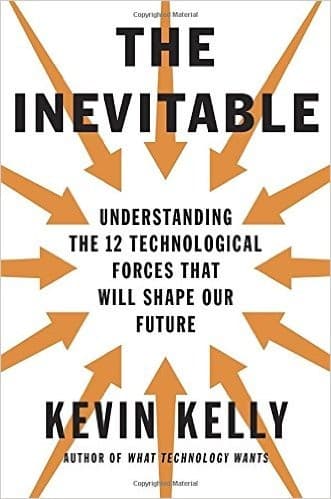
- Kelly argues that technology has 12 broad, directional forces that are “inevitable” in the sense of deep tendencies, not fixed destinies or specific products.
- The book’s central move is to treat technological change as a set of mutually reinforcing verbs—becoming, cognifying, flowing, screening, accessing, sharing, filtering, remixing, interacting, tracking, questioning, beginning—rather than a collection of gadgets.
- The practical stakes are that we should embrace inevitable technologies while regulating harms, because trying to ban the underlying trend usually fails.
The Shape of Technological Change
- Becoming is the deepest force: everything requires ongoing maintenance, upgrades never end, and technology makes us perpetual “newbies” in a world of accelerating obsolescence.
- Kelly uses protopia to reject utopia and dystopia; progress is not perfection but a small net improvement each day that compounds over time.
- He says the future is hard to predict because becoming is self-cloaking; we keep interpreting new systems through old frames, which is why experts repeatedly miss what matters.
- His retrospective point about the internet is that the web was not mainly about hypertext or television-like channels, but about sharing and user participation on an unprecedented scale.
- He treats the web as something that is expanding from a place you visit into an always-on layer embedded in objects, services, and time itself.
Cognifying, Flowing, and Screening
- Cognifying means adding cheap, distributed intelligence to everything, so “take X and add AI” becomes the basic business formula for countless startups.
- The future AI, in Kelly’s view, is less a single HAL-like machine than a planetary superorganism of connected chips, data, and cloud services.
- He emphasizes that modern AI rests on three breakthroughs: GPUs, big data, and deep learning.
- His examples include Watson’s cloud evolution, DeepMind’s self-taught Atari play, and the spread of AI into photography, law, chemistry, design, medicine, music, and more.
- Kelly argues that most near-term AI will be narrow and nonhuman-like; he prefers “artificial smartness” over artificial consciousness and thinks machine intelligence should be seen as alien, not human.
- He extends this to robots as embodied alien minds: automation will first replace routines in factories, warehouses, farming, logistics, and white-collar work, but will also create new roles for people who can work with machines.
- Flowing describes the shift from fixed products to streams, access, updates, and real-time services; the internet is the world’s largest copy machine.
- Once digital goods become free and ubiquitous, value migrates to what cannot be copied: especially generatives like immediacy, personalization, interpretation, authenticity, accessibility, embodiment, patronage, and discoverability.
- The logic of flowing is visible in music, movies, books, software, and later in transportation, agriculture, and health care, where ownership gives way to continuous service.
- Screening names the culture of digital displays, where people increasingly watch, interact with, and assemble flowing information rather than read fixed pages.
- Kelly contrasts People of the Book with People of the Screen: books support linearity, authority, and fixed law, while screens support speed, flux, and user-assembled truth.
- He argues that screens have not killed writing; instead they have produced a surge of text, with books becoming more fluid, networked, and editable.
- His ideal future book is not a static artifact but a verb—“booking”—a continuing process of writing, linking, correcting, sharing, and updating.
Filtering, Tracking, and the Networked World
- Filtering is necessary because abundance has exploded; recommendation systems now do the main work of sorting, ranking, and surfacing what matters.
- Kelly’s warning is that filters can become filter bubbles if they overfit to past taste, narrowing what people see and even hardening political views.
- He thinks the best filters should recommend not only what you like, but what you might learn to like, widening taste rather than merely confirming it.
- He frames attention as the scarce resource in a world of near-free goods, so economic value shifts toward experiences, personalization, and human time.
- Tracking begins with self-measurement and extends outward into lifelogging, wearable sensors, smart devices, cars, platforms, and the internet of things.
- He treats the Quantified Self, MyLifeBits, lifestreams, and total memory systems as signs that data can become a new sense and a better baseline for understanding ourselves.
- Kelly’s darker but more realistic answer to privacy is coveillance: mutual surveillance with symmetry, rights, duties, and accountability, rather than a fantasy of no tracking at all.
- He argues that transparency and personalization are linked, that anonymity is useful only in limited doses, and that large-scale anonymous systems often enable irresponsibility.
- At internet scale, he says, bits want to move and connect; the real challenge is not whether everything can be tracked and linked, but what social rules govern that fact.
- His broader claim is that networked systems create new forms of trust, coordination, and collective intelligence, as seen in Wikipedia, eBay, Uber, and other platforms that make stranger-to-stranger collaboration viable.
What To Take Away
- Kelly’s book is a map of the direction of change, not a forecast of exact inventions: the crucial point is the structure of technology’s momentum.
- The recurring pattern is dematerialization, decentralization, and remaking of value: copies get cheaper, services get richer, and intangibles matter more.
- Human advantage shifts away from resisting machines and toward using, shaping, and collaborating with them, especially in AI-rich and robot-rich environments.
- The long-run world Kelly imagines is one of ever-more connected, editable, tracked, filtered, and networked life, where the main question is how to civilize that connectivity.
Generated with GPT-5.4 Mini · prompt 2026-05-11-v6