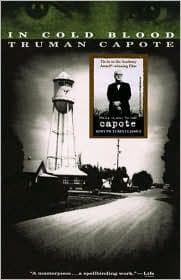
Core Idea
- In Cold Blood is a true-crime narrative about the 1959 Clutter family murders in Holcomb, Kansas, and the book’s central tension is the clash between an orderly, respectable rural world and the senseless violence that destroys it.
- Capote reconstructs the crime, the manhunt, the trial, and the executions with novelistic detail, but his deeper concern is how murder radiates outward into fear, suspicion, memory, and moral uncertainty.
- The book keeps returning to the question of why the killings happened, while also showing that no explanation fully accounts for the violence, the loneliness, or the human wreckage left behind.
Holcomb, the Clutters, and the Night of the Murders
- Holcomb is presented as a remote wheat-plains town whose ordinary life of school, church, and work is shattered on Sunday morning, November 15, 1959, when four shotgun blasts leave six people dead.
- Herbert Clutter is shown as a disciplined, admired farmer-businessman who built River Valley Farm from leased land and borrowed money and ran it by strict moral standards, especially against drinking.
- His home life is carefully drawn: wife Bonnie is fragile and chronically ill; daughter Nancy is efficient, popular, and overcommitted; son Kenyon is quiet; and daughter Beverly is away from home.
- The Clutters’ house symbolizes domestic order, and the book emphasizes the violent contrast between that openness and the killers’ covert entrance, binding, and execution.
- The murders are described with forensic specificity: Nancy shot in the back of the head, Bonnie bound and shot point-blank, Kenyon shot in the face, and Herb shot and then had his throat cut.
- The town’s immediate response is disbelief, then fear, then mistrust; neighbors who once left doors unlocked begin to suspect one another.
- Bobby Rupp, Nancy’s boyfriend, is pulled into the emotional aftermath as both mourner and suspect, while the family’s planned Thanksgiving reunion turns into a gathering at a mass grave.
Dick Hickock and Perry Smith: Motive, Fantasy, and the Crime
- Capote presents Dick Hickock and Perry Smith as outwardly similar but internally very different: Dick is pragmatic, manipulative, and driven by the “score,” while Perry is imaginative, wounded, and emotionally unstable.
- Dick believes Perry is a “natural killer,” useful because he is supposedly conscienceless enough to help with a robbery and murder.
- Perry’s life story is shown as fractured by family collapse, orphanage abuse, military service, prison, addiction, tattoos, and fantasy; he collects maps, music, objects, and dreams of Mexico and treasure as if they could build a new self.
- Their partnership is uneasy and full of mutual use: Dick needs Perry’s violence and inventiveness, while Perry is drawn to Dick partly by loneliness, anger, and a desire for recognition.
- The crime itself is not a clean robbery but a messy, improvisational act; the killers buy rope, tape, gloves, and stockings, insist there will be “No witnesses,” and then find no safe and almost no money.
- Perry later narrates the murders as a sequence of escalating panic and humiliation rather than a single planned execution, and he says the Clutters yielded only about forty to fifty dollars.
- The book repeatedly suggests that the killers’ violence is inseparable from their inner damage, but it refuses to simplify that damage into a single motive.
Investigation, Confession, and Trial
- Alvin Dewey of the Kansas Bureau of Investigation becomes the case’s driving force, and the investigation is presented as a long, exhausting effort to reconstruct the night from tiny clues.
- Important physical evidence includes shoeprints, bound knots, cord, tape, shotgun shells, the stolen radio and binoculars, and the murder weapon recovered from Hickock’s home.
- The breakthrough comes from Floyd Wells, a prisoner who realizes Hickock had bragged in prison about planning to rob and kill the Clutters; fear and conscience finally make him speak.
- Once linked to the crime, Hickock and Smith are arrested in Las Vegas, and Perry gradually gives a detailed confession, though he tries to shift moral blame and protect Dick’s mother from shame.
- The trial centers not only on guilt but on whether the killers are legally and morally monstrous enough for death; the prosecution seeks hanging, while the defense argues about sanity, venue, and due process.
- Capote emphasizes the courtroom spectacle: photographs of the bodies, the Clutter auction, the crowded jury selection, and the public appetite for explanation.
- The jury convicts both men on all counts, and the death sentence becomes the state’s answer to a murder that seems to have no social logic.
Death Row, Psychology, and Execution
- Death Row at Lansing is rendered as a severe, enclosed world of cells, hunger, heat, routine, and dread, separated from ordinary prison life as a “prison within a prison.”
- Perry’s inner life remains central after conviction: he reads, writes, dreams of escape, befriends a squirrel, contemplates suicide, and clings to moments of human sympathy, especially from Don Cullivan.
- Hickock is more outwardly casual but remains self-justifying and predatory, still talking of escape and denying full responsibility.
- The book broadens into other Kansas death-row stories, especially Lowell Lee Andrews, to show the range of condemned men and to test ideas about criminal responsibility and the M’Naghten Rule.
- Psychiatric commentary, especially around Perry, frames some murders as violent acts that look rational on the surface but emerge from deep psychic fracture, rage, and dissociation.
- After years of appeals, Smith and Hickock are finally executed in April 1965; Hickock dies first, still jaunty and evasive, while Perry’s final statement is more reflective and condemns capital punishment.
- Dewey’s response to the executions is notably ambivalent: Hickock seems worthless to him, but Perry remains a wounded, tragic figure whose misery he cannot dismiss.
What To Take Away
- The book is as much about aftermath as about murder: fear, rumor, grief, and memory spread through a whole community.
- Capote treats crime as both a factual investigation and a psychological riddle, but he never lets psychology cancel responsibility.
- The Clutters are remembered as real, specific people, not just victims, which is why the book’s violence feels so devastating.
- Its lasting force comes from holding together three things at once: documentary precision, moral unease, and tragic human sympathy.
Generated with GPT-5.4 Mini · prompt 2026-05-11-v6