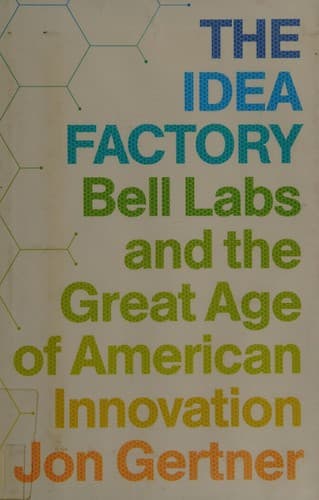
Core Idea
- Innovation at scale requires both genius AND institutional design: Bell Labs succeeded because Mervin Kelly built a structure that amplified individual brilliance through disciplined collaboration.
- Three linked stages must flow together: fundamental research → systems engineering evaluation → development/manufacturing; ideas that skip stages die in deployment.
How to Organize for Innovation
Structure & Physical Design
- Design spaces for collision: Long corridors, shared cafeterias, and hallways forced unplanned encounters across disciplines; proximity drives serendipitous breakthroughs.
- Hire complementary pairs: Match theorists (Bardeen) with experimentalists (Brattain); pair systems thinkers (Engel's hexagons) with hands-on builders (DiPiazza's trailers).
- Recruit early & pay for talent: Intercept top performers before competitors; offer 2x university salaries to attract problem-solvers who can "build things."
Problem-Rich Environment
- Give freedom within constraints: Researchers had autonomy but worked on phone system challenges; natural constraints eliminated endless ideation.
- Legitimize 20% exploration time: Cellular project started as side work before becoming a full program; don't force focus, enable parallel bets.
- Hire "unscarred" talent for impossibilities: Young teams lacking failure experience often succeed on moonshots because they don't know it's impossible.
How to Evaluate & Pursue Ideas
Validation Rules
- Apply "Better, or Cheaper, or Both": Every innovation must improve cost/performance or it won't deploy; elegance alone doesn't matter.
- Test both sides of two-way technologies: Picturephone failed because market research measured interest in seeing, not willingness to be seen; validate complete user experience.
- Distinguish mistakes of perception from judgment: External breakthroughs you missed (waveguide vs. fiber) require different lessons than execution failures (Picturephone's wrong problem).
Portfolio Strategy
- Maintain parallel time horizons: Fund 3-5 year AND 20-year bets simultaneously; fiber optics seemed distant in 1960 but Labs funded it anyway.
- Don't confuse technical feasibility with market need: ESS phone switches worked brilliantly but had no killer use case; being "better" ≠ being wanted.
- Recognize "steam engine time": Cellular succeeded because transistors + ESS + ICs + microprocessors matured together; build for convergence, not linear progress.
Decentralized Risk-Taking
- Give moonshot teams freedom to iterate: Cellular team had independence to fail; over-control from leadership kills long-shot projects.
- Fund exploration without guaranteed ROI: Labs invested $100M+ in cellular/fiber before commercial viability proved; modern venture models can't sustain this.
Talent & Culture
- Document institutional memory: Systematic knowledge-sharing (Baker's cafeteria conversations) prevents silos; map who knows what across departments.
- Don't monopolize breakthroughs: License key patents royalty-free to competitors (as Bell Labs did with transistor); strengthens reputation and forestalls antitrust risk.
- Preserve unified mission: Post-breakup, Labs lost its singular purpose and fractured despite brilliant talent; institutional independence matters.
Action Plan
- Design your physical workspace for unplanned cross-disciplinary encounters (hallways, shared spaces, visible collaboration areas).
- Build complementary teams: Pair theorists with experimentalists, systems thinkers with hands-on builders; don't hire only one type.
- Create a problem-rich constraint (customer needs, technical limits) that naturally directs research without micromanagement.
- Establish parallel investment tracks for both short-term (3-5 year) and long-term (20-year) bets before either proves viable.
- Test market fit early and thoroughly—especially for two-way technologies; feasibility ≠ demand.
Generated with Claude Sonnet 4.6 · prompt legacy-pre-v6 · model inferred from repository history