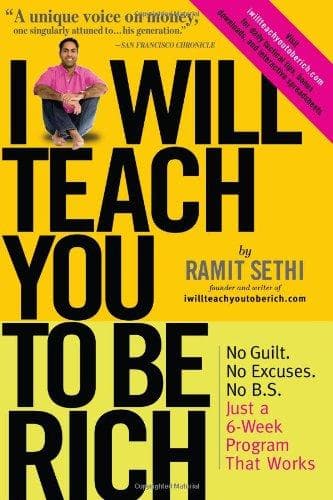
Core Idea
- Ramit’s core message is that personal finance is mostly about simple systems, not expertise: automate the basics, avoid fees, invest early, and stop obsessing over tiny details.
- He frames the goal as getting to a personalized version of “rich,” where money supports what you actually value, not where you merely look disciplined.
- His recurring standard is the 85 Percent Solution: do something reasonably well now instead of waiting for perfect knowledge.
Build the Financial Foundation First
- The book starts with a hard priority order: credit cards, banks, investing, spending, automation, and then optimization, not the other way around.
- Credit score matters because it affects borrowing terms for years; he distinguishes it from the credit report, and urges readers to check reports yearly.
- Credit cards are useful for records, protections, rewards, and warranties, but only if bills are paid on time, every time; missed payments can destroy a score quickly.
- He recommends keeping cards open, using them regularly enough to stay active, and lowering credit utilization by having more available credit when debt is gone.
- He prefers a small number of cards chosen deliberately online, usually with no annual fee unless the rewards justify it; he dismisses chasing card gimmicks.
- If you already have debt, the priority is aggressive repayment, not balance-transfer tricks, HELOCs, or raiding retirement accounts.
- For debt payoff, he offers two workable approaches: highest APR first for efficiency or smallest balance first for momentum; the key is to start immediately.
- Student loans are treated as painful but manageable, and even small extra payments can save years of interest.
- His bank advice is blunt: most brick-and-mortar banks are fee traps, so prefer no-fee checking plus a high-yield online savings account.
- He treats checking as an inbox for money and savings as a goals account, because separating them reduces impulse spending.
- Bank fees matter more than slightly better interest rates, and he repeatedly emphasizes that many fees are negotiable if you ask directly and persist politely.
Invest Early, but Keep It Simple
- Ramit argues that saving alone is too slow; wealth comes from putting money into the market early enough for compounding to matter.
- He contrasts savings-account returns with long-run market returns and uses the point to show why delay is expensive.
- The Ladder of Personal Finance is his hierarchy: get the 401(k) match, pay off debt, open and fund a Roth IRA, max the 401(k), then use taxable investing or invest in yourself.
- He praises the 401(k) because it uses pretax money, employer match, and payroll inertia, but notes it is tax-deferred rather than tax-free.
- He strongly criticizes cashing out a 401(k) when changing jobs and prefers rolling it into an IRA when possible.
- Roth IRAs are especially important for young people because contributions are after-tax, growth is tax-free, and the account is flexible if handled correctly.
- He recommends discount brokerages over full-service brokers because low fees matter more than fancy advice for most people.
- He rejects stock-picking as the main route to investing success and instead pushes passive management: low-cost index funds or lifecycle funds.
- His critique of experts is that credentials, ratings, and media predictions do not reliably produce results; fund managers often fail to beat the market after fees.
- The central mechanism is asset allocation, which he says explains most portfolio volatility; stocks, bonds, and cash play different roles.
- Stocks are for long-term growth, bonds for lower-risk stability and income, and cash for safety but weak real returns.
- His preferred compromise for many people is a lifecycle/target-date fund, which is his “85 Percent Solution” for investing because it automates diversification and rebalancing.
- He says the main danger is not volatility itself but fear-driven inaction, or what he calls the Do Nothing Approach.
Spend Intentionally, Then Automate the Rest
- He rejects traditional budgeting as miserable and unrealistic, replacing it with the Conscious Spending Plan: decide in advance where money goes, then spend the rest guilt-free.
- The key distinction is frugal vs. cheap: frugal means spending lavishly on what you love and cutting ruthlessly on what you do not.
- His bucket system divides take-home pay into Fixed Costs, Investments, Savings, and Guilt-free Spending Money.
- He suggests rough targets of 50–60% fixed costs, 10% investments, 5–10% savings, and 20–35% guilt-free spending, with small cushions for surprises.
- He argues for focusing on the biggest leaks first, using an 80/20 lens rather than trying to shave every expense.
- The À La Carte Method is his example of conscious spending: cancel subscriptions and buy only what you actually use, when you use it.
- He recommends making spending control mechanical, using the envelope system or separate debit buckets so overspending requires sacrificing something else.
- If the problem is not spending but income, he suggests three routes: negotiate a raise, get a better-paying job, or freelance with nontechnical skills.
- He warns about lifestyle creep after raises and windfalls; his rule is to enjoy some of it but save or invest most of the increase.
- For irregular income, he recommends first building a survival buffer, then using tools like Solo 401(k)s or SEP-IRAs if self-employed.
Make Money Flow on Default
- One of the book’s strongest themes is automation: set up automatic transfers and bill payments so good behavior happens without daily discipline.
- He wants payroll, savings, investing, and bill pay synchronized so the system runs with almost no monthly attention.
- The result of automation is that money gets routed by design, spending becomes what is left over, and financial management takes very little time.
- He sees this as a major advantage of young age: mistakes are cheaper now, and habits built early compound into much bigger results later.
What To Take Away
- The book’s real argument is that ordinary finance advice is overcomplicated; the high-value moves are boring, repeatable, and mostly automatic.
- Fees, debt, and delay are the enemy, while automation, low-cost investing, and conscious spending are the core tools.
- Ramit’s style is intentionally anti-paralysis: do the 85% right thing, start now, and improve later.
- The payoff is not just more money, but more control over what your money is for.
Generated with GPT-5.4 Mini · prompt 2026-05-11-v6