Core Idea
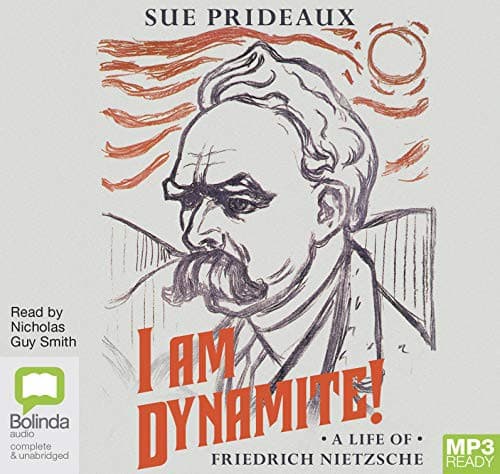
- Sue Prideaux’s biography argues that Nietzsche’s philosophy cannot be separated from his life: his illnesses, musical sensibility, friendships, loves, solitude, and family wounds all shaped the ideas for which he became famous.
- The book’s central claim is that Nietzsche was not a detached system-builder but an experimental thinker who used aphorism, self-myth, and provocation to attack Christianity, nationalism, philistinism, and the need for metaphysical certainty.
- Prideaux also insists that Nietzsche’s later infamy was largely manufactured after his collapse, when his sister Elisabeth edited, staged, and politicized his work into a form he himself would not have recognized.
Nietzsche’s Formation: Music, Illness, and Early Intuition
- Nietzsche first comes alive in the book as a child of music, grief, and precocity: he longed to be a musician, inherited his father’s musical gift, and learned early to think through sound and feeling rather than abstract doctrine.
- His father’s early death, the family’s neurological fragility, and Nietzsche’s own chronic headaches, eye pain, vomiting, and weakness are treated as constitutive facts, not background detail.
- At school, especially at Schulpforta, he was driven by extreme discipline, classical study, and severe self-formation, yet he also wrote poems, tragedies, music, and juvenile prose with startling assurance.
- Even as a devout boy, he was already revising Christianity inwardly, and Prideaux treats this as the beginning of his life-long habit of challenging inherited belief from within.
- His early fascination with Schopenhauer, Hölderlin, and Empedocles mattered because each offered a way to think suffering, becoming, madness, and the limits of reason outside conventional theology.
From Wagner to Philosophy: Tragedy, Science, and Style
- Wagner is the great catalyst in Nietzsche’s intellectual life, first as an almost religious artistic idol and then as a figure he had to overcome.
- Prideaux traces how Wagner’s music, especially Tristan, gave Nietzsche an ecstatic model for the Dionysian: art as bodily trembling, dissolution of self, and access to what lies beneath representation.
- In The Birth of Tragedy, Nietzsche’s first book, the core distinction is between the Apollonian order of form, clarity, and dream-image, and the Dionysian force of ecstasy, music, intoxication, and self-forgetting.
- Greek tragedy, in his account, mattered because it fused these two powers; modern culture, by contrast, had become flattened by rationalism, science, and “naturalistic” taste.
- He casts Socrates as the turning point in cultural decline, because Socratic confidence in reason and knowledge helped destroy tragedy and inaugurate a world of scholarly but spiritually impoverished “Alexandrian man.”
- Prideaux shows that Nietzsche’s turn toward aphorism and fragment was not stylistic ornament but a practical response to pain, limited stamina, and a new philosophy of thought as compressed, mobile, and provisional.
- His later admiration for French moralists such as Montaigne, La Rochefoucauld, Stendhal, and Voltaire reinforced this terser, anti-systematic mode.
The Late Nietzsche: Self-Overcoming, Eternal Recurrence, and Misappropriation
- In the middle and late books, Nietzsche’s key concerns become self-overcoming, amor fati, eternal recurrence, and the need to live without otherworldly consolations after the death of God.
- Thus Spoke Zarathustra is presented as the culminating poetic expression of this phase: a prophet-book of descent, solitude, and proclamation in which the Übermensch stands for a future human being faithful to the earth.
- Prideaux emphasizes that the Übermensch is not a racial type in Nietzsche’s own framing, but an ideal of overcoming herd comfort, resentment, and metaphysical dependence.
- The book’s rhetoric is repeatedly autobiographical: Lou Salomé, Paul Rée, Wagner, his sister, and his own bodily crises all enter Nietzsche’s philosophy in disguised form.
- The Salomé episode is especially important because it reveals Nietzsche’s emotional volatility, his longing for intellectual companionship, and his sense that attachment becomes chain sickness.
- The Gay Science and The Antichrist mark his sharpest anti-Christian turn: Christianity is attacked not as mere belief error but as a system of guilt, sacrifice, and ressentiment that distorts life.
- Yet Prideaux carefully preserves Nietzsche’s distinction between Jesus and Christianity: he admires Jesus as life-affirming and non-resistant while condemning Paul and the Church as corrupters.
- The Case of Wagner completes the break with his former idol, attacking Wagner as decadent, manipulative, and nationalistic even as Nietzsche never entirely loses his fascination with him.
- Prideaux repeatedly warns against later distortions: the blond beast, will to power, and Übermensch were later flattened into slogans by editors, ideologues, and Nazis, but Nietzsche’s actual writing is more ambiguous, interpretive, and anti-systematic than its enemies or admirers often allow.
Elisabeth, Collapse, and the Afterlife of Nietzsche
- Nietzsche’s collapse in 1889 ends his active authorship, and Prideaux treats the medical story cautiously, refusing easy certainty where the records are contradictory and self-serving.
- After the collapse, Elisabeth becomes the decisive force: she manages the archive, stages the living Nietzsche at Villa Silberblick, and turns him into a quasi-sacred cultural object.
- Her editorial fabrication of The Will to Power is presented as one of the book’s central historical wrongs, because it converts unfinished notes into a pseudo-system that amplifies exactly the kinds of simplifications Nietzsche resisted.
- Prideaux shows how Nietzsche’s posthumous reputation was shaped by selective quoting, nationalist appropriation, and the later Nazi appetite for heroic aphorisms stripped of context.
- The biography ends by defending Nietzsche against both saintly and fascist caricatures: he was neither a prophet of totalitarianism nor a tidy philosopher of doctrine, but a dangerous, brilliant, wounded thinker who kept asking what it means to say yes to life without illusion.
What To Take Away
- Nietzsche’s philosophy in Prideaux’s account is inseparable from his body, his music, and his broken attachments.
- His major concepts—Apollonian/Dionysian, death of God, amor fati, eternal recurrence, Übermensch—are best read as responses to suffering, modernity, and cultural decay, not as abstract slogans.
- The book’s historical warning is that Nietzsche was dangerously easy to simplify, and that later editors and ideologues did precisely that.
- Prideaux’s deeper portrait is of a thinker who tried to remain honest about illusion, interpretation, and necessity while refusing consolation from religion, nation, or system.
Generated with GPT-5.4 Mini · prompt 2026-05-11-v6