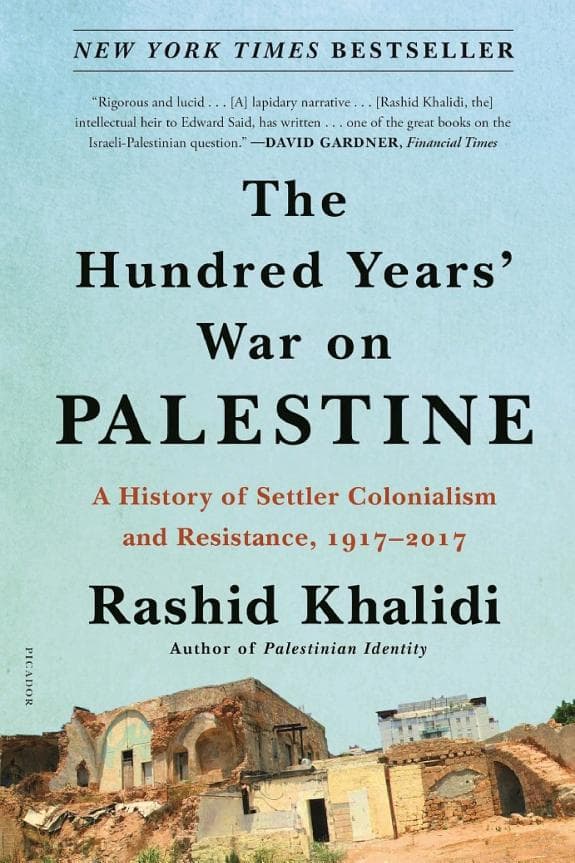
Core Idea
- Khalidi argues that modern Palestinian history is best understood as a hundred-year war on Palestine: a colonial settler project sustained by British, American, and other great-power backing, not simply a symmetrical national conflict.
- Across the book, Palestinians are repeatedly made invisible in international diplomacy, while Zionist and Israeli leaders secure state-building advantages through empire, war, and legal instruments that convert power into “facts.”
- The central moral and political claim is that the conflict cannot be resolved by managed autonomy or technical “peace processes”; it requires recognition of two peoples, equal rights, and an end to denial of Palestinian existence.
From Zionist Colonial Project to Nakba
- Khalidi opens with Yusuf Diya al-Khalidi’s 1899 letter to Herzl, which warned that Palestine “is inhabited by others”; Herzl’s reply exemplifies a pattern of dismissing the indigenous population while claiming colonization would benefit them.
- He reads early Zionism as explicitly colonial in method, even when expressed in liberal language about development, tolerance, and civilizational uplift.
- Institutions like the Jewish Colonization Association / Palestine Jewish Colonization Association helped finance land purchase and settlement, while Zionism depended heavily on British imperial support.
- The Balfour Declaration and especially the 1922 League of Nations Mandate are treated as decisive instruments of dispossession: they endorsed a “Jewish national home,” omitted Arabs and Palestinians by name, and created a framework for parallel Jewish state-building.
- Khalidi highlights Jabotinsky’s frankness: because Arabs would resist colonization, Zionism needed an “iron wall” of force and an outside imperial power.
- Under the Mandate, British officials used censorship, divide-and-rule, and elite manipulation; the 1936–39 revolt was a mass response, but it was crushed by overwhelming force, deportations, executions, and brutal collective punishment.
- The defeat of the revolt shattered Palestinian society and leadership, leaving Palestinians politically weaker just as Zionist institutions were becoming more state-like.
- The Nakba of 1948 is presented not as a spontaneous wartime flight but as systematic ethnic cleansing: Plan Dalet, conquest of cities and villages, massacres such as Deir Yasin, destruction of homes, and denial of return expelled roughly 80 percent of the Arab population in the territory that became Israel.
- Khalidi stresses that the Zionist state did not emerge suddenly in 1948; it was prepared by decades of para-state institution building, international lobbying, and military organization under the Mandate.
- Palestinians, by contrast, lacked comparable institutions, were split by factional and family politics, and were trapped between British rule and divided Arab regimes.
1967, Resolution 242, and the Rise of Palestinian Nationalism
- Khalidi calls June 1967 the “Third Declaration of War” on Palestine because it produced another great-power order, UN Security Council Resolution 242, that erased Palestinians as political subjects.
- He rejects the myth that Israel faced annihilation in 1967, arguing that US intelligence and later Israeli generals did not see an imminent Arab threat.
- Israel’s lightning air assault destroyed Arab air power and enabled conquest of the West Bank, East Jerusalem, Gaza, Sinai, and the Golan Heights in six days.
- The war unfolded amid the Arab Cold War and Egyptian troop moves into Sinai, but Khalidi emphasizes that Israel had long prepared for a first strike and received American diplomatic cover.
- Resolution 242 is a key target of criticism: it omits Palestine and refugees, and the English phrasing “withdrawal from territories occupied” let Israel argue it need not withdraw from all occupied lands.
- By turning the conflict into a state-to-state problem, 242 legitimized a post-1949 territorial baseline and sidelined the right of return recognized in UNGA Resolution 194.
- Khalidi argues that by defeating the Arab states, Israel paradoxically revived Palestinian nationalism.
- The post-1967 cultural renaissance produced writers such as Ghassan Kanafani, Mahmoud Darwish, Emile Habibi, Fadwa Touqan, and Tawfiq Zayyad, who reshaped Palestinian identity in literature and poetry.
- Fatah and the PFLP emerged as the main militant currents, with Fatah deliberately nonideological and Palestine-centered, and the PFLP rooted in the broader Arab nationalist politics of the Movement of Arab Nationalists.
- The PLO, created by the Arab League in 1964, was transformed after 1967 into the main representative of Palestinian national claims, aided more by communications and diplomacy than by battlefield power.
- Khalidi treats Karameh as a symbolic turning point and notes that the PLO’s best successes were diplomatic, not military, culminating in Arab League recognition and Arafat’s UN appearance.
- At the same time, the PLO was weakened by exile politics, limited understanding of the United States, and repeated Israeli and Arab-state efforts to destroy it, especially in Jordan and Lebanon.
Intifada, Oslo, and the Managed-Conflict Trap
- The First Intifada (1987–95) is described as a surprising Palestinian breakthrough: a broad-based, locally organized uprising that began in Gaza and spread through clandestine networks and a secret Unified National Leadership.
- Its tactics were mainly nonviolent—strikes, boycotts, tax refusal, and civil disobedience—while women, students, professionals, shopkeepers, farmers, and camp residents all played central roles.
- Israel’s response, especially Rabin’s “iron fist,” exposed the brutality behind the “enlightened occupation” narrative and damaged Israel’s image internationally.
- Khalidi sees the intifada as the first clear Palestinian victory in the long war, but also as a challenge the exiled Tunis leadership could not fully control.
- The 1988 PLO turn toward a two-state formula and recognition of 242 and 338 marked a major ideological shift from earlier claims to all of Palestine.
- Khalidi treats Oslo as deeply asymmetrical: Israel recognized the PLO without recognizing a Palestinian state, while Palestinians recognized Israel without getting liberation, sovereignty, or an end to settlement expansion.
- The Palestinian Authority became, in effect, a security subcontractor under continuing Israeli control of land, water, borders, population registers, and movement.
- The collapse of Oslo’s promise is tied to the rise of Hamas, the assassination of key figures like Abu Jihad, the 1991 Gulf War’s damage to Palestinian alliances, the failure of the Madrid process, and the exclusion of core issues such as refugees, Jerusalem, and settlements.
- Khalidi concludes that US diplomacy was never neutral; Washington repeatedly acted in tandem with Israel, from the Mandate era through peace-process management and into Trump-era recognition of Jerusalem and settlement annexation.
What To Take Away
- The book’s organizing insight is that Palestine has been shaped by a long imperial and settler-colonial war, not just a series of disconnected crises.
- Khalidi repeatedly shows how absence from official language—from “non-Jewish population” to the omission of Palestinians in 242—becomes a political weapon.
- The recurring pattern is that military force, legal texts, and diplomacy work together to convert conquest into legitimacy.
- His final position is not a plea for vague coexistence, but for equal citizenship and equal national recognition in a shared land, because denial has only prolonged the conflict.
Generated with GPT-5.4 Mini · prompt 2026-05-11-v6