Core Idea
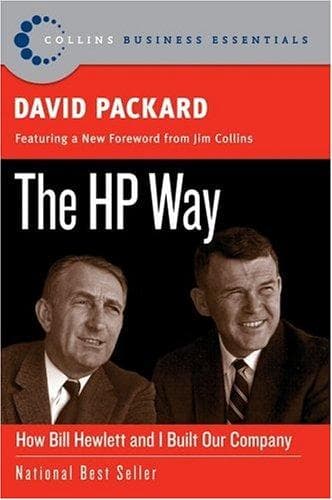
- The HP Way is Packard’s account of how Hewlett-Packard was built around contribution, not just profit: the company should make technically excellent products that solve real customer problems while also serving employees, community, and science.
- The book argues that HP’s long-term strength came from holding several things together at once: high standards and freedom, growth and profitability, innovation and focus, personal trust and accountability, and decentralization with shared purpose.
- Packard treats management as a human practice, not a command system: people do their best work when objectives are clear, supervisors understand the work, and employees are trusted to use judgment.
How HP Was Built
- Packard’s personal story matters because HP’s culture grew out of early lessons in teamwork, competition, curiosity, and hands-on problem solving, from Pueblo and Stanford to ham radio, athletics, and engineering.
- His relationship with Bill Hewlett formed the company’s core: they were complementary builders, with Hewlett stronger in circuits and Packard stronger in manufacturing and process.
- Early HP grew from the Addison Avenue garage, odd contract jobs, and a first product line led by the 200A audio oscillator, which sold well because it delivered a good instrument at a lower price than established competitors.
- Packard emphasizes that HP’s early success came from doing many practical things themselves—design, pricing, packaging, shipping, bookkeeping, and sales—while learning the economics of parts, cash flow, and growth.
- Wartime work accelerated HP’s development through military contracts, production discipline, and microwave projects that later anchored postwar business in signal generators, analyzers, voltmeters, and related instrumentation.
- Packard repeatedly argues against unrelated diversification; HP should expand only where it could make a real technical contribution using existing strengths.
The HP Way in Management and Culture
- Packard’s central management doctrine is Management by Objective (MBO) rather than management by control: goals are agreed on, but people are given latitude in how to reach them.
- MBWA (“management by walking around”) is the practical companion to MBO, born from Packard’s GE experience on the factory floor; leaders need direct, informal contact with work and workers, not just reports.
- He insists that supervision is not mainly about giving orders but about enabling performance, translating company goals into department goals, and understanding technical detail well enough to judge work fairly.
- HP rejects military-style hierarchy and “hire and fire” management; Packard prefers job continuity, stable teams, and reasonable flexibility, even if that means temporary overtime or shared reductions in hard times.
- The company’s personnel practices are meant to create dignity and trust: profit sharing for all eligible employees, catastrophic medical insurance, family-oriented gestures from Lucile Packard, company picnics, recreation sites, and later flextime.
- Packard sees trust as a business principle, not sentimentality: open storerooms, first-name communication, open doors, and tolerance for personal problems are meant to encourage responsibility, initiative, and even experimentation.
- He warns that trust and openness do not mean lack of standards; quality work requires pride in details, and he uses anecdotes like the machinist defending “my die” to show why small things matter.
- Education and continuous learning are treated as strategic necessities, with heavy spending on employee training and study because techniques become outdated and better ways must be sought constantly.
Structure, Growth, and the Limits of Centralization
- HP became more divisional as it grew, but Packard frames restructuring as a way to preserve the original spirit rather than replace it: autonomous units should stay close to customers and decisions.
- The company expanded from product divisions to groups, then to acquisitions, overseas operations, and research units such as HP Associates and HP Laboratories, all while trying to avoid becoming an unwieldy conglomerate.
- Packard repeatedly warns that “more companies die from indigestion than starvation,” meaning acquisitions can help only if cultures, products, and management can be integrated without smothering the organization.
- He presents the 1990s slowdown as a lesson in the danger of creeping centralization, especially in computers, where committees and layers had become too heavy; reducing bureaucracy restored agility.
- HP’s structure is supposed to support the same principle as its culture: decentralize authority, keep units accountable, and preserve enough common identity that groups cooperate rather than fragment.
Products, Markets, and the Customer
- HP’s success depended on making technically serious products that customers actually wanted, and Packard is skeptical of innovation for its own sake.
- He gives several examples of contribution-based innovation: the frequency counter family, the handheld HP 35, the LaserJet, the display monitor that Chuck House pushed to market, and manufacturing advances such as the Kingman card and early integrated circuits.
- Packard is especially interested in the tension between technical excellence and market reality: in consumer and mass markets, customers may not ask for the most advanced features, so HP had to learn ease of use, availability, and pricing discipline.
- The company’s salespeople are expected to be customer advocates, not mere order-takers; they should recommend what best fits long-term needs and avoid bad-mouthing competitors.
- Pricing is treated as part of value creation, not just volume strategy: HP should charge for real contribution rather than chase market share by underpricing its work.
- Financial discipline is another recurring theme: HP preferred self-financing, avoided long-term debt, watched receivables and inventories carefully, and treated profit as the measure of real contribution and the fuel for future growth.
What To Take Away
- The HP Way is less a slogan than a system: contribution, trust, technical seriousness, and decentralization had to reinforce one another.
- Packard’s clearest claim is that good management is personal and specific, not abstract: leaders must know the work, respect the people, and stay close to reality.
- HP’s long run shows, in Packard’s view, that companies can grow large without losing their character if they keep balancing freedom with standards and expansion with discipline.
- The book’s deepest warning is that practices can harden into idols: methods like consensus, MBWA, or job continuity work only if they still serve the underlying values.
Generated with GPT-5.4 Mini · prompt 2026-05-11-v6