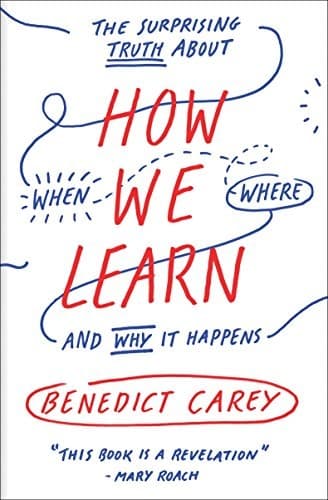
Core Idea
- Carey’s thesis is that learning works best when it is not forced into common-sense habits like constant concentration, single-context study, and massed repetition.
- The brain learns through quirks: forgetting, distraction, spacing, testing, context change, sleep, and incubation can all strengthen memory and problem solving when used well.
- The book treats learning science as practical and personal: small changes in how we study and work can matter more than talent, brute effort, or perfectly disciplined routines.
How Memory and Learning Actually Work
- Memory is not a storage cabinet of fixed files; recall is a reconstruction, and each retrieval can slightly alter what is remembered.
- Carey distinguishes episodic/autobiographical memory from semantic memory, and uses Henry Molaison (H.M.) to show that conscious memory formation depends on the hippocampus.
- H.M. also showed that some learning survives without conscious memory, proving there are at least two systems: explicit memory and subconscious/motor learning.
- Split-brain research adds that the left hemisphere often acts as a “story maker”, narrating a coherent account from partial evidence rather than accessing a single central truth.
- Forgetting is not just loss; it is also a filter that reduces noise and makes retrieval and focus possible.
- Carey’s storage strength / retrieval strength distinction is central: storage can grow with learning, while retrieval strength decays quickly without use.
- This leads to the new theory of disuse idea that forgetting is often a friend to learning, not its enemy.
What Improves Learning
- Spacing is one of the strongest findings in the book: distributed practice beats cramming for long-term retention, even though cramming can help briefly.
- Ebbinghaus, Jost’s Law, Bahrick’s vocabulary work, SuperMemo, and later spacing studies all point to the same principle: reviews work best when they are spread out and timed to the distance from the final test.
- Testing is itself a learning event, not just a measure; self-testing strengthens memory more than passive rereading and exposes fluency illusions.
- Carey highlights the testing effect with studies from Gates, Spitzer, and Karpicke/Roediger, including findings that retrieval practice can outperform extra study on delayed tests.
- Pretesting can help too, even when answers are wrong, as long as feedback follows soon after; guessing primes attention and later retention.
- Desirable difficulty is the recurring logic behind these effects: harder, less fluent learning often produces better later recall.
- Interleaving and varied practice also help because they force the learner to discriminate and choose, rather than simply repeat one move or one category.
- In motor learning, mixed practice often beats blocked practice for transfer, as shown in studies from beanbag throwing to badminton serves.
- In verbal and perceptual learning, mixed sets can improve retention and identification even when students believe blocked practice feels easier.
- Carey also emphasizes context variation: studying and testing in the same room, with the same music, can help, but relying on one context is brittle, so changing settings can create more retrieval cues.
Incubation, Percolation, and Sleep
- Carey argues that stepping away from a stuck problem can help, especially for insight problems with a hidden solution that requires a shift in perspective.
- Classic work by Wallas frames creativity as preparation, incubation, illumination, verification; incubation is the offline reworking that happens after genuine stuckness.
- Maier’s rope problem, Duncker’s candle problem, and the Remote Associates Test show that tiny cues, broken assumptions, and time away can unlock solutions.
- The main caveat is that incubation is context-dependent: different tasks benefit from different kinds of breaks, and not all “distraction” helps equally.
- Carey also distinguishes short incubation from longer percolation, where a project stays mentally alive over hours or days after you stop actively pushing it.
- The Zeigarnik effect supports this idea: unfinished tasks stay more active in memory than completed ones, keeping attention and motivation attached to the problem.
- Goals tune perception, so when a person is pursuing a topic, related cues seem to pop out of the environment and feed the work.
- Sleep is presented as an active learning process, not downtime: REM supports pattern/association work, Stage 2 supports motor learning, and slow-wave sleep supports declarative memory.
- Naps can provide part of these benefits, and Tononi’s view helps explain sleep as a way of pruning trivial connections and consolidating useful ones.
Bigger Picture: Why the Advice Looks Strange
- Carey’s larger argument is evolutionary: the brain was built for a foraging, changing environment, not for modern schooling’s fixed rooms, silent desks, and one-skill-at-a-time routines.
- Learning methods seem counterintuitive because education often rewards a false ideal of constant concentration, while real cognition includes pauses, distraction, and partial attention.
- He treats being “lost” as potentially productive: confusion can trigger a search for meaning, and a nonsensical or disorienting experience can improve pattern recognition.
- The book’s methods are meant as a great equalizer because they do not require special privilege, just better use of timing, context, and effort.
What To Take Away
- Forgetting, interruption, and rest are not learning failures by default; they can be tools that make learning deeper and more durable.
- Study is often improved by retrieval: spacing, self-testing, pretesting with feedback, and interleaving all make memory work harder in productive ways.
- A single “ideal” study environment is a trap; varied contexts, strategic breaks, and sleep can broaden cues and strengthen transfer.
- The book’s practical message is to stop fighting the brain’s odd timing and use its quirks deliberately instead.
Generated with GPT-5.4 Mini · prompt 2026-05-11-v6