Core Idea
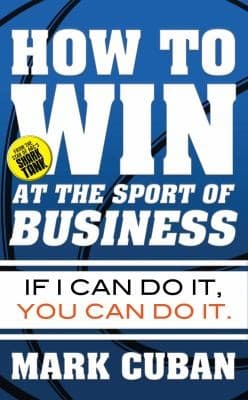
- Cuban treats business as a sport: it is constant, competitive, and unforgiving, so winning comes from effort, preparation, speed, and refusing to fool yourself.
- His central claim is that most people improve by learning faster than others, surviving the battle they are already in, and using sweat equity before outside capital.
- The book’s recurring premise is blunt: you usually only need to be right once, but you have to be ready when that chance appears.
How Cuban Thinks About Winning
- Cuban frames his own career as a series of jobs taken to get paid to learn, not as polished steps on a prestige ladder.
- He argues that public information is a real edge only if you consume more of it than other people, which is why he credits relentless reading of manuals, magazines, and books.
- He defines effort by results, not by hours at a desk, and treats effort as the one variable you fully control.
- He says young people should try many things before narrowing focus, because focus is overrated early on and calling is discovered through trial.
- He treats debt as a major constraint because it reduces freedom to explore, simplify, and take risks.
- His view of destiny is practical rather than mystical: you do not know what you are meant to do until you try something and see whether you are good at it and love it.
Business Rules, Startups, and Competitive Strategy
- Cuban prefers sweat equity and customer-funded growth over investor-funded growth, because outside money changes leverage in the investor’s favor.
- He warns that founders waste time on elaborate plans when they should be testing whether an idea survives contact with real customers.
- His early businesses followed a pattern of calling people, making sales directly, and using that traction to prove value before building much infrastructure.
- He recommends trying to shoot holes in your own idea with knowledgeable outsiders before committing serious resources.
- He uses Dell and Microsoft to show how smart firms can reshape markets through price, packaging, and accessibility rather than novelty alone.
- Dell’s falling weekly prices made lower prices part of the market expectation, while Microsoft’s $99 bundle of Word, Excel, and PowerPoint undercut incumbents by changing the effective software bundle.
- From those examples he draws a defensive rule: always ask how someone could preempt your product, and always expect to face giants like Google, Facebook, Oracle, or Microsoft someday.
- He argues that one of the biggest entrepreneurial mistakes is taking on too many battles at once instead of winning the ones already in hand.
- He also warns about being drowned in opportunity, where exciting new possibilities become a way to avoid fixing the core business.
Operating Principles and Cuban’s Lists
- Cuban’s signature rule is don’t lie to yourself: founders are usually bad judges of their own strengths and weaknesses, so they need honest compensation, not fantasy.
- He says he was not naturally organized and could not become so by willpower alone, so he partnered with Martin Woodall, whose detail orientation balanced Cuban’s speed and improvisation.
- He treats complementary partners as a practical solution to self-knowledge: if you are weak in one dimension, find someone who is strong there.
- He celebrates whining as the first step toward change: complain about what is broken, then do something about it.
- He says the path of least resistance explains a lot of customer behavior, so winning products are often the ones that are easier to buy, easier to use, or easier to experience.
- He applies that idea to ventures like Broadcast.com, HDNet, and his admiration for companies such as Amazon, Apple, Google, and TiVo.
- He argues that you should not rely on customers to invent the future, because they can identify what is broken but usually cannot design what comes next.
- His Twelve Cuban Rules for Startups stress obsession, hiring people who love the work, knowing how the company will make money, focusing on core competencies, and avoiding vanity spending like espresso machines, offices, swag, and PR firms.
- Those rules also favor open, flat, cheap startup structures and expect founders to do their own outreach instead of outsourcing communication.
- His Twelve Cuban Mantras for Success condense the same worldview: time matters, fear should not block action, and success comes from doing rather than dreaming.
- Memorable mantras such as “No balls, no babies,” “Pigs get fat, hogs get slaughtered,” and “You only have to be right once” capture his preference for action, restraint, and readiness.
What To Take Away
- The book is less a theory of management than a case for obsession, speed, learning, and self-awareness.
- Cuban’s main strategic discipline is to focus on the core battle, avoid dilution, and let the market—not ego—tell you whether you are winning.
- His main operating discipline is to know your weaknesses, build around them, and keep selling.
- The broader lesson is that business rewards people who prepare relentlessly, adapt quickly, and keep going until they hit the one big right answer.
Generated with GPT-5.4 Mini · prompt 2026-05-11-v6