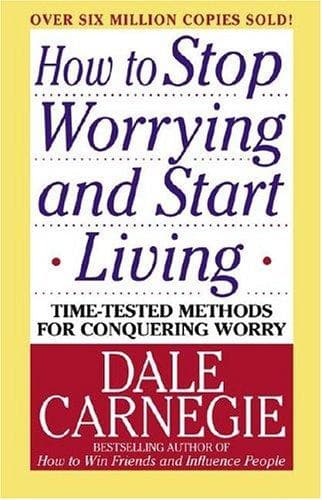
Core Idea
- Carnegie’s central claim is that worry is usually wasted mental motion: it weakens action, damages health, and steals the present without improving the future.
- The book’s remedy is practical, not mystical: live in day-tight compartments, face facts, accept what cannot be changed, and keep the mind occupied with useful action.
- He argues that worry is often a habit of attention, so it can be reduced by training habits of thought, work, perspective, and faith.
The Main Methods for Beating Worry
- Live in day-tight compartments: shut out dead yesterdays and unborn tomorrows, and concentrate on today’s work.
- Carnegie uses Sir William Osler’s ocean-liner metaphor and Jesus’ “take no thought for the morrow” to say tomorrow is best prepared for by doing today well.
- Willis H. Carrier’s three-step formula is a key tool: (1) ask what the worst possible outcome is, (2) accept it if necessary, and (3) calmly try to improve on it.
- This works because it pulls the mind out of vague dread and back onto solid ground where thinking is possible.
- For real problem-solving, he insists on three separate acts: get the facts, analyze the facts, decide, and act.
- Dean Herbert E. Hawkes’s point is that confusion causes much worry, and many people decide before they know enough.
- Carnegie repeatedly advises writing the problem down, listing what can be done, and acting immediately once a decision is reached.
- For business worries, he recommends a memo system built around four questions: What is the problem? What is the cause? What are all possible solutions? What solution do you suggest?
- Leon Shimkin and Frank Bettger are used to show that this kind of structured analysis shortens meetings, reduces needless conferences, and saves time.
Habits of Mind That Lower Tension
- Carnegie says absorbed work is one of the best medicines for worry: keep busy and the mind has less room to brood.
- He warns against fussing over trifles, calling them the “mere termites of life”; tiny irritations can ruin happiness if they are allowed to matter too much.
- He recommends using the law of averages to test fears: most dreaded events are far less likely than imagination makes them seem.
- His examples range from lightning fears to blackmail scares, epidemic fears, and shipment losses; in each case, checking the odds calms the mind.
- Another rule is to co-operate with the inevitable: if a situation cannot be changed, resisting it only wastes energy.
- Here he leans on William James’s “Be willing to have it so,” the serenity prayer, and the image of bending like a willow instead of breaking like an oak.
- He also urges a stop-loss order on worries: decide in advance how much a matter is worth, then stop paying emotional cost beyond that point.
- His “don’t try to saw sawdust” rule means the past cannot be changed; the only sane use of it is to learn from mistakes and then write them off.
- He treats rumination over lost money, broken plans, and old humiliations as pointless mental labor.
Attitude, Service, and Faith
- A major section of the book argues that thought and attitude shape experience more than external conditions do.
- Carnegie distinguishes concern from worry: concern faces a problem and acts, while worry circles helplessly.
- He uses examples from suggestion, psychotherapy, and personal recovery stories to argue that changing how we think can change strength, health, and conduct.
- A practical bridge from feeling to action is to act cheerful before you feel cheerful: smile, straighten up, breathe deeply, whistle, sing, and the mood often follows.
- He urges readers to never try to get even, because revenge and resentment hurt the person who holds them more than the enemy.
- He also says not to expect gratitude: give for the joy of giving, not for thanks that may never come.
- The book’s social cure is to forget yourself by becoming interested in others and doing one good deed each day.
- Carnegie presents this as “enlightened selfishness”: interest in other people reduces melancholy, pulls attention outward, and creates happiness.
- Religious faith is his deepest answer to worry: prayer, he says, puts troubles into words, reminds people they are not alone, and moves them toward action.
- He treats faith as practical as well as spiritual, citing cases of men and women who recovered courage, sleep, and energy through prayer.
What To Take Away
- The book’s recurring answer to worry is not optimism alone but method: face facts, accept reality, and act on what can be changed.
- The deepest discipline is to live in the present and stop paying for imagined futures or unchangeable pasts.
- Carnegie believes worry is most effectively beaten by a combination of work, perspective, social interest, and faith.
- His final message is that a good life is built by turning attention outward and forward: do today’s task, help someone, and let the rest go.
Generated with GPT-5.4 Mini · prompt 2026-05-11-v6