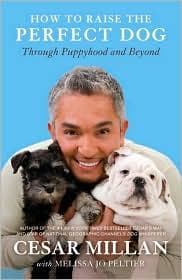
Core Idea
- Puppies are dogs first, not human babies, and Millan’s central claim is that their “dogness” must be respected from birth through adolescence.
- The first months are the most important and most fragile period of a dog’s life: the owner’s energy, structure, and consistency determine whether the puppy becomes stable or fearful, dominant, or anxious.
- Millan’s formula is that good dog raising is not indulgence but exercise, discipline, affection in that order.
Raising the Puppy: Nature, Breeding, and Selection
- Millan treats the mother dog and breeder as the puppy’s first teachers, arguing that nature’s blueprint is better than human coddling.
- A calm-assertive mother like Binky shows how puppies learn from structure, not pampering, and how the litter is conditioned to accept firm limits early.
- He praises breeders like Brooke Walker for health screening, temperament selection, controlled whelping, early handling, crate training, and lifelong buyer accountability.
- He strongly rejects puppy mills, pet stores, and casual internet sellers, arguing that the stress and filth of mill conditions shape puppies into fearful, unstable dogs.
- The right puppy is less about breed label than energy match: Millan repeatedly says owners should choose based on very high, high, medium, or low energy, and usually select the same or lower energy than their own.
- Breed purpose still matters: terriers need outlets for digging, herders need work, bulldogs carry stubborn pugnacity, and pit bulls should be understood as determined, loyal dogs whose power must be directed well.
- His featured puppies—Junior, Blizzard, Angel, and Mr. President—are used to show how different breeds and energies require different handling.
- Temperament tests, parent meetings, and breeder observation can help, but Millan insists they are only part of the picture.
The First Months: Socialization, Boundaries, and Home Life
- Puppies learn through scent, body language, and energy far more than through speech, so the owner’s tone and posture matter more than baby talk.
- The transition home should be managed like a carefully staged migration: bring familiar scents, use the crate early, keep the puppy close, and avoid forcing or carrying her through every challenge.
- Millan sees crates and gates as tools of safety and calm, not punishment; they help create a den-like space and reduce separation anxiety.
- He warns that rescuing a puppy from every small difficulty prevents learning; the owner should be a partner, not a rescuer.
- Housebreaking depends on schedule, supervision, and prevention, not punishment; accidents should be treated neutrally and cleaned up without emotional reaction.
- A puppy should learn to eliminate outdoors on natural surfaces, not rely solely on wee-wee pads, because the house is a den rather than a bathroom.
- He emphasizes no-touch, no-talk, no-eye-contact as the right first social mode when a puppy arrives or is overstimulated.
- Early corrections can include eye contact, body blocking, a calm “tssst,” ignoring, and light touch that imitates a mother’s bite, but never hitting or emotional shouting.
- Separation anxiety is presented as a normal but serious issue in dogs, and Millan’s solution is gradual desensitization rather than soothing words that reinforce distress.
- Teething, chewing, barking, jumping, nipping, and whining are framed as natural behaviors that become problems only when owners fail to redirect them into acceptable outlets.
Health, Safety, and Veterinary Care
- Millan repeatedly stresses prevention: good breeders, clean environments, and health records matter because disease and inherited problems can become expensive and life-altering.
- He recommends being careful about vaccination timing, noting the gap as maternal antibodies fade and puppies remain vulnerable, especially to parvovirus.
- He supports a structured vaccine schedule, mentions titer testing, and warns that overvaccination may contribute to chronic illness.
- Socialization should begin soon after initial vaccination, but with caution: avoid unknown-risk places like dog parks early on, while still allowing controlled exposure to healthy dogs, cars, and neighborhood life.
- His parvo scare with rescued Yorkies underscores his warning that contaminated sources are common in pet stores, puppy mills, and irresponsible facilities.
- Nutrition, grooming, ear and paw checks, flea/tick control, and early car/vet conditioning are all part of building a resilient dog.
- Breed-specific health realities matter: the English bulldog’s anatomy requires special attention to breathing, eyes, temperature, and facial cleaning.
Adolescence, Sexual Maturity, and Leadership
- Millan treats adolescence as a second major phase of testing, when the dog knows the rules but starts pushing them, often leading owners to surrender dogs around 8 months to 2 years.
- He links adolescent shifts to physical growth, defense drive, and sex hormones, especially marking, roaming, and increased reactivity in intact males and heat cycles in females.
- His solution for non-breeders is strongly pro-spay/neuter, which he recommends around six months as an ethical response to overpopulation and a way to reduce hormonal chaos.
- He rejects the idea that sterilization ruins personality or necessarily causes obesity, while still insisting it is not a substitute for training.
- Adolescent dogs need renewed structure, leash discipline, restricted spaces, and persistence; a dog that looks “distracted” or “forgetful” is often simply being pulled by instincts.
- Public and dog-dog socialization become riskier in adolescence because puppy charm no longer protects the dog from conflict.
- His endpoint is a dog that can remain submissive, calm, and mentally present even in stimulating environments, not one that is merely obedient in the kitchen.
What To Take Away
- Early structure creates freedom in Millan’s view: boundaries, routines, and calm leadership make dogs more relaxed, not less.
- The owner’s job is to learn the dog’s language—especially energy, scent, and timing—and use that language consistently from day one.
- Puppies are not fragile ornaments; they are developing animals that need socialization, correction, and responsibility suited to their species.
- Millan’s deepest warning is that love without leadership can produce the very fear, instability, and behavior problems owners hope to avoid.
Generated with GPT-5.4 Mini · prompt 2026-05-11-v6