Core Idea
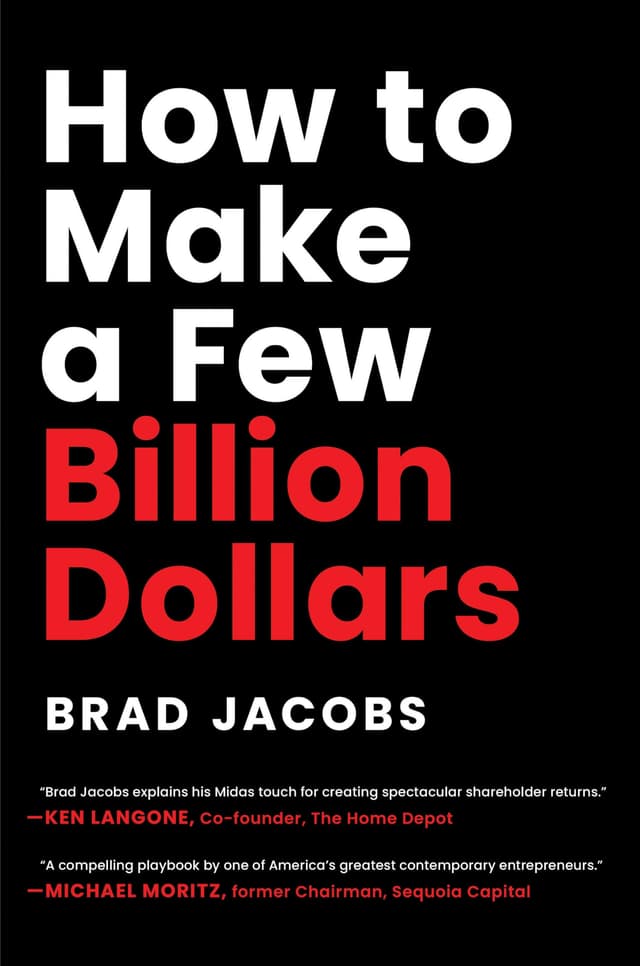
- Brad Jacobs argues that making billions is less about luck than about rewiring how you think, spotting massive trends early, and then applying disciplined execution to scale them.
- His model combines optimism without delusion, radical acceptance of reality, and relentless focus on the few leverage points that actually move outcomes.
- The book is both a memoir of his companies—Amerex, Hamilton Resources, United Waste Systems, United Rentals, XPO, GXO, and RXO—and a playbook for turning public companies into compounding machines.
How Jacobs Thinks
- Jacobs treats business success as starting in the mind: he uses thought experiments to expand possibility, and exercises like “throwing love vibes” and gratitude conversations to shift people out of conflict and toward better judgment.
- He leans on CBT to challenge automatic negative thoughts, asking what the worst-case scenario would be and how he would cope, rather than treating self-criticism as truth.
- He warns against perfectionism, dichotomous thinking, and overjudging imperfect situations, because business is messy and effectiveness comes from facing that mess clearly.
- His recurring tool is radical acceptance: see reality as it is, not as you wish it were, and then choose the best next move with risk in view.
- He also uses non-judgmental concentration and a “feeling the brain” practice to quiet mental noise and sometimes reach unusually creative, synesthetic states.
- Humility is central: even huge success should not create invincibility, because the scale of the universe and the limits of one person’s knowledge should keep a CEO grounded.
Finding and Riding the Big Trend
- Jacobs repeats Ludwig Jesselson’s lesson that you can make mistakes in many areas and still succeed if you get the big trend right.
- He treats technology as the dominant long-run trend, from stone tools to AI, automation, robotics, and data-driven operating models.
- His trend-finding process is systematic: research deeply, write hard questions, then interview CEOs, bankers, VCs, buy-side investors, vendors, activists, and skeptical journalists.
- He looks for businesses with scalability, market growth, economies of scale, and tech leverage, especially where he can buy at lower multiples than the public market values his own company.
- He calls AI the mothership of the future, expecting it to reshape nearly every industry and eliminate many rule-based jobs, while eventually challenging even the CEO role.
- He sees AI pressure on accounting, education, insurance broking, law, journalism, advertising, and coding, while expecting benefits in healthcare, retail, manufacturing, and parts of homebuilding.
- He also highlights 3D printing as a supply-chain shift that could reduce reliance on overseas cheap labor and make logistics more information-driven.
- He treats EVs and autonomous vehicles as important but economically and operationally complicated, especially given infrastructure needs, battery disposal, and China’s control over minerals.
- His earlier companies illustrate the pattern: Amerex and Hamilton exploited information asymmetry in oil, United Waste used routing and consolidation, United Rentals used data and acquisitions, and XPO automated freight brokerage and logistics.
How He Executes
- Jacobs’s acquisition rule is to buy only when the downside still works, the base case is excellent, and the upside is “off the charts.”
- He rejects deals that look exciting but depend on too many assumptions, because scale only matters if the business remains strong when things do not go perfectly.
- He wants each acquisition to improve the customer proposition and financial results; if it only makes the company bigger, it is not a good deal.
- He emphasizes speed without pressure: do extensive homework before engagement, move quickly in negotiation, and keep multiple targets alive so no single deal creates desperation.
- He prefers businesses with compatible cultures, then integrates them aggressively but respectfully rather than trying to force-fit a bad match.
- Integration priorities are cultural integration first and operational integration second, with early movement toward one tech platform, one HR system, one CRM, one KPI dashboard, one compensation system, and one brand.
- He “overorganizes” integration into individually owned tasks with tight feedback loops, because ambiguity and huge task lists can destroy momentum.
- Seller treatment matters: do not play hard to get, do not renegotiate after handshake except for major misrepresentation, and respect the seller’s legacy, employees, and community.
- His hiring standard is intelligence, hunger, integrity, and collegiality, and he rejects pedigree worship in favor of people who are smart, humble, and eager to learn.
- He uses the A/B/C player framework: A players are irreplaceable, B players are acceptable but not ideal, and C players should be exited quickly but kindly.
- He believes in paying for outsized contribution through strong incentives and equity, because base pay should be fair but true believers need meaningful upside.
What To Take Away
- The book’s distinctive claim is that wealth creation is a discipline of perception before it is a discipline of finance.
- Jacobs’s edge comes from combining optimism, radical acceptance, and hard-nosed analysis instead of choosing one at the expense of the others.
- His most important operating principle is not lone genius but systems for trend detection, M&A diligence, integration, hiring, compensation, and meetings.
- The unifying standard across the book is results—for customers, shareholders, employees, and the long-term shape of the business.
Generated with GPT-5.4 Mini · prompt 2026-05-11-v6