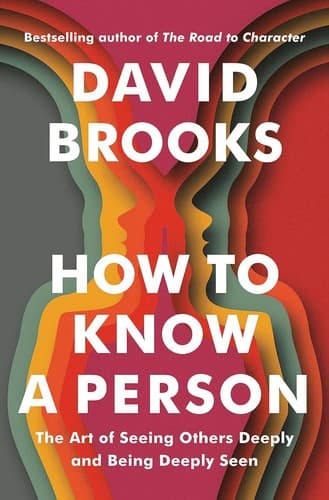
Core Idea
- Brooks argues that the deepest human need is recognition: to be looked at with loving respect, accuracy, and acceptance, and to feel genuinely seen.
- The book’s central distinction is between Diminishers, who make people feel small or invisible, and Illuminators, who help others come alive by noticing their dignity, complexity, and inner life.
- Knowing a person is not mainly about gathering facts; it is a moral and relational skill built from attention, curiosity, affection, and the willingness to accompany someone without reducing them.
How We Fail to See People
- Brooks says people routinely misread one another through egotism, anxiety, naïve realism, objectivism, essentialism, and the habit of freezing others in old versions of themselves.
- He warns that social-science-style detachment may help us study groups, but it is a bad way to know an individual, whose subjectivity includes imagination, memory, desire, emotion, attachment, and faith.
- The book treats the modern crisis of connection—loneliness, distrust, shrinking friendship, and politicized resentment—as partly a moral failure of families, schools, and institutions to teach how to relate.
- Brooks uses research on empathic accuracy to show how poorly people often read each other, and notes that even spouses can become locked into stale assumptions about who the other person is.
- He argues that loneliness can curdle into bitterness, suspicion, and violence, and that politics often becomes a substitute for recognition and belonging without actually creating community.
What It Means to Illumine, Empathize, and Accompany
- Illumination is the art of bringing out another person’s depth and dignity; Brooks links it to nunchi and herzensbildung, or training the heart to see full humanity.
- An Illuminator’s gaze is marked by tenderness, receptivity, active curiosity, affection, generosity, and a holistic refusal to reduce people to one trait or category.
- Brooks’s examples—Mister Rogers, Ted Lasso, Rembrandt portraits, the Waco story of Jimmy Dorrell and LaRue Dorsey—show that attention itself changes what and who a person becomes.
- He draws on Iris Murdoch to argue that morality is mostly about attention: the essential wrong is failing to see correctly, while the essential good is casting “just and loving attention.”
- Accompaniment goes beyond insight: it means staying near someone with patience, playfulness, relaxed awareness, and presence, especially when there is no quick fix.
- Brooks uses the float on the Platte River, Simone Weil’s idea of negative effort, and the value of silence in grief to show that trust often grows through unforced, ordinary togetherness.
- In depression, the friend’s job is not to cheer the person up but to acknowledge reality, keep them from feeling abandoned, and make room for a world that may not make sense to the healthy observer.
- He stresses that depression is not merely sadness; it is an altered state of consciousness that distorts time, space, and self, so helping requires a kind of leap of faith into the other person’s reality.
How a Person Works: Empathy, Story, Culture, and Character
- Brooks defines empathy as trainable skills with three parts: mirroring the emotion accurately, mentalizing why it is there, and caring in a way fitted to the person’s actual need.
- He contrasts high-empathy people with destructive low-empathy figures and says empathy can be strengthened through contact theory, close observation, complex literature, and emotion-labeling practices like Marc Brackett’s RULER.
- The book treats suffering as potentially world-reorganizing: trauma can force a person to rebuild their model of reality, and to know them well you need to know both who they were before and who they became after.
- Brooks emphasizes that a life story matters because people think and remember narratively; good questions ask how someone came to believe what they believe, who shaped them, and what plot they think they are living inside.
- He says ancestry and culture are not just background facts but active forces in perception and judgment, shaping how people see responsibility, context, belonging, and possibility.
- The chapter on personality favors the Big Five over Myers-Briggs and treats traits like extroversion, conscientiousness, neuroticism, agreeableness, and openness as real gifts with tradeoffs rather than simple virtues or flaws.
- Brooks’s life-task framework describes development as a sequence of common human tasks: imperial agency, interpersonal belonging, career consolidation, generativity, and finally integrity versus despair.
- Wisdom, in this view, is less about delivering answers than about helping someone see themselves clearly inside their story, contradictions, relationships, and unfinished development.
What To Take Away
- Knowing a person is a moral act: your attention can either flatten someone into a type or help reveal their unique and unrepeatable humanity.
- The best human relationships are built by seeing, listening, staying, and asking better questions, not by rushing to fix, judge, or advise.
- A wise person does not simply tell others what to do; they create a space where people can hear themselves, revise their story, and feel held without being handled.
- Brooks’s final standard is everyday character: the capacity to meet another person with a loving gaze that makes them feel more real, not less.
Generated with GPT-5.4 Mini · prompt 2026-05-11-v6