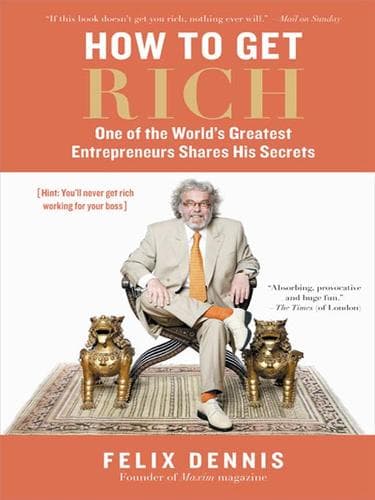
Core Idea
- Dennis presents the book as a blunt, anti-self-help manual about how to become rich in the real world, not a promise of easy success.
- His central claim is that money buys freedom, time, and options; wealth does not guarantee happiness and often brings stress, guilt, and responsibility.
- He defines “rich” in practical terms, aiming at the $30 million–$80 million range of quickly realizable wealth rather than fantasy billionaire status.
What Getting Rich Actually Requires
- Dennis argues that the biggest barriers are fear of failure, fear of public embarrassment, and the social pressure to stay safe.
- He says desire is not enough; only an inner compulsion strong enough to tolerate loneliness, sacrifice, and risk can sustain the effort.
- He divides would-be entrepreneurs into the young and penniless, the slightly better off, and senior managers/professionals, and treats each group’s psychology differently.
- Being young and broke is, in his view, an advantage because there is little to lose, more stamina, more adaptability, and less attachment to conventional wisdom.
- He repeatedly stresses that the rich need a mental carapace: thick enough to ignore mockery and envy, but not so thick that useful criticism cannot get in.
- His self-test for ambition is ruthless: if you cannot endure long hours, uncertainty, family worry, and visible failure, you are not a real candidate.
- He frames fear as something to ride rather than obey, using “bridling” and “saddling” it as a recurring metaphor.
Search, Not Career: How Opportunities Are Found
- The key early task is the Search: finding the arena where money can actually be made, rather than following a prescribed career path.
- Jobs are treated as reconnaissance expeditions, useful for learning industries, management, negotiation, and market realities, but not as places to develop loyalty.
- “Team spirit” is often, in his view, a mechanism employers use to keep ambitious people obedient and desk-bound.
- He says to look for sectors that are growing, relatively uncrowded, and cheap to enter, because a rising tide can lift newcomers.
- He uses his own magazine ventures as examples of seeing openings before others did, including early personal computing magazines and the poster-magazine format.
- He values inclination, aptitude, and fate: know what you are drawn to, test whether you are actually good at it, and then exploit luck when it appears.
- Aptitude must be checked through trial, error, and blunt outside opinion; he cites John Lennon telling him his singing was only imitation and should be abandoned.
- He insists that luck favors the prepared, quoting the idea that success comes from preparation meeting opportunity.
The Real Mechanics of Wealth: Execution, Ownership, Capital, and Talent
- Dennis attacks the myth that a great idea makes you rich; execution, speed, control, and ownership matter far more.
- He argues that ideas cannot be owned in the abstract, only implementation can, which is why companies win or lose on execution rather than originality.
- He praises copying and improving good models, and criticizes the “it wasn’t invented here” syndrome as a costly form of vanity.
- His examples include Ray Kroc standardizing and franchising McDonald’s, EMAP improving the lads’-magazine model with FHM, and his own failures when he refused to emulate rivals’ successful game-magazine formats.
- He warns that founders often lose the real prize by diluting equity too far; ownership and control are the source of wealth, not salary or applause.
- Venture capital and borrowed money are treated cautiously: he calls VCs “dolphins” who demand control, growth, and an exit on their timetable.
- Capital raising is described as the worst part of entrepreneurship: humiliating, exhausting, and unavoidable for the self-made.
- He distinguishes sharks, dolphins, and fishes; the “fishes” are the informal network of friends, printers, lawyers, distributors, and helpers who often make the first company possible.
- His own first business succeeded because many early needs were met on trust and deferred payment, including a printer/distributor arrangement that made the venture look viable without cash.
- He treats talent management as essential: find talented people early, reward them with responsibility, protect them, and know when they become too expensive or stale.
- He says the best incentive is often not cash alone but the chance to run something meaningful.
Operating Rules: Cash Flow, Persistence, Delegation, and Competition
- He treats cash flow as the heartbeat of a business; balance sheets matter less than whether the company can keep paying bills and controlling its destiny.
- He admits to manipulative early invoicing games and warns that factoring is a devil’s bargain best avoided unless absolutely necessary.
- He argues for brutal operating discipline: low payroll, cheap rent, no status spending, chase debtors personally, and always meet payroll.
- A major mistake is reinforcing failure by falling in love with a project that should be abandoned; his expensive example is Blender, which he kept funding long after the market had rejected it.
- Another recurring rule is think big, act small: stay modest, close to detail, and financially disciplined even after success.
- He warns that success can breed self-destruction; his own excesses of drink, drugs, prostitutes, and spending nearly ended badly.
- Delegation is necessary but must be controlled; he prefers a narrow set of vetoes over day-to-day micromanagement.
- He dislikes constant electronic checking-in because it signals mistrust and proves that the boss cannot really delegate.
- Competition is morally central to capitalism in his account; monopoly and complacency weaken industries, while rivalry forces improvement.
- He recounts the Ziff Davis battle as an example of a costly but instructive fight, and later says he would prefer smarter alliances or sales when appropriate.
- He is blunt that sale proceeds belong to owners, not employees, because owners took the capital risk; salaries and bonuses are the proper annual reward.
- He argues that public companies create a different, more bureaucratic world of disclosure, legal caution, and market irrationality, which can still make entrepreneurs rich but feels alien compared with private ownership.
What To Take Away
- Riches, for Dennis, come less from brilliance than from compulsion, control, and persistence under pressure.
- The decisive questions are whether you can endure fear, secure ownership, and keep cash flow alive long enough for luck and timing to matter.
- He believes the self-made rich win by finding or copying workable models, assembling talented people, and refusing to surrender equity or nerve.
- The book’s tone is intentionally unsentimental: getting rich is possible, but it is hard, lonely, and often ugly.
Generated with GPT-5.4 Mini · prompt 2026-05-11-v6